I don’t know. Possibly not, to be honest. But as for not trusting Pitou, Gon has a habit of not trusting people who hurt people he cares about (for all he called Chrollo out for in Yorknew, he’s not actually very different). Additionally, Pitou had not just hurt someone he cared about (Kite) but also hurt someone he saw as a stand-in for Ging, his father, and Gon had to that point dedicated his entire life to trying to find his dad so… it was kind of the perfect storm of sad events.
Eeeeek okay. So HxH had a ton of themes, some unique to each arc, some overarching.
I’d
say the overarching ones I’ll chat about here are growing up (aka responsibility), recovery
from trauma, discovery, the importance of connection, and human nature.
These are explored differently in each arc, though. First, I
want to address overarching themes as addressed in the character
development since HxH fundamentally addresses its themes through both
character development and worldbuilding, and then I’ll briefly talk
about each arc.
So
let’s start with the premise. Here are our three main protagonists
(there is a fourth but he doesn’t have an arc so I shan’t talk about him
as much).
Gon–>a boy on a quest to find his father.
Killua–>a boy on a quest to escape his family.
Kurapika–>a boy on a quest to avenge his tribe.
Notice
how it expands, showing us the importance of both self-discovery,
connection, and discovery of the world in these quests and therefore the character development.
Deconstructed, however, this becomes:
Gon–>a boy struggling to cope with abandonment.
Killua–>a boy struggling to cope with abuse.
Kurapika–>a boy struggling to cope with loss.
I.e.,
trauma recovery. Connection seems to be offered as an necessity for
these kids to recover. We also have this approach they take to their
quests:
Gon–>a boy trying to become his father.
Killua–>a boy trying not to become like his family.
Kurapika–>a boy trying to honor his tribe’s memory.
Through
their struggles with these goals, we see the consequences of their
struggles to grow up (responsibility). What does it look like for
Killua, who has siblings in terrible situations some of whom are not
coping well?
What does it mean for Gon if he’s talented if he isn’t
deciding his own path?
What does it mean for Kurapika if keeping himself
chained to honoring a memory is literally killing him?
Now
let’s look at the three characters’ negative foils, who are all
excellent characters whom I love and whom exemplify the flaws of our
protagonists.
Hisoka–>Gon’s foil, a manchild who seeks the next
adventure at the cost of responsibility (which he actively shuns) and whom has
no respect for any life including his own.
Illumi–>Killua’s
foil, who is desperate to control the few things he can (takes
responsibility too far in the other direction from Hisoka). He’s willing to die if his death can manipulate someone.
Chrollo–>Kurapika’s
foil, who tries to remain cold and cut off from the world despite
forming a cult of personality around him and finds the two things don’t
really go together peacefully. He doesn’t think his life matters if his legacy is assured.
Essentially, through them
we see the importance of human connection (and the consequences of not
having it), what Togashi considers actually growing up/taking
responsibility, and honestly, what it means not to recover from trauma
because each of these characters spiral based on something that happens
during the course of the story.
So let‘s talk about arcs now:
Hunter
Exam Arc: really looks at how human beings pursue their goals at
extreme costs, and how similar goals don’t necessarily equate to similar
motivations.
Zoldyck Family Arc: really looks at the
persistence and tendency of human beings not to give up, and introduces
the idea that not all discovery is going to be beautiful.
Heaven’s
Arena Arc: looks at the way human beings love a challenge, and yet
starts to set the seeds for the dangers of trying to rush into goals/do
things too fast.
Yorknew City/Phantom Troupe Arc: looks at the
different ways people connect and the importance of choosing your own
path vs. fate, and explores the idea that not everything humans do has
meaning.
Greed Island: takes an even darker look at just how
far people will go for selfish, petty goals despite being one of the
lightest arcs.
Chimera Ant Arc: explores pretty much all the
themes TG’s been trying to explore and SnK too. Explores the futility of
war, yet the way human beings are drawn to it, the way evolution is a
motivator for humanity as a whole, what makes a human being a human
being, and again, how connection really is enough to save the world from
war and distress but humans are not patient enough for that. Also
explores the limits of friendship and connection.
Election Arc: the importance of taking responsibility in relationships, and of breaking out on your own to grow up.
Dark
Continent Arc: the current arc; it’s not finished yet. But I’d say it
definitely seems to be exploring what human beings do when they’re
pushed to their absolute limits and what happens when what you’re
holding onto, be it people/connection or an idea like fun, is torn away.
Oh, I don’t think Gon is a monster at all! I didn’t know the fandom really thought that–if they do they can fight me 😛 I think he’s a sweet child who has serious flaws and you can directly trace a lot of those flaws back to his father’s abandonment. Throughout each and every arc, you can see how Gon’s trauma over being abandoned is building and building and building until it eventually explodes in the Chimera Ant Arc, which is where his coping mechanisms fail him completely.
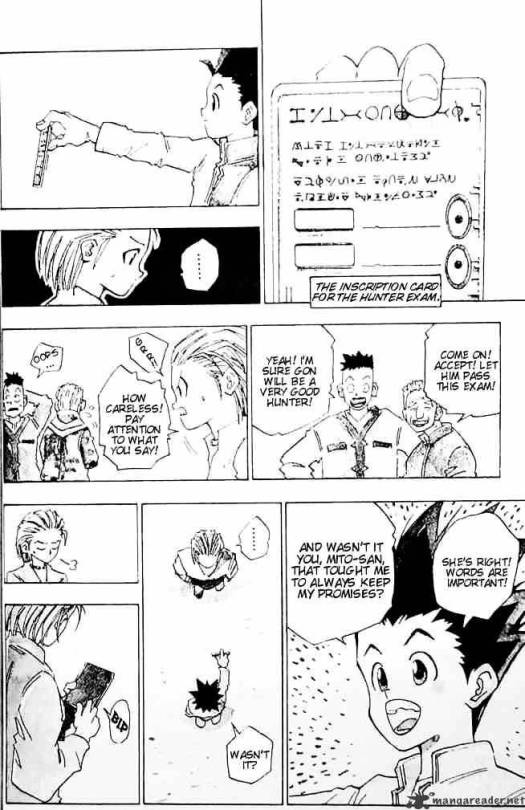
In the Hunter Exam Arc, we are introduced to Gon as a 12 year old kid who abandons his aunt, the one he considers his mother, to run off and take a deadly exam to find his dad.
Repeatedly Gon is noted to be reminiscent of Ging in this arc, and we’re supposed to see that not just in terms of “what a great hunter you’ll be!” like it appears to be on the surface, but also… uh oh Gon, be careful that this tendency of yours doesn’t turn into your father’s path, or Hisoka’s.
Because he’s copying his father’s actions by leaving a loved one for adventure, and following his father’s path is exactly what Gon veers on the edge of throughout HxH.
However, of course, there are major differences: Gon is a kid. Ging is an adult. Leaving a parent is fundamentally different from leaving a child. If you make the choice to bring a child into this world, you are responsible for them. A child isn’t responsible for their parent; that being said, Gon doesn’t think a whole lot about Mito’s feelings, or give anyone who dies in the Hunter Exam much thought.
And why would he? He knows people leave. All the time. He sees Ging as sort of this infallible controller of his world, as an idol who set up this hunt for Gon’s own good, and rationalizes that if he left him, it’s okay.
He’s idolizing the father he doesn’t know, trusting him that no matter what happens, what horrors befall contestants in the Hunter Exam, it’s all worth it because his father’s worth it, because he himself is worth it and if his father abandoned him because he just didn’t care enough then that sense of worth would collapse (Gon has very little sense of self-worth thanks to being abandoned, btw.)
In the Heaven’s Arena Arc, Gon rushes into facing Hisoka before he is truly ready, something that Hisoka notes and Wing as well.
And so he loses his fight with Hisoka. But Gon is desperate to achieve all he can so he can find his father, and that’s why he rushes into facing Hisoka. He’s been waiting like what, twelve, thirteen years to meet his dad, of course he doesn’t want to be patient about learning nen.
In Yorknew, Gon famously asks the Phantom Troupe how they can kill people who have no ties to them, who never did anything to them.
And like… Gon, your best friend literally has been doing that in front of you even if he’s quit the assassin business. But again. Gon is a child. It all ties into Gon’s desperate need to see a purpose in everything (if he lost this and never grew up, he’d be Hisoka), meaning with a purpose because he sees everything that happens to him post exam as something Ging had orchestrated, and this is the first time the narrative directly forces Gon to see that not everything has a deeper personal meaning to it. Sometimes people hurt people for no reason, or for superficial reasons.
Greed Island, while it’s by far my least favorite arc, sets up this desperate belief of Gon’s really, really, really well.
He believes he needs to beat the game honorably, as Ging would want him to. He won’t take the easy way out even when it means breaking his body and Killua’s while facing Razor in the dodgeball game.
Because he is dependent on Ging’s approval and because he thinks everything has meaning when it comes to Ging. Except Ging actually just doesn’t give a shit.
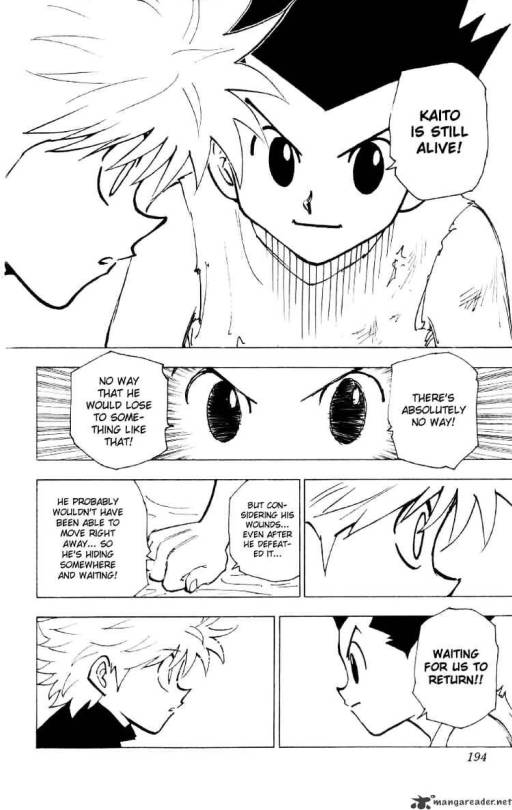
But Ging literally sends him to Kite instead of to himself based on a whim, on which card Ging picks, on whether he’s traveling alone or not. It’s literally pointless of Ging to do this, but he does. And because of this Gon winds up attaching himself to Kite as a father figure and sinking deeper into his desperate beliefs that everything has meaning and will be okay because Kite (whom he sees as an extension of Ging) is in control. “Kite wouldn’t let that thing beat him!” he tells Killua of Pitou.
And during his confrontation with Pitou, Gon’s screaming at them that he “can’t wait anymore!”
Gon is not talking about just fighting Pitou/getting Kite back. He’s talking about Ging.
And he loses himself, literally growing up way too fast and almost dying because of it.
It’s therefore fitting that he finally meets Ging after Killua gets Nanika to save him, right as Ging’s about to explore the Dark Continent. The world is opening up–it’s not contained anymore. And Gon’s world is opening up. It’s not limited to Ging’s orchestrations anymore, but rather Gon is now free to explore his own path.
So my simplest answer to your question on how the narrative handled
Ging is: I think Togashi has just begun with him and so it is difficult to say how he will be used
and explored in the future.
As a matter of fact the Election arc where Ging appeared for the first time is basically a short
arc which serves both as a closure to the first part of the manga with
Gon and Killua separating and each one ending a significant part of their arc:
And
as an introduction arc to new characters like the Zodiacs who will be
at the centre of future arcs. Among these characters Ging and Pariston
in particular are set up as important and will probably get arcs of
their own.
In short, right now trying to predict where Ging’s
character will go or to give a final judgement on him would be
equivalent to basically doing the same with Gon based on the first three
volumes of the manga.
What’s more, I think that thoughts on Ging should be divided into two categories.
a) Thoughts on him as a central part of Gon’s arc since he has been Gon’s main motivation up until they met.
b) Thoughts on him as a character with his own arc and personal involvement into the main plot.
So
I’ll try to give you some thoughts on him by foiling him with two other
characters: Silva Zoldyck and Gon himself. In particular the first will
help me analyze him as Gon’s father, while comparing him to Gon will
help me trying to define him better as his own character.
Chapters: 6/7 Fandom: Hunter X Hunter Rating: Mature Warnings: No Archive Warnings Apply Relationships: Hisoka/Illumi Zoldyck Characters: Hisoka (Hunter X Hunter), Illumi Zoldyck, Gon Freecs, Alluka Zoldyck, Killua Zoldyck, Kuroro Lucifer | Chrollo Lucifer, Kalluto Zoldyck, Kurapika (Hunter x Hunter), Milluki Zoldyck, Ging Freecs Additional Tags: Angst, Self-Destruction, Family Drama, Alternate Universe – Modern Setting Series: Part 2 of In Shadows Summary:
When Hisoka finds himself helping Illumi raise his siblings, he views it as an amusing chapter in his quest for the next thrill. However, the Zoldycks and Gon Freecss have another plan.
Chapters: 3/7 Fandom: Hunter X Hunter Rating: Mature Warnings: No Archive Warnings Apply Relationships: Hisoka/Illumi Zoldyck Characters: Hisoka (Hunter X Hunter), Illumi Zoldyck, Gon Freecs, Alluka Zoldyck, Killua Zoldyck, Kuroro Lucifer | Chrollo Lucifer, Kalluto Zoldyck, Kurapika (Hunter x Hunter), Milluki Zoldyck, Ging Freecs Additional Tags: Angst, Self-Destruction, Family Drama, Alternate Universe – Modern Setting Series: Part 2 of In Shadows Summary:
When Hisoka finds himself helping Illumi raise his siblings, he views it as an amusing chapter in his quest for the next thrill. However, the Zoldycks and Gon Freecss have another plan.
Chapters: 2/7 Fandom: Hunter X Hunter Rating: Mature Warnings: No Archive Warnings Apply Relationships: Hisoka/Illumi Zoldyck Characters: Hisoka (Hunter X Hunter), Illumi Zoldyck, Gon Freecs, Alluka Zoldyck, Killua Zoldyck, Kuroro Lucifer | Chrollo Lucifer, Kalluto Zoldyck, Kurapika (Hunter x Hunter), Milluki Zoldyck, Ging Freecs Additional Tags: Angst, Self-Destruction, Family Drama, Alternate Universe – Modern Setting Series: Part 2 of In Shadows Summary:
When Hisoka finds himself helping Illumi raise his siblings, he views it as an amusing chapter in his quest for the next thrill. However, the Zoldycks and Gon Freecss have another plan.
Both Gon and Hisoka’s nen powers are inspired by elements of their childhood:
Gon’s Jajanken is born from him loving Janken and playing at it with some Whale Island’s inhabitants. Basically it is a game of his childhood he transforms into a weapon.
The two powers Hisoka has are similarly named after sweets he loved as a child.
This similarity is interesting especially because HxH is after all nothing more than the story of Gon trying to grow up and Hisoka is basically what Gon would become if he remains stuck in his childish mentality i.e. a man-child.
Ahem. Okay so if I had to rank my top 3 arcs it would be:
Election Arc
Chimera Ant Arc
Phantom Troupe/Yorknew Arc
In the anime actually switch Yorknew to second place because parts of the Chimera Ant arc feel a bit draggy in the anime, but anyways, I love these arcs so, so much, and they are by far my favorite arcs. I love that in the Yorknew arc everyone plays an important role–the four main characters, Hisoka and Illumi, even the dastardly Zoldyck parents in Silva and Zeno, and of course, the Phantom Troupe.
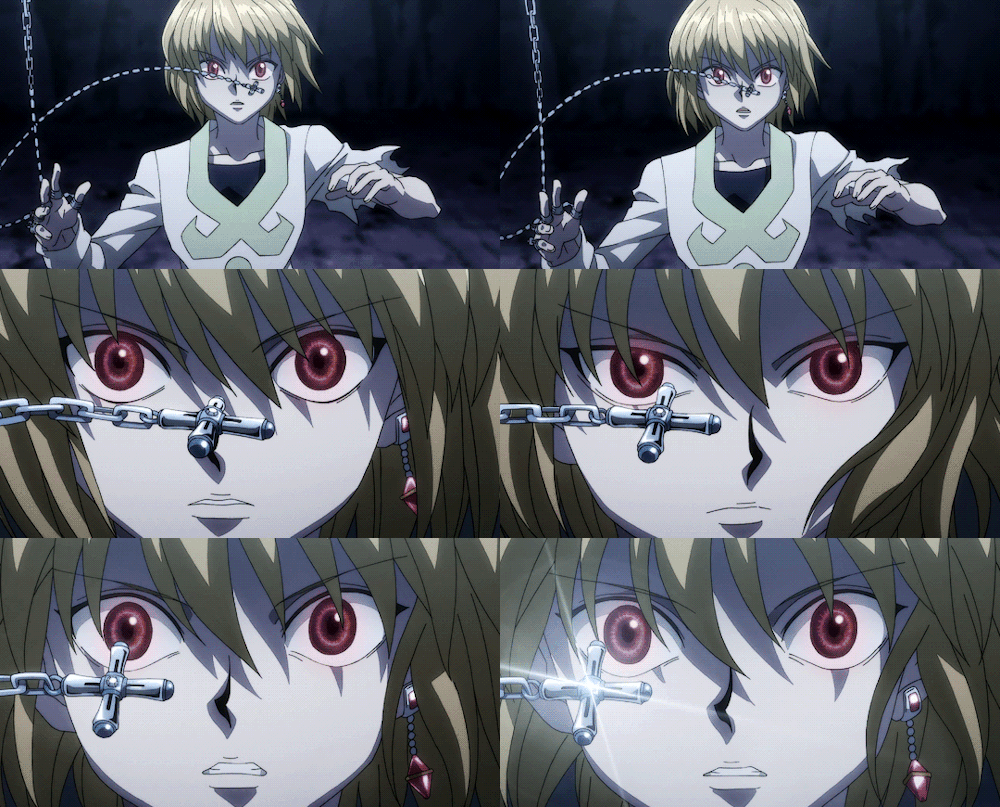
What I find most fascinating about it is the foiling between Kurapika and Chrollo and also how gorgeous Chrollo is– Like Gon is Hisoka, and Killua is Illumi, Chrollo is Kurapika. @linkspooky wrote a great meta on Chrollo this morning and @aspoonofsugar wrote this great meta on Kurapika and Chrollo’s foiling in their nen usage. Chrollo and Kurapika are two people trapped by their choices in life, and the stakes and themes and character arcs presented in that arc are currently being expanded in the ongoing arc.
Chrollo killed Kurapika’s family on a whim, because he liked those eyes according to Uvogin your own eyes are beautiful chrollo. I doubt he even thought about it considering how most of the PT doesn’t seem to remember the Kurta massacre as anything significant. And it’s this precise apathy that’s been building Chrollo’s downfall from the beginning. He thinks things don’t matter until they do. The more he exploits his powers (which by their nature means exploiting other people), the more he loses what matters to him: the Phantom Troupe. Your best power is your face Chrollo Firstly, Uvogin, for whom he cries, but then he retaliates with a terrifying show of power against the mafia. But then that backfires when Kurapika chains his nen and forbids him from communicating with the PT (and it’s interesting that Hisoka plays with Chrollo’s newly stolen power (from Neon) to betray Chrollo’s makeshift family), and Chrollo’s saved from that by Pakunoda really, but at the cost of her life. Then of course in the most recent arc Chrollo shows off against Hisoka, but now he’s lost Kortopi and Shalnark as a direct consequence of this.
He’s a walking contradiction just like Kurapika, who thinks justice is everything but is willing to go to… unjust lengths to complete his goals. The more Kurapika delves into his quest, starting in the Yorknew arc, the more he pulls away from his friends. And then his actions directly endanger his friends. Chrollo and Kurapika both want to be close to people and yet simultaneously want to be distant to prevent being hurt again, like Link said. be close to me chrollo
The theme of freedom vs chains is present in all three of the main characters’ foilings with their respective antagonist (Kurapika and Chrollo, Gon and Hisoka, Killua and Illumi). The PT/Yorknew arc may have ended with Kurapika chaining Chrollo’s nen, but his nen and its usage is just a chain itself, of a different sort. And Kurapika’s chains chain him as much as he thinks they will set him free, because what he’s really fighting against is not Chrollo or the Phantom Troupe, but against himself and the legacy he believes rests on his shoulders. Likewise, I think Killua’s issues are less about escaping Illumi and more about breaking free of his parents and the life they’ve set for him, and Gon’s are less about being strong enough to fight Hisoka but being strong enough to decide his own life for himself instead of making his decisions to impress Ging.










 hamliet