I do now! Lol. I don’t know how much I will keep up with it though, so I’m not sure it will be accurate for very long. I’m kind of bad at keeping up with this kind of thing, Tumblr & Twitter are about all I can do lol. But it’s here–my username is the same as it is on this site, Hamliet.
Ah, I’m really happy with how this turned out! ❤ I’m trying a new coloring/shading method, and I think it’s a level up from my usual :)More HxH characters coming up soon… Characters other than Hisoka hahahaha
You can never know for certain! But foreshadowing is a pretty good hint, and there are techniques writers across the globe use to foreshadow it. For example, I wrote this about Mutsuki’s redemption in TGre, pointing to the use of “save the cat” which is a technique taught in screenwriting courses (but also broadly used in other types of fictional narratives).
“Save the cat” is
moment a writer give a character towards the start of their arc that involves
them saving someone/something that doesn’t benefit them in any
way–generally it’s something a writer does to ensure the readers like
the character. Characters who are protagonists like Kaneki and Touka
have these moments (for her, saving Kaneki from eating Hide). So do
characters who have been painted as antagonists and go on to receive
redemption arcs like Takizawa (going to help Amon during the Owl
operation), Tsukiyama (helping save Kaneki from Yamori) and Nishiki
(Kimi)… and so does Mutsuki (Urie in the auction arc–which I’d argue
is actually the least selfish of any of these). Basically, if a
character has a save-the-cat moment, they’re unlikely to turn into an
irredeemable villain because the author probably wants you to like them.
In BNHA, “save the cat” was also used for Dabi, etc. I’m going to talk about Dabi a lot here, and also address other stories besides animes, if that’s okay?
People who are likely to get redemption are characters who are also coded as victims. See: Mutsuki, Dabi, Zuko from Avatar, Nora in Noragami, Kylo Ren in Star Wars, etc. Characters who are not coded as victims are more likely to have the audience resist their redemption if they get it anyways (Endeavor in BNHA). Whether this should be the case or not is not what I’m addressing; I’m simply observing how things tend to go.
I think looking at the specific themes present in the story being told, as well as the story’s genre, is also massively important. Like, for example, BNHA is an optimistic story about kids working hard to overcome obstacles. In contrast, SnK is a really harsh, brutal story about people who often do not get redemption (Bertolt) that encourages you to examine yourself and the world around you. Dabi being killed as someone who went bad after abuse (victim–this presumes he is Touya) when we’ve been encouraged to sympathize with him (save the cat–the Aoyama scene in the forest and also Dabi expressing pain for his victim’s families) while his abuser gets redemption (Endeavor) seems like it’d be hard to get to work in the story, whereas such a plot development could work in SnK. Again, Dabi’s redemption isn’t written yet, so who knows what could happen, but him not getting some measure of one doesn’t seem to be where the story is headed imo.
I also think “redemption” is a bit iffy once you leave more black and white stories like BNHA or Star Wars or ATLA. Like, it’s defined differently when the story isn’t about blatant evil vs saving the world.
In Banana Fish, for example, does Ash get redemption, just because we’re encouraged to sympathize with him? Is connecting with other people akin to redemption in that story? (I’d argue it is.)
In HxH, did Pitou get redemption, because we sympathize with Pitou in the end, even though they didn’t do anything to address the wrongs they’d done in the past and still wanted to kill Gon? Is redemption in a deconstructive story like HxH more akin to the audience seeing their worth as a being/what they offer the world and letting them do some good in the world (saving Komugi)? Does Pakunoda get redemption? It’s complicated, and a lot of it relies on changing your audience’s opinion on them from “villain you fear” to “character you empathize with.”
For more reading, I suggest this well-written analysis of how redemption tends to work in fiction by @ohtze. It was written a few years ago, primarily about Zuko, Sasuke, and Kylo Ren. It’s not saying redemption arcs have to work that way, but rather that this is a way they often go.
Let’s wait for the chapter for a complete answer, but the answer is that my heart will break even more. 😛
Jk. I mean yes I’m sad. But I think this ties into the themes of Chrollo’s and Kurapika’s arcs, and which Kenny’s arc apparently ties into as well: grief. Keeny can’t recover from the loss of his wife and child, and commits suicide. For now, Fugetsu has Kacho’s nen beast “Kacho” still with her, even though she’s dead. Again it hints to me Kurapika needs to choose to live for the living and not the dead, and Chrollo if he has any hope will need to do the same.


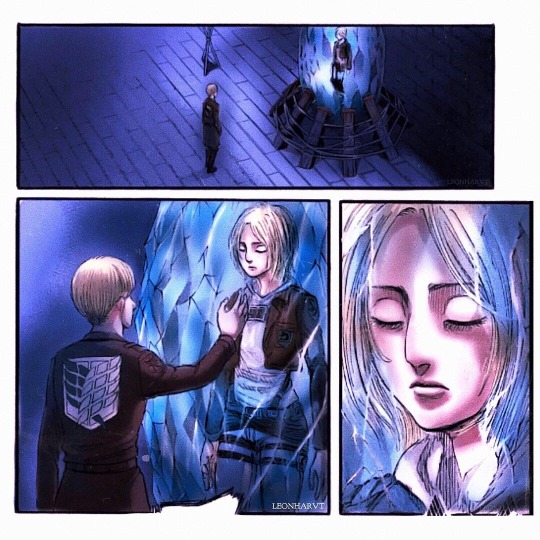


 hamliet