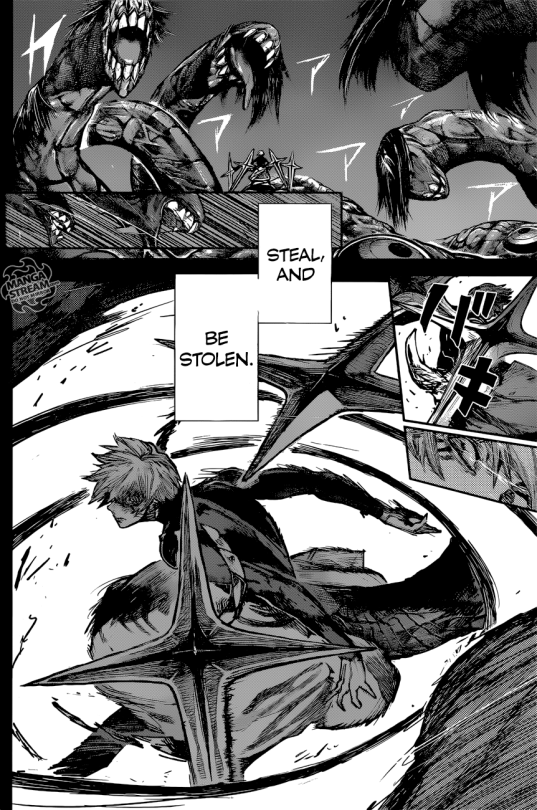
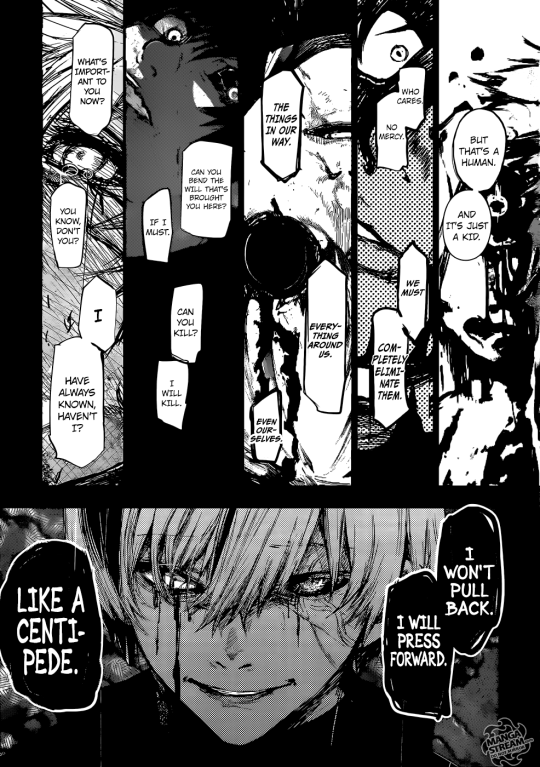
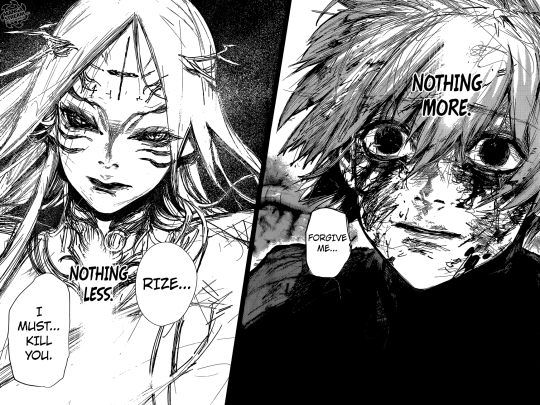
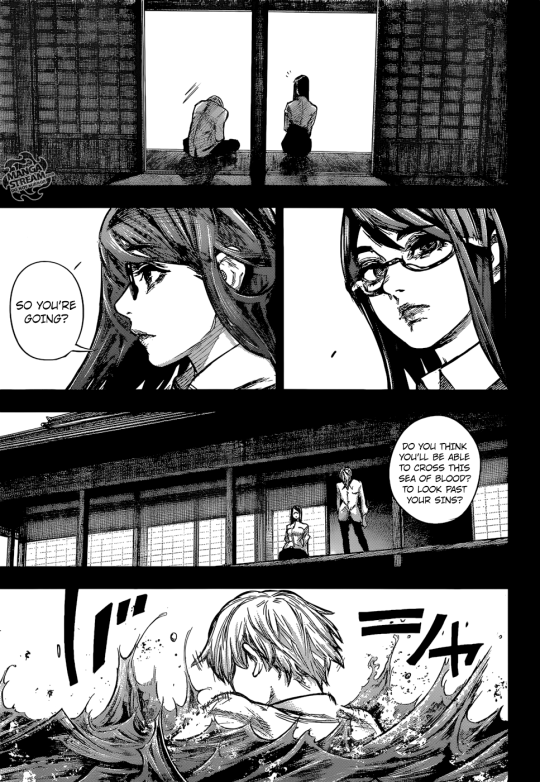
I just hope that y’all’s criticism doesn’t stop Ishida from writing again, I mean, after all the online harassment that he suffered, if I was in his shoes, I would never touch that kind of environment again

Honestly, Anon?

How. DARE. You. You are rude, and sending this was a really not a kind thing to do. What part of you thought it was a good idea to be like “I hope Ishida Sensei isn’t ever criticized, guess I better send a passive aggressive (aka a way to bully while still looking good) post to someone else telling them they’re awful for something they DIDN’T EVEN DO?” 

I have expressed absolutely nothing but GRATITUDE towards Ishida for his amazing work. 

I never will express anything but gratitude towards him. TG saved my life. I think the last arc was terribly written, but I separate the work from the person. I think Ishida one of the most talented writers I have ever had the privilege of reading, and I have nothing but complete love for the man. But I don’t have to blindly accept everything he puts out just because. I doubt he wants that since a major theme of TG was empathy and allowing for different opinions.

I am so SICK of this fandom equating things that should not be equated. I certainly have not nor would ever attack Ishida for my l=not liking the ending, call him a bad writer (good writers can produce less than quality work sometimes; it’s called being a human being). I love his work and want to see more of it, and will gladly purchase all the TG volumes. 

But since I’ve wanted to say this for months now let’s fucking go.

image

I’ve been really frustrated with the way the TG fandom has been acting lately, in particular equating all critical analysis/meta with hate and saying anyone who did not like the TG ending or anyone who says it feels like Ishida rushed it is hating on him. That simply is not true, and people who say that betray an immature understanding of the words used and also a lack of understanding of literature and how the field of literature functions. Which I studied. I have a degree in it.

Critique and critical analysis are parts of fandom though they don’t have to be your part of fandom. You don’t like most metas? Don’t read! That’s totally fine! It’s fine to engage in fandom via memes or meta, shipping or fanart, fanfic or stanning or roleplay or whatever, and to not engage with the types of engagement you don’t like. It’s. All. Good. Take care of your mental health first. It’s also totally fine to unfollow if it’s really not good for you right now. Nothing wrong with that. 

That being said, it hurts to read vague posts lumping you in with antis and misogynists and haters just because you interpret things differently and don’t think a story is perfect. Critical analysis is not hate: it’s a legitimate way to analyze what a series means to you personally, and for every meta writer I know it’s a way for them to express their love for the series.

For some of us, character flaws mean a lot, so maybe we write about that and how the characters might overcome it, because that’s genuinely what we find the most meaningful part of a story to us. Like, do people really think meta writers devote hours and hours and hours of our time to rereading the text, pouring over panels to identify patterns, writing 10K word essays on how a character can overcome their flaws because we hate the story and want to shit on the character? Even when I wrote about how I think TG has bungled its themes, I wrote it because I love those themes (which are GOOD) and I love this story.

So part of critical analysis involves, well, critique. It’s why movie critics are a thing, TV show critics, book critics. Ishida is an amazing writer whom I respect immensely, but he is human and not a god, and it is not disrespectful to say that the story has flaws, nor to discuss those perceived flaws and how they affect one’s view of the text. What isn’t okay is ad hominem attacks on a writer just as it is not okay to ad hominem attack a blogger. The notion that one should be quiet and not critique work because it’s being written by someone else is baffling because that’s legitimately what literary/journalistic criticism is: critique of another person’s story. You don’t critique your own work; that’s called revising. It’s disrespectful to imply an author doesn’t expect critique; all writers expect it. Name calling on the other hand is wholly wrong, and anyone trashing Ishida or insulting him should stop immediately. But I’ve seen so many in the fandom conflating these two things (attacks and critique) and it’s really unfair and creates a strawman argument and rather than addressing the issue of hate simply addresses nothing at all.

A lot of the vaguing and occasionally actual bullying I’ve seen is coming from people who claim to have experienced the fandom being made an uncomfortable place for them before with hate and antis (this, for the record, is not singling out a particular subset of the fandom as I’ve seen it on multiple sides). And it probably has been, and antis for any ship or character are honestly horrible. But the way the same people treat meta writers makes me feel like it’s not about creating a more comfortable fandom, but rather creating a fandom where everyone agrees with them. Like, after the release of 177, people who have previously complained about dealing with antis posted literal hate directed at real people (people w/ a perspective I happen to share) over a fictional story/character. Just focus on what you like to do, be it meta and critique or fanfic or writing about how a character has impacted you and how much you love him, and let other people do what they want to do. That’s all fine. But actual attacks were a thing. 

What else am I supposed to conclude besides that the TG fandom doesn’t actually have a problem with bullying or with hate, but only has a problem when it’s directed at your particular likes?

Like legit one time I wrote a 1000 essay on how meaningful and beautiful I find Kaneki’s character with like, one mention of “selfish” in the context of “I can relate” and do you have any idea how much pushback I got from that, how people vagued for months about how I was ableist for one word used in a context of “I love him?” I’m a real person, not a fictional character. I cried. What do people want anyways? A 500 word disclaimer before every post that me saying x is selfish sometimes doesn’t mean I’m reducing a character to just being selfish? I don’t have time for that. No one does. I don’t know what else I can do.

If you relate to a character to the point where you cannot handle someone not loving every attribute of said fictional character and you start lashing out at realpeople over it because you feel personally attacked, you might need to take a step back. There’s also a difference between “I think this character is acting selfishly and needs to overcome it” or “I personally find this character unlikeable,” and “I want this character to die painfully.” The latter one is definitely hate and by all means complain about it being tagged or whatnot, but the former two are not–they are merely different opinions.

I’ve seen so many people saying for months now that popular meta writers discourage disagreement when there are no receipts to back that claim up. It is true that occasionally every single one of us gets passionate about something and requests that a certain topic (usually with real world triggers, like the death of kids, abuse in the case of the ongoing BNHA arc, etc.) not be debated on our blog, but like, every meta writer I know, whether I agree with them or not, knows that meta writing is literally founded in disagreement. Like for real. That’s how the field of literature and literary criticism (which is what meta is) works. Someone disagrees, or a thought is provoked by reading someone else’s essay (professional meta) and then they write their own. Ishida definitely knows literature, so I am sure he gets this. Every. Writer. Gets. This. 

So if you don’t like the meta content out there, create your own. That’s legit why I started writing TG meta: no one was making the points I thought of when it came to Mutsuki so I decided to post them. If you disagree with certain metas, instead of vaguing about the writers or speculating about how they treat their families over an opinion on a fictional character (yes, popular bloggers have done that), respond with a meta of your own outlining the textual evidence why your opinion is strong. I’d love to read it. Metas have really helped me enjoy the story more and find new perspectives from which to appreciate TG–even if I don’t agree! Literally one of my favorite metas theorized Mutsuki would die. Clearly I strongly disagreed with that but like, it was still a meta I really loved.

People also can’t post about how people who use one word once are ruining the fandom for them when they post similar things about characters whom they don’t like, or story choices they don’t like. People are allowed to do that to post salt about characters and story choices they dislike, by the way, but they can’t pretend they hate any version of salt and only want positivity when they clearly do not: they just hate salt that stems from a different opinion. Maybe some of us just wanted to enjoy the anime while knowing it wasn’t going to be great. All the salt about it wasn’t what I wanted to see as I just wanted to enjoy it, but again, I’m an adult who can read their opinion and not have it affect my own.

Responding to ideas is again, fine to do. What isn’t fine is making it personal with vague, yet still ad hominem, attacks. For months I’ve put up with people complaining on both twitter and tumblr about how meta writers are ruining their fandom experience and in those posts they’ve been making it personal, attacking my or my friends’ ability to read (I like… have a degree in literature), attacking my empathy, attacking my family relationships which they know nothing about, and saying I’m selfishly hurting people by saying X Character can be selfish. Do people have any idea how it felt to see people reblogging posts that actually called people who didn’t like certain recent chapters names? To see some of those posts get occasionally hundreds of reblogs?

There’s not a better way to say to me, “you aren’t welcome.” It makes it seem like the people accusing meta writers of just being bitter are simply focused on erasing any kind of disagreement even when it is polite. If the fandom wanted an echo chamber, this is how you create one.

TG’s Chiastic Structure and Final Arc Predictions

hamliet:

What’s a chiastic structure?

Glad
you asked. It’s a narrative structure used in a lot of epics (the Iliad and
Odyssey, Paradise Lost) and modern classics as well. Harry Potter and
Star Wars employ it, as do maaaany books of the Bible (no I didn’t take several  entire classes in chiastic structure when I was in college why do you ask; hi Professor B I
hope I’m making you proud rn). It basically refers to a paralleling
structure, wherein events or motifs parallel
other events and motifs, forming a chiasm if you were to chart it out. (It’s also
referred to as ring structure.)

Here’s my handy dandy chart for TG’s structure:

image

I’m
using arcs as dividing points and this is reeeeeally simplified but I’m
going to discuss the motifs used in each arc and how they parallel each other. This is not to say the arcs only parallel each other in this
sense; for example the first six arcs of both TG and :re parallel each other really
eerily well, and of course the Fool’s Journey is a structure of its own, but I’m specifically describing the chiastic structure layout (which is also present) so I’m
sticking to that in this meta. Yes I switched the Cochlea and Clown Raids arcs because I think that works better (keep in mind arcs are broad frameworks I’m using, remove the arcs and the motifs used would all work together chiastically but for the sake of simplicity and also the fact that I simply don’t have time for that rn I’m using arcs).

Let’s start in the middle. The Torso
investigation Arc and the Auction Arc. Notably, these arcs are about the
Qs, and they’re about Sasaki struggling to fit in with his new “family”
and yet being perpetually reminded of his family back in Anteiku.
We
have Touka appearing to Kaneki at the end of the Torso investigation as the
Nutcracker investigation picks up, and we have Hinami appearing to save
him at the end of the Auction Arc.

image

Both of these arcs tell Kaneki he
belongs in two worlds. With the Qs family and with ghouls, and that
humans and ghouls are not so easily separated into good and back, black and white. We see this when Saiko, the one who is ostensibly human, chooses to not save Kaneki from Takizawa, but Hinami on
the other hand chooses to save him (both Saiko & Hina are coded as
children of Kaneki).

image

The Anteiku Raid and the Rose Arc.
Gee, look how the most tragic arcs in the mangas–the arcs in which we
see the most deaths (or fakeout deaths) of characters we love–parallel
each other and how Kaneki’s confronted with how badly he just wants to be loved the entire time. 

image

They also represent Kaneki losing his sense of security--in
the Rose Arc when he gets his memories back and in the Anteiku Raid when
he loses his memories. Tsukiyama also wants to save Kaneki in both of
these arcs.

Keep reading

Reblogging because Ishida’s tweet is making me feel emotions. This is probably the meta I’m most proud of because my theorizing was actually not completely wrong this time: TG did indeed come full circle, as we’ve seen the past few chapters. :’‘‘)

image
image
image
image
image
image
image
image

Tokyo Ghoul’s Thematic Tightrope

TG has always walked the line between idealism and realism in an absolutely fascinating way, and it’s one of the main things I adore about this series. Both of these themes are explicitly explored through the characters of Furuta and Kaneki, and the reason people are not happy with what has been done with them is not because “I just hate Kaneki but Furuta’s an angel who deserved none of this,” (I LOVE Kaneki) it’s because the themes, depending on the person, may not have been satisfactorily addressed.

The series’ ending conclusion is that it tries to bring these two disparate pieces together in a way that was framed peculiarly, and because of that framing the message ultimately comes across as simplistic and, to some, confusing, because textually, it’s simply inaccurate to say Kaneki fought tragedy but Furuta did not. Instead of emphasizing individual responsibility and choices, the story seems to have emphasized choices made by others.

(It’s great that some find 177 optimistic, and this is not an attempt to convince people it’s not optimistic, but to explain that, even though we all agree Ishida was trying to send a hopeful message, many of us came away with the opposite message instead. It’s not correct to say that the message Ishida intended to say is the message he actually sent, nor is it correct to say that he did not send that message.)

image
image

We all know that TG wants us to live. It’s the most powerful line of the series imo: live, even if it’s not stylish.

image

That’s idealistic, and optimistic. Hence, the series sets up an expectation that it will deliver on this front. And in many ways it does just that. Even when things look hopeless, like when Mutsuki spirals, or when Urie frames out, or when Kaneki breaks into Dragon, these three characters are rescued by their loved ones, rescued from themselves. That’s beautiful.

image
image

However, the framing around Kaneki’s case in particular troubles me. He was told he did not have long to live.

image

We all wanted him to live, and the story granted it to us: he fixed his issue. Good. But fixing his life span came at
the cost of 100 kids’ lives: one hundred traumatized orphans who were experimented upon and legitimately called “100 Kaneki Kens” by the narrative, and the narrative has not explicitly acknowledged this. Which the story could have work… except it contradicts the
story’s earlier themes of having to truly grapple with the wrongs done
to children as the concept of wrongs done to kids has been reflected in just about
every characters’ arc, and even in the worldbuilding, starting from the Doves’ Emergence Arc.

image

The story has always emphasized this theme as highly important and influential for Kaneki personally and for the other characters as well, so if it was emphasized so much, it sets up an expectation in the reader that this should be dealt with explicily rather than never expressly acknowledged. I actually think Kaneki eating the Oggai is a good narrative decision for his lowest point, even if I personally find it triggering. The fact that it wasn’t then acknowledged, however, makes this theme of choosing to protect kids kind of fall apart. It also again stresses the idea of making choices for other people about the value of certain lives over other lives. And yes, Kaneki did not have a choice once in that scenario, but again, that emphasizes the idea that the world doesn’t allow for choices.

image

The story then also has Kaneki choose to kill Rize even though he does not want to (and it’s good that he doesn’t want to), but I don’t think anyone thinks that the way in which it was done was a good narrative decision. I actually haven’t seen anyone saying it was, lol. It would be one thing if he had not just been saved from the same exact situation, but he was. It would be one thing if he tried and then realized he could not. It would be one thing if Rize’s decision to stay at the Torii Gates was given more narrative emphasis rather than her commenting only on Kaneki’s decision, but it wasn’t.

image
image

Keep pressing on no matter what is a fine message, but to press on at the
cost of kids’ lives and the life of a girl in the same circumstances he
was just saved on frames this theme in a very uncomfortable way. Especially since Kaneki’s major flaw is criticizing behavior in other people that he also exhibits (that’s what Shironeki was kind of about).

Additionally, it can be interpreted as sending an “ends justify the means” message which I personally
find morally reprehensible, and, well, there
are lots of implications to Kaneki having to kill 100 orphans and a
woman with little current choice that are deeply unsettling. While I
totally agree that Ishida did not mean to imply what that implies, it
doesn’t change the fact that some of us are going to be more troubled by
how problematic that is than others. Intentions to communicate something important do not necessarily matter if the communication becomes muddled and the receiver hears something other.

I personally
root for Kaneki against Furuta and always have, but the entire framing
of this scene left me with a deeply pessimistic message. Accept the
world, yes, do what you can, yes. But kill or be killed, rather than
asking why anyone needs to die at all? That struck me as contradictory for the rest of the series’ themes. It is true that you cannot save the world, nor can you change it: you can only change yourself. The problem is that the narrative places emphasis on this when it comes to Kaneki’s character, but not with other characters, and allows Kaneki idealism in ways that it does not allow others. Of course, he is the main character, but thinking of himself as the center of everything has always led to disaster for him within the story. And it is not actually Kaneki’s choices that saved him, speaking textually. 

It’s Touka’s. It’s Tsukiyama’s. It’s Hide’s. And it’s Furuta’s. They saved him.

I don’t think anyone would say Touka’s love for Kaneki is not idealistic. Most people would not wait three years and dig their husband out of a Dragon. I’m not saying this is bad in any way at all, mind you. I love Touken and think it’s beautiful, but I am saying it’s idealistic. And that’s good, but it sets certain expectations: namely, if Kaneki is on the receiving end of a lot of peoples’ idealistic forgiveness and belief that he can and will choose to make better decisions in the future (Hide, Tsukiyama, the Qs, etc. all share this perspective), it makes sense that we would expect him to then share this idealistic perspective with others, even if in they end they do not take it. But he does not. And this is actually not something new. He admitted to Takizawa he only cared about his loved ones (which is fine! But if you put yourself in a position where you are responsible for those people multiple times, as he has and as Ayato called him on, that’s less fine),

and he did not save Eto (the clowns presumably did) when he’d promised to: and she wasn’t trying to kill him then. She was lying there dying in front of him and had just saved Touka and everyone else and told him so. So it’s hard to see this Rize thing as growth when he’s done it before.

Again, this is where the rushing comes in: if Kaneki had offered this to Rize and she expressly rejected it, or if this was emphasized more in the Torii Gate scene, it could have worked, but it was truncated. To have the conclusion of “some people do need
to die” (which is Kaneki’s conclusion) told to us from Kaneki’s perspective rather than shown (especially when Rize’s issues tend to be about precisely not being allowed to share her perspective), and not explored when TG has a
habit of exploring its themes until Moon Hell, means that the themes ultimately come across as muddy. Is it Rize’s choice to die tragically? Or Kaneki’s to kill her? We’re supposed to see it as Rize’s most likely, but it simply isn’t clear, and to have it not clear when Kaneki is making a choice about someone else’s life is putting the onus on other people rather than on individual responsibility. 

Continuing along those lines, the story early on tells us that connection is important. Interactions are chemical reactions; people are forever changed by them. People like Yamori, Arima, Furuta, and Rize, who do not connect with people, die without redemption (Eto is an exception, for… some reason. I’d say this is an inconsistency). However, the story also shows us that connection is hard. That’s a realistic view of connection, in that Kaneki struggles to connect with people and has actually deliberately severed himself from connection multiple times: first with Anteiku, then with the Qs, etc. It’s always been framed as something sad, because he doesn’t believe he can be loved, and Kaneki’s struggles to maintain connection are realistic and for me, highly relatable. However, the way in which people respond to his struggles to connect is idealistic and indeed beautiful, but also creates a dissonance with its contrast. It is honestly hard for me to believe that literally not one person would have expressed frustration or sorrow over Kaneki becoming Dragon, rather than just sorrow for him. That is not realistic. It’s beautiful in its idealism, but contrasts in an awkward way with the realism of Kaneki’s own struggles. It again puts the onus on other people rather than on oneself, which doesn’t work if we’re supposed to be interpreting Kaneki’s choices as what makes the difference. Such idealism also doesn’t work with Kaneki’s ultimate “kill or be killed” conclusion with the rushed pacing and framing the latest chapter had.

The conclusion of “I need to kill the Oggai/Rize to save everyone I love” struggles thematically because it is this entire mindset that has run the cruel world TG inhabits. The CCG agents (not the Washuu) kills ghouls to save the people they love. Like, I think what makes TG so interesting is that we can all relate to the notion that if there were terrifying people who had to eat humans to live, the world would not respond with empathy. The ghouls kill humans to stay alive and keep their loved ones alive. Essentially? While ghouls and humans may now be working together, that basic philosophy has remained the same. Making choices for other people about the worth of their lives is how this Tokyo runs in TG.

A lot of people find that pretty pessimistic. You can interpret that as “well, we can’t change the world, but we can still find happiness”–except TG has always offered a solution: changing the world via empathy. Empathy, putting yourself in the place of another. It’s what Touka offers Mado as a solution in the Dove’s Emergence Arc, and then she kills Mado because again, it’s kill or be killed there.

image

And yet the narrative does not let her off for this, because she deeply regrets it. So the scene in 177, without Rize being afforded a chance, suggests a cycle that is unbreakable, that the cage cannot be broken, and if you try to break it, you become a villain. The three characters who tried the hardest to break it are Furuta, Eto, Arima. That’s… an issue, especially when the story begins with this:

image

The only character who has tried to break that cage, who tried for revolution, is Furuta. Claiming that Furuta wanted to make things worse and Kaneki only wanted
to make things better is a false ditchotomy. 
Kaneki only wanted a world that he could live in.

image

This is the entire point
of Kaneki hiding in the 24th ward arc. He would have probably stayed in
the 24th ward forever if he could rather than actually confront the
others. He admits as much inside his head: he had no plan, no intention
of fixing the world for ghouls and human, he only wanted a world where
he could belong, where he was needed and therefore he only acted on what
was directly in front of him. Maybe that’s the point, maybe he was never supposed to be born for love and revolution, but then I think it’s odd that everyone reading it thought it was supposed to be about freeing ghouls… because the story did set up those expectations.

This is in comparison to Furuta who has spent his entire life trying to
break the system from within, who dedicated his whole life to one
plan. All of Furuta’s actions are making things worse with a purpose.
We see exactly why this is necessary because every single person within
the CCG is simply so accustomed to the cruel way things are that they
barely even react. Torturers like Kijima and Tokage run free
with no repercussions. Saiko has consent forms for a life-altering
surgery signed by her mother and not her. Mutsuki is given a knife, and
then turned into a living weapon when they show both a predisposition
for violence and also come from a horrifically abusive family. The
entirety of the CCG is built on compliance.
They literally needed to be pushed to that extreme in order to break
free. The Oggai are the CCG’s method of taking child soldiers. The Washuu which control everything were slaughtered by Furuta who then went
on to replace them, and show exactly everybody how the Washuu acted in
his personality as “Kichimura.” Dragon literally drags humans into a
conflict that ghouls have been living and born into their entire lives,
and humans have the privilege of just treating like it’s an urban
legend.

All of these are targeted strikes against the system.

Kaneki, on the other hand,  broke quinques and hoped for the
best.

Kaneki’s successes are all built explicitly on the back of Furuta’s work. If Furuta had not done
the dirty work Kaneki never would have even survived as king because
Furuta did all the dirty work for him. He never had to confront the CCG
because Furuta dismantled it for him from within. He never had to
destroy the Washuu because Furuta already took care of that and he did
it much better than both Marude and Hide.

Kaneki
wanted to talk to the Washuu. He had no plan.

image
image

When Furuta was not
directly challenging him, the only thing Kaneki did was move to save
investigators. When Furuta was directly challenging him, he hid to the
24th ward and then slowly starved to death. When Kaneki was presented
with the exact same limited life span problem Furuta dealt with his
entire life, Kaneki didn’t fight tragedy. He distracted himself. Kaneki
only fixed his lifespan because of something Furuta did once again:
because Furuta provided him the Oggai to eat.

Furuta acts, Kaneki reacts. That’s been consistent throughout the entire narrative. The fact that the story suggests that acting is wrong in Furuta’s case (and it hella is! Nothing he does is excusable, but his motivations=dismantle the system so that no one has to suffer what he suffered) and that it’s right in Kaneki’s case (his motivations=protect his loved ones from suffering) is… well, the line between them is really thin. Not wanting to do something (like Kaneki has seldom ever wanted to hurt anybody) doesn’t change the fact that he has, in fact, hurt someone, and as Yoshimura says, “the act of taking a life is always evil.” To have the significant choice of Kaneki’s, the choice that’s supposed to exemplify him taking responsibility, being to kill someone who has no choice, is strange.

You have to accept the world and decided not to twist it yourself. In theory, I like these messages from Kaneki and Amon. In practice, the framing of the story with pushing aside other themes and Kaneki still committing an action the story has always described as wrong against someone experiencing the exact same thing he just went through, makes it hard. It’s a tightrope between just what the difference between Furuta and Kaneki actually is, and I personally can see why people buy this chapter as inspirational, and why people do not.

Huge runner-up list? Now I’m curious. Also: The Donut Porpoise prays for your soul, although you probably wish he didn’t. (No, I did not invent that silly nickname. I wish I had though.)

Hahahaha!

So, I’d add Noro to the Good Dads & say Hina’s dad might be on there. I also think Kaneki will be a good dad to Pleasure-chan and he’ll be the only Good Dad to live.

EDIT: I FORGOT KUROIWA he is a GOOD DAD. IM SORRY PAPA TOAD.

I’d say Yoshitoki, Houji, Mirumo, Arima, Arata, Kaneki to the Qs, & Urie’s dad fall in the middle and you could arrange them along shades of gray. They did the best they could (they at least tried, all of them) but their trying wasn’t exactly what their kids needed. Like Mirumo is a good dad to Shuu but did the same thing to Karren that Kaneki’s aunt did to him (and I’m sure she was a good mom to her kid) so… he’s a bad dad to his niece. Lol. Hirako’s on my Bad Dad list currently but I think he will grow to be a good dad to Yusa.

Mado Kureo is kind of the opposite of Kuzen, if you think about it. Kuzen is a good person in many ways, but a bad dad to Eto, Touka, & Ayato. Mado is a bad person in most ways, but a good dad who prioritized Akira over promotions, etc. The novel Void does a really great job of illustrating just how supportive he was of Akira.

hi!! do you think this will officially be the end of TG, or do you think Ishida has something else planned?

Hello hello!

I think this is the end of the story. I really, truly do. The story itself is indicating we came full circle. The chiastic structure is real. 

image
image
image
image
image

As for me, I personally feel like this on TG… everyone knows I don’t like and felt hurt/even betrayed by the framing of the message thanks to the panel directly above, and I feel like its themes fell apart in the ending. I still feel this way. But that does not mean I don’t think the journey was worth it. TG really did save my life, and it introduced me to many wonderful friends (for real, some wonderful people even sent me a package after my father died, and everyone’s support over the past year–which has been one of the hardest of my life–means a hell of a lot. Internet can be good, and I am so grateful to Sensei for this story that brought a lot of beauty into my life). The story has been a really productive coping mechanism. 

Anyways, Kaneki sums up how I feel about TG in 176, melodramatic though it may seem (but since it literally saved my life at one point I don’t care how melodramatic it sounds):

image

It feels so good that the CCG is about to start collapsing as an organization. We have V revealing the truth that the Washuu consumed the bodies of fallen investigators and pillaged graves (something Amon can relate to for a moment), the whole Sphinx stuff with blending ghouls in bottles, half humans being born in a rape garden. I just love moments in media when a major organization has it’s shady dealings revealed and suffer a quick downfall or reformation. Aaaah I’m so excited!

YUP. This was one of my favorite reveals tbh. Farewell, CCG, you will not be missed. But like for real:

Imagine Urie’s reaction to finding out the reason he couldn’t open his dad’s casket was because his dad wasn’t even there. He blamed Kuroiwa when it was the people he was counting on to provide him with worth and meaning via promotion who ate him.

Imagine Akira and Amon realizing Mado’s grave was empty all this time, and like Hinami, they don’t have a place to mourn.

Imagine Ui seeing Hairu as a quinque, muttering Arima’s name.

Imagine the Qs seeing Shirazu as a quinque when he couldn’t even handle quinques like Nutcracker (that’s why it’s so, so perfect that he’s being turned into one).

Juuzou seeing the real Arata as a quinque–a person, undeniably, instead of just a skin to wear.

Karren, Arima, Yoshimura–all of them–as quinques. Hard to deny what you’ve been using all along when your hypocrisy is gonna smack you in the face with the horror of what you’ve been doing.

It’s thematically perfect, and I’m so. Hyped.

Eto, Naki, Gage & Gugi, Irimi & Koma, et al are (probably not) going to be okay

Unless the manga wants to erase its message of living with loss that it’s been hammering into us for over 300 chapters. Because while Yomo’s mantra was not complete, it was only one half of the truth, I think we can pretty much say that not living with loss is a disastrous idea.

Like, do we want to say what Ui did in his pursuit of getting Hairu back was narratively endorsed? Even he didn’t think it was okay and expressed remorse. Does that just… not matter now? 

image
image

Do we want to say Mutsuki refusing to accept Kaneki’s loss is not okay only because of the actions, or do we want to say the root cause of not being able to let go is a problem?

image

Do we want to say Hirako et al clinging to Arima and still using child soldiers as a result is a message the manga wants to endorse? 

image

Juuzou with Shinohara?

image

I don’t think so at all. I think it’s highly unlikely these characters are here to stay. It’s almost certainly a temporary resurrection imo that is going to force the living to choose between dying themselves or staying alive, but losing.  

I have problem with tg re theme right now , so what Mirumo did coded as good because his love for shuu but the other characters do the same and they die , like Kimi did horrible things to kids but never admitted neither the story coded as bad but donato do the same thing to the children and he’s admitting but he dies ? It’s really confusing why it’s okey to some but the others not ??

So you’re addressing the manga’s inconsistent framing and I actually think it’s consistent in being inconsistent–so perhaps there’s something Ishida is trying to say with that.

  • Mirumo–did to Karren what Kaneki’s aunt did to him, but we sympathize with Mirumo and not with Kaneki’s aunt.
  • Shironeki–did what Shiromutsuki did but was coded more sympathetically because he went after people we weren’t sympathetic for than Shiromutsuki going after someone we know. 
  • Kimi–kills traumatized orphans to be close to her lover despite there being other options (she founded the Great Wheel right?); Donato kills kids despite being able to eat adults. One is a protagonist, one an antagonist.
  • Arima–a genocidal favored son of Tsuneyoshi who made himself into a villain to restart the world–aka exactly what Furuta has done. One is basically revered and the other is the villain. 

I think it is supposed to make us question. We’re supposed to look at this and wonder why am I justifying it in this person and not in this one? It ties back to one of TG’s themes: who is a monster? Who is a good person, and who is a villain? 

Could it be that narrative roles are bullshit, and people don’t fall into those labels in real life at all? Could it be that x character can be both protagonist and villain, depending on your perspective? 

TG’s characters move forward by struggling with their internal conflict and examining themselves, leading them to self-actualization. It would make sense that Ishida’s trying to provoke the same in his readers. 

Hello, Hamliet! Don’t you think these frames from Furuta’s flashback are in contradiction? I mean these two: «Tsuneyoshi dotes on him more than any of the other illegitimate children» and «that being said, he sits at the foot of the Washuu table, his ceiling is set»

Hello hello!

And yep. This manga is one you really can’t read at face value without evaluating who is talking, what their motivations are, what the context is, etc. I have… a lot of feelings about this scene so can I ramble/rant about how absolutely horrifying I find this brief flashback, and what it tells us?

Yoshitoki saying to Arima that Furuta, a Garden child, was loved and doted on does not mean that Furuta was actually loved in any kind of meaningful way, or that he was spoiled–if anything it implies the opposite to me. Like, let’s break this down in depth.

Setting:

The Garden. A place where women are bred/raped to bear children and the children are trained as child soldiers. The fact that Yoshitoki associates Tsuneyoshi’s love of Furuta with his love of Furuta’s mother tells us he probably views both of them as objects to be controlled. He does not genuinely love Furuta nor his mother, even if he favors them, it’s for what they can offer him, not because of who they are. You cannot truly, unconditionally, beautifully love someone you are keeping locked up and imprisoned and physically harming. Keep in mind that this is chapter 173, and in chapter 73 of :re, we had Torso imprisoning Mutsuki under the exact same circumstances and saying he loved Mutsuki. If you don’t call that love, this is not in any way love. The circumstances are absolutely not different.

Furthermore, let’s look at Hairu. Everything we know about Hairu was her begging to be loved… through her accomplishments. She wanted to be praised and died seeking praise. Why would Furuta be any different?

The characters:

Yoshitoki, who presumably would one day wind up taking over for Tsuneyoshi and raping women like Furuta’s mother and fathering children. Of course he’s going to use the word love. Does he want to say “ah yes, the woman my father likes raping more than others and the kid I’ll one day use until he dies in the line of duty or old age at 30 if he’s lucky?” We cannot take Yoshitoki at his word here. He knows that this is wrong, imo, based on his wording, but he’s sugar coating it.

Arima. Someone who is being abused himself and trained like one of those people and who would go on to hate his life and the things he’d done. It’s basically asking us: do we think Arima was loved? That’s the kind of favoritism Yoshitoki shows Furuta, the same he showed Arima, which we saw was like one conversation. It’s not love. It’s you can be used.

What is actually said:

You can’t disentangle “he is loved, Tsuneyoshi dotes on him” from “he sits at the foot of the Washuu table; his ceiling is set.” Meaning, this was the best Furuta could ever hope for. A slave born to a mother who was a sex slave and a father who would only ever praise him for what he could do. He isn’t saying Furuta is spoiled; he’s saying the opposite. Furuta’s life is terrible.

Of course it’s not even remotely excuse for what Furuta would go on to do, but it’s supposed to help us understand, so that we, along with Kaneki soon probably, can empathize with him. It’s absolutely heartbreaking, and this scene is almost certainly supposed to make us feel for Furuta even if we still want him to lose, obviously, not be like “well of course he turned out that way he was loved and that wasn’t even enough he was just a bad egg.”

Is it wrong that I want Furuta to be rehabilitated, sometime after the manga ends? What if he had a place where he could learn to undo what was done to him, with his coping mechanisms of lashing out? He is to cite Kaneki one of the smartest characters in ishida’s work. I just need him to be redeemed and I hope Rize doesn’t each him as foreshadowed? Thoughts?

It’s not wrong at all! I want the same thing! 

I mean the thing is Furuta has cast himself as the villain in this story because he believes no one loves him. And no one does love him. And it appears his father’s “love” was conditional on his abilities–like, that’s exactly what they say this chapter–and my guess is the moment he fell out of favor was related to Rize escaping because it makes a ton of psychological sense for why he projects all of his issues onto her (which is horrible and unfair to poor Rize). Because he literally gave up everything for her. Of course, that’s how life and love work. You give and sometimes you get back but sometimes you don’t, and that’s no excuse for what he did to her.

But Kaneki is definitely not going to kill him, and if he empathizes with Furuta and Furuta rejects it a la Amon and Donato, that’s a bad sign. But I don’t know. Furuta doesn’t strike me as someone nearly as far gone as Donato–and let’s talk about how, in addition to the Kaneki paralleling, Donato and Arima both parallel Furuta, as does Uta, which the narrative seems to be hammering into us right now. 

Like Uta, Furuta is driven by despair and by the belief that life will not get better. Unlike Uta, he does not have a Yomo to cling to. 

And unlike Uta and like Donato, Furuta plays the villain. 

That was Arima’s plan too, was it not? To play the villain, the CCG’s Grim Reaper, though he was secretly the king. And to die and the person who killed him to be lauded. And like Uta and like Furuta, he was depressed and suicidal and believed he could not be forgiven. And he chose to die even though he didn’t have to, not even with his shortened life span, but because he did not want to live with the weight of his sins. 

And isn’t that what Furuta believes? That life isn’t worth living? Whether or not he feels regret over anything and he very well might not, he feels life isn’t worth living because he’s had no chance since he was born. It’s not like this chapter was subtle about comparing him to Arima.

Why would the story grant Furuta’s wish when Arima’s suicidal wish has only led to disaster? I really, really hope it would not grant him that wish. It’s also true that a lot of Ishida’s foreshadowing tends to be subverted (like the idea that the Qs will have to kill Sasaki if he loses control, and each other=they’ve all saved each other and Kaneki), so we will see. 

I would really like this to end with Furuta like it did with Uta and Yomo–empathy, even if Kaneki isn’t like, gonna be BFFs with Fruit-chan, and with Furuta helping them to atone. Because if that mask is off he’s cured from his anti-aging isn’t he? At least he might be. Sooo. If Rize tries to eat Furuta, I would love more than anything to see Kaneki stop it.