I really don’t think the ending will be nihilistic. The ending panel Isayama showed recently is hopeful–a parent telling their child they are free. While it is possible this is Grisha ironically telling Eren this, it’s kind of a strange choice for an ending panel if that’s so, so I really think we’re headed for a bittersweet ending. I don’t think the majority of the cast will survive–currently my bets for survival are Mikasa, Gabi, Jean, and Historia. I think others have a chance though, including Falco, whose chances I like better than, say, Connie’s or Hange’s. But I do think the Eldians will be free.
I actually don’t know about Falco inheriting the titan–it’s a little strange writing-wise if so. It’s kind of reverse serumbowl where instead of scrabbling to save one person you love via titanization, they’re fighting to save someone (actually a lot of people, like a massive part of Paradis) from titanization. Can they stop Zeke before he screams and turns everyone into a titan? I don’t know, but I don’t think it’s out of the question. The fact that it’s revealed before they transform does hint writing-wise that it might not happen, and Gabi’s already realizing her mistake and the potential consequences for Falco, so does the narrative really need to rub it in by following through with that kind of consequence? It might to fully reinforce to her how awful Marlay is treating the Eldians, but. I kind of think what Gabi’s recently seen with Mr. Braus and Kaya and Mikasa might be enough on its own.
Not to mention Falco and Gabi are pretty clearly a representation of Eren and all the SC members, and I think it seems pretty clear Eren isn’t going to be saved, though I do think he’ll have a moment of recognition and redemption (depending on how you define redemption). So why repeat that story in a nihilistic cycle idea if the ending says “you’re free?” Not to mention I think they need to break the titan curse somehow, probably via these pathways things… so I actually still have hope for Falco!
Good question! I quite like Zeke as a character so I would be interested in seeing this explored but I’m not sure. It’s possible, but there are other factors at play as well: namely, if they had died without being eaten by another shifter they would be reborn in some innocent child. Maybe Zeke doesn’t like seeing innocent kids born w only thirteen years to live (I think he genuinely does understand the horror of this because of what his parents did to him, and so is in complete despair and wants to destroy everyone to destroy this), but also it’d be hard to track them down then. I think he just didn’t want Eren to have to fight too many people at once. My personal opinion is that Zeke has cut himself off from feeling for people in general, but he isn’t incapable of it. He just chooses not to.
I actually never once had this impression–the opposite. I think Historia is excellently written as a character, as is Ymir–until her death which I still think was poorly written.
Both of them have arcs about learning to do what they want to do, instead of being codependent–aka unhealthily obsessed with proving their worth through serving others at the expense of themselves, because they don’t believe they will ever be loved. They are foils. Historia I believe will overcome this flaw (and made tremendous progress in the uprising arc), whereas Ymir tragically did not (a character does not have to overcome their flaws to be well done).
However, it’s also true that the most important character in Ymir’s arc is Historia, and the most important character in Historia’s arc is Ymir and has always and will probably always be Ymir. There is nothing wrong with that. Mikasa’s primary relationship is with Eren, and Gabi and Falco’s with each other as well. That doesn’t mean no other characters or nothing else in their arcs matter, but it does mean that their relationship is vital to their development. It’s not forced or just in there as fanservice (there’s actually not fanservice/ sexualization of Ymir and Historia); it’s natural and shows how Ymir loves Historia because she sees herself in her, and believes she’s a person who deserves to be loved. And Historia sees this in her relationship with Ymir, because she knows Ymir did love her. It’s thematic, tying into many of the story’s themes about self-worth and abuse done to children and second chances and hope, even in the middle of the worst circumstances imaginable.
Ymir’s death was sad, but she still got that second chance at life and through her, even though she’s dead, I do believe Historia will get her second chance (and therefore be a great mom to her baby) as well.
If people talk about the ship a lot, it’s because there is a lot packed into that ship. Despite its ending, it’s how I believe an excellent romance can be incorporated into the main plot and only add to the story’s quality as a whole. And because of its plot importance and thematic importance and character growth imporance, it is really excellent lesbian representation which like, is sorely lacking in general media.
Iam not a theologian, so my knowledge may be wrong and are based on the books I have read so far. Please don’t blame me.
I have already written two posts on possible theological reasons for Attack on Titan. Continuing to read I found several other issues that seem interesting to me. It will certainly not be my last destination in this regard, but I like this topic too much and I wanted to introduce it anyway.
First of all, Ymir Fritz is introduced as a mythical ancestor similar to the one of the Abrahamic religions, Christianity, Judaism and Islam. Despite her design, which recalls Norse mythology, her place in the three monotheistic religions is indisputable because the ethnicity to which she refers. Eldians are an allegory of the Jews and not only under a theological point of view, as Paradis is an allegory of the State of Israel from a political point of view. King Fritz seems to be the bearer of a Zionist-like ideology, since he took a land for his own needs but with other ethnic groups present on it: this is because the Eldians – like Jews – evidently felt they could not live with other populations and the need to take refuge in a part of the world to live in peace. The power of the Giants in Marley’s vision (placed in a WWII setting is a bearer of Nazi ideology) could symbolize the great Jewish financial power of those years.
Eldians also call themselves “the people of Ymir”, as Jews define themselves as God’s people. The Eldia restoration movement is convinced that it is chosen by the forefather Ymir. In the biblical tradition the giants are called “Nephilim” and are the consequence of a carnal relationship between fallen angels (i.e. the legions of the devil) and mortal women. There is no need to specify that from a religious point of view, the carnally union between the spiritual world and the physical world is considered blasphemous and can only generate curses. Other theories see giants as historically existent people with an extraordinary strength, just as Ymir is experienced both as a spiritual and mythological being and as a historical figure. Her being the Abrahamic progenitor is based on her historical dating in the universe of Shinjeki no Kyojin, i.e. 2000 years before the events narrated and the birth of Eren (which in the series represents the messiah), exactly as the figure of Abraham is dated 2000 years before Christ.
The various depictions of Ymir see her entertain some kind of relationship with a demonic figure and her name varies in the literature from Ymir to Krista. Therefore, it is not to be excluded that the monster and Ymir had some relationship, from which the curse of the giants was generated and that, therefore, according to the biblical tradition, it was a relationship between a demon and a mortal. There is no doubt, in fact, that the giants are a curse and is confirmed by the testimonies of different characters in the series. Even Frieda is described as “possessed” in some moments, as if she suffers a demonic possession: whoever is possessed by the power of the giant lives a state of such profound desperation (which someone in theology defines as “the dark night of the soul”) that does not leave other solution but suicide.
In almost all the confessions of Christianity, original sin is the one that Adam and Eve, forefathers of humanity according to the biblical tradition, would have committed against God, as described in the book of Genesis. This is in fact the genesis of the Jewish religion and its people, such as the relationship with the demon of the earth and the sin committed by Ymir (of which the apple is a symbol in rock painting). In any case, Jews do not believe they have inherited the “guilt” from Adam, but only the consequences of his reckless choice. In the same way Eldians do not have a real fault for the sins of Ymir (even if they have decided to expiate it), but they suffer the consequences. In any case, Adam is recognized by some currents as the one who brought death into the world through his disobedience. Another issue is the concept of expiation proper of the Marley’s Eldians, who pretend to take on their shoulders the sins of their predecessors in order to extinguish them definitively. In the Jewish doctrine, unlike the Christian one, there are no sins that can not be expelled and everything can be extinguished through repentance and sacrifice. This is what Marley’s eldians do and in particular we are made clear by Gabi in her speech with Kaya. In this sense also the number 13, which are the years of life remaining to those who inherit the power of the giant: the number 13 is the number of death and rebirth and who lives under the number 13 has the possibility to conclude what is left unfinished by its predecessors.
Ymir, however, is used by the peoples according to the cause and nothing is actually known about her and her truths. It could also be considered a founder really existed, unlike Abraham which is part of the myth and not historically proven. Unfortunately nobody knows the truth and probably nobody will ever know it. I have already mentioned in a previous post that for me Attack on Titan is the story of a people passing from the Old Testament to the New Testament. This is based on the religious vision within the walls, which is much more similar to the old beliefs than to the new ones. At the beginning of the series, when the giants break through the walls, a man makes a speech about how they are deserved, because they have sinned in different ways. The concept of “bad people happen bad things and good people happen good things” is a custom, probably dating back to a pagan period, in which if a lightning struck your home was because you had sinned against the gods and were punishing you. This concept is discussed in the book of Job, in which this upright man is struck by one misfortune after another and not because he has sinned against God; rather, he is described as his most faithful servant. Representing Eren a messianic archetype, and being the protagonist and therefore the one who is destined to resolve the story, the idea is about a travel from from the ancient testament of Abraham (Ymir) to the new testament of Eren. The division of the world of Eren in black and white, as a matter of fact, is continually discussed and criticized and must learn to love his enemy and understand it, and this is the supreme teaching of Jesus Christ himself. Eren, however, is a bridge between the religious vision of Christianity of Messiah chosen by God (since it would seem that all events are controlled by Ymir or a higher spiritual force) and the atheist one of Buddhism, in which through its path will ascend how to be perfect (eliminating its narrative flows). Moreover, it would also seem to be in common with the Davidic messiah, who opposes and defeats the opponents and even the first King presents similarities with the figure of David (David fought against the giant Goliath, but he was a man like Marley’s men): the final Jewish goal is realized in a Davidic monarchy that the messianic advent should restore. The oppression of the giants settled on their land deprives the liberals of the eldians of Paradis like Roman people settled Palestine in the times of Christ. The Jewish messiah refers to a human leader, a physical descendant of the lineage of King David, who will rule and unite the people of Israel and lead him to a messianic era of global peace, and this is also what Grisha and Dina saw in Zeke. The Jewish messiah, unlike the Christian one, is not considered divine.
The departure of the Eldian people as people of the Old Testament is also underlined by the original Nine giants: as the Jews originate themselves from the twelve tribes of Israel, it seems plausible that the Eldians originated from the nine giants. The third ending, then, represents a mass exodus (where the diaspora is the symbol of the Jewish people and its sufferings) in the desert and towards a light. The desert is a place of expiation. The end of the ending shows a painting by Ymir with the Giant Nine, but there is a fracture on her face. Giants are considered chaotic beings, but the term “chaos” has not always meant disorder and originally meant fracture.
About a possible conclusion of the series, I like hazard a theory. According to some biblicists, the struggle between Gog and Magog described in Ezekiel should take place at the end of the days, where this term means an event with catastrophic consequences at the global level, such as to cause the destruction of the earth and the human species. The threat of the giants inside the walls that will devastate the world can not be left to a mere quotation, but given the cumbersome presence in the series it is highly probable that this will actually happen at the end (moreover the walls will somehow have to be turn down). Gog and Magog up to the legendary populations of Asia, cited first in the biblical tradition and then in the Koranic tradition as wild and bloody people, source of looming and terrible threat or however identifiable as negative entities. These are the two mutually contrasting factions, as Marley describes eldian people with millennia of rapes and devastation behind them and which threatens the world with the giants, while eldia from Paradis sees the Marleyans as people without hearts and bloodthirsty who unleash on the island giants without brains and really violent.
The assumptions are those for an apocalypse, in what was initially presented as a post-apocalyptic manga
It
has been a while since I wanted to write an analysis of the second
ending of Attack on Titan, because the first thing you notice are the
protagonists but on the wall there are some interesting cave
paintings. It is difficult to analyze them, that’s why this post
wants to give some ideas and I would like to be re-blogged with
further ideas by those like me who were attracted by the topic.
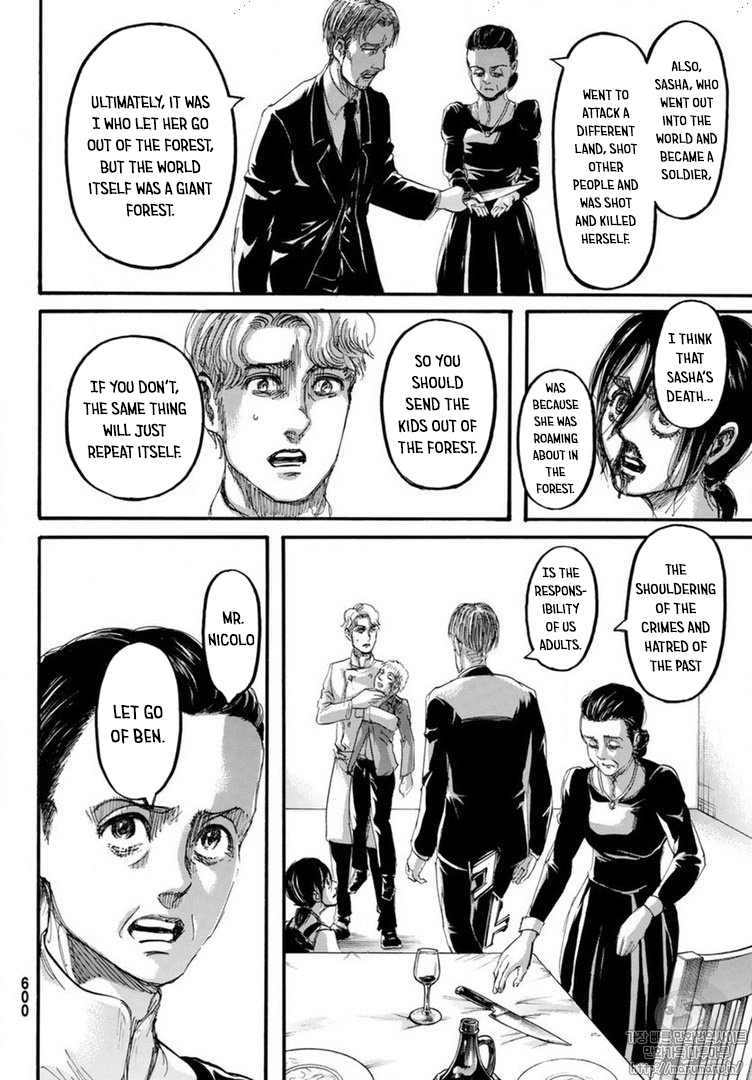
Both have a very black and white vision. This is why Mr Braus’s prospective is so important:
Because it acknowledges both points of view. Sasha was a person who managed to overcome her fear in order to help people. She was also a soldier who took part in an operation which involved attacking civilians. It is meaningful that her father acknowledges this. Sasha was no devil nor angel, but a person who ended up caught up in a cycle of violence.
It is this specific prospective the characters must all come to accept and I liked how it was exemplified through three different points of view on the same character.
Killing Zeke before he turns them all into titans, honestly. I think the manga is approaching its end (maybe a few more volumes?), so I am not sure it will be very long.
I really don’t think that will happen. It could, of course. One never knows. But I don’t think so because it seems to be a repeat of what’s going on with Armin, which would contribute to the cycle that never ends nihilistic ending idea, which I just… I don’t buy it. I really don’t. It’s possible, of course, and there are many ways it could work, but it also does not seem to work with statements like this:
“The shouldering of the crimes and hatred of the past is the responsibility of us adults.”
The entire series is really focused on the ways adults force children to act for them. Grisha forced Zeke to be a spy. He forced Eren to be a titan. The military in Paradis runs on child soldiers. Historia suffered for who her parents were. Ymir suffered for being forced to become a figurehead when she was just a starving child. Marlay brainwashes kids like Annie, Reiner, Bertolt, and now Gabi and Falco.
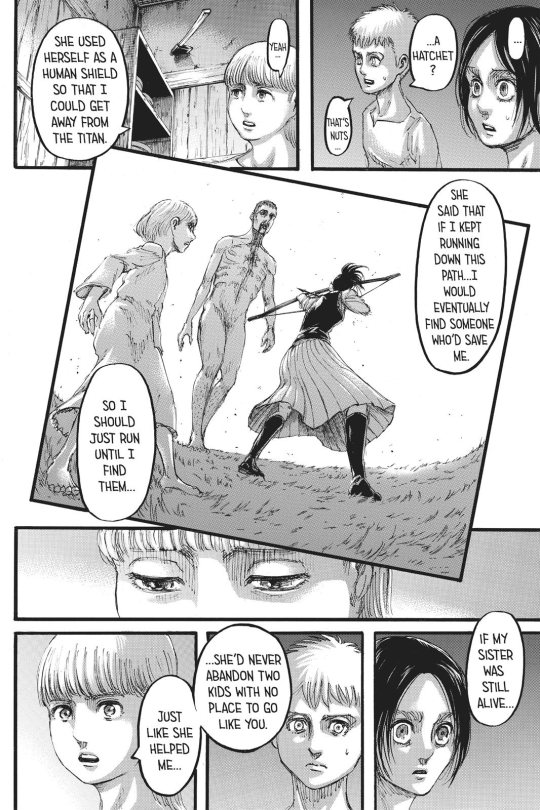
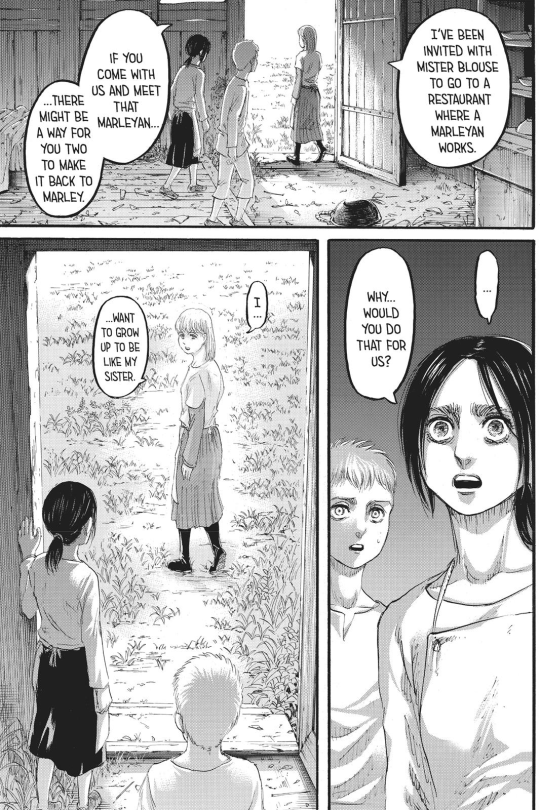
But Gabi and Falco have a chance. It’s notable that Armin and Mikasa are the ones who save her, when she’s basically female Eren. I still genuinely expect the majority of the cast to die, but the kids–Gabi and Falco–to live. I could be wrong and what you suggest could happen, but I also think the titanization needs to end by the end of the story.
I think it was the first major death for the 104th since Shiganshina. Despite all the bloodshed in the first part of the manga, that all took place over a timeline of about three months for our cast! Then they had years of peace and relative safety, titans gone, making allies, etc. But during that time we know they grew closer to each other than they were before. To have that sense of safety destroyed and a new sense of loss–I imagine that’s why it’s hitting the characters hard, and the readers as well, since for both readers and the characters Sasha represented a kind of innocence, a finding happiness in the simplest of things (food), lightheartedness, etc. Now that’s gone… or is it? As Kaya reminded us, Sasha’s legacy lives on.
I’m sorry Anon, I’m not quite sure what you mean! Are you saying Eren might “sisterzone” Mikasa or that the writing is? I’ll answer both, if that’s okay.
The writing definitely is not “sisterzoning” Mikasa. Mikasa’s feelings I think are abundantly clear after chapter 50, in which it’s entirely possible she was moving to kiss him during the Clash of the Titans Arc. For the record, I didn’t ship it until chapter 50, though I did always think she had feelings for him.
I don’t think it’s a realistic reading to deny that Mikasa canonically has romantic feelings for Eren–it’s kind of blatant. Furthermore, Falco’s feelings for Gabi also clearly have a romantic component; pretending to be siblings doesn’t really change that and I just don’t think that situation is the best comparison as I doubt it’ll have further relevance.
As for how Eren sees Mikasa, that’s a different story all together, and Isayama pointing out Eren sees her as a motherly presence is not the same thing as saying Mikasa sees herself in a maternal sense (but there is some Oedipal-ness there). And it’s true–Mikasa is always trying to protect him as Carla asked her to do, but she would have done that anyways because she pretty clearly sees him as a major part of her identity, even to an unhealthy extent which I’ve talked about before, and that protectiveness is actually pushing Eren away in some sense. I do think the end goal of Mikasa’s arc has to be growing away from Eren; that being said, it’s not unrealistic to imagine that Eren would realize they could have had a happy future if, if, if.
If the circumstances of their world weren’t so cruel.
If they didn’t have to constantly fight to survive.
If Eren didn’t have a time limit on his lifespan.
If he’d decided not to go to Marlay.
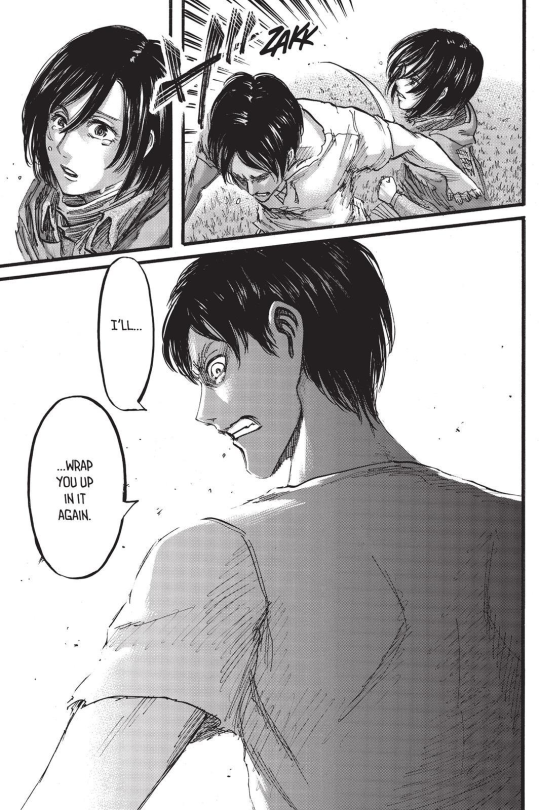
Eren’s arc is tragic as hell. Even looking at the symbolism in the scene from chapter 50. Mikasa is essentially telling him she loves him, maybe wants to kiss him, and he focuses on I want to fight to save you. In doing that, he saves her, but he also loses that moment.
Eren will probably help save humanity even if Armin is the actual hero, but the cost is pretty clearly going to be his relationship with his loved ones–though I do absolutely think Mikasa and Armin will love Eren no matter how they disapprove of his actions, and I think he will love them regardless. But the closeness and the future, however short, they might have had, is probably gone.
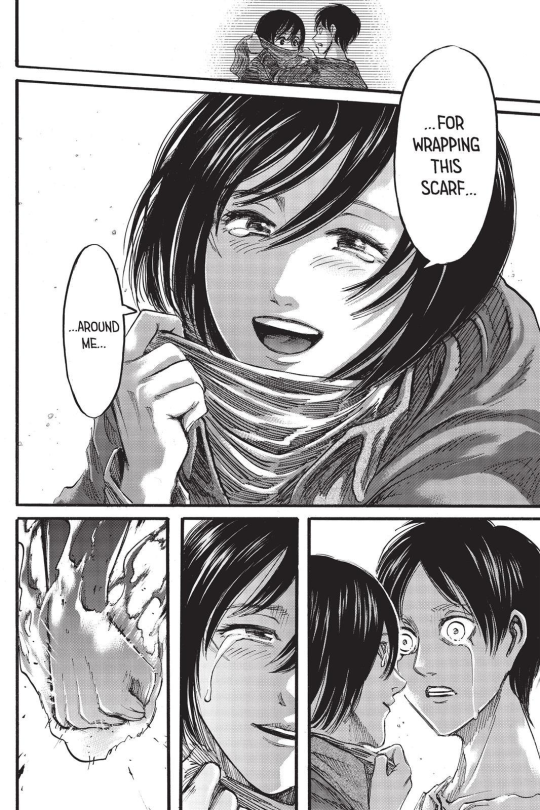
And Mikasa knows this as she says here:
There isn’t a happy ending for them together like she’d have wanted, but she’s still clinging as we see in recent chapters wherein her clinging almost leads to her and Armin getting blown up.
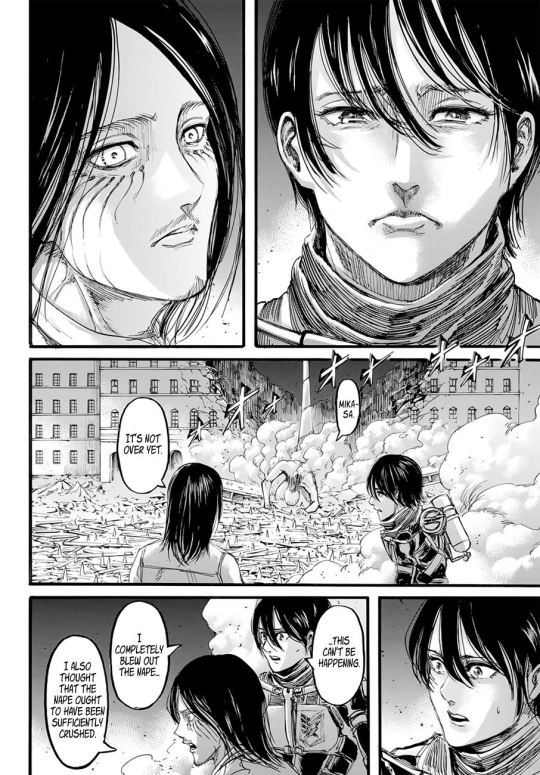
To save the rest of her loved ones, Mikasa won’t be able to save Eren. I think that’s definitely where the story is going, but I do think it’s also realistic that Eren and Mikasa will have a moment wherein Eren acknowledges what could have been, and that he loves her, regardless of whether there is a romantic component.
I personally think there is likely to be (the set up is obvious, like with Touka and Kaneki in TG or Ochaco and Izuku in BNHA–it’s def a darker story with no hope for a happy ending for them, but main female character + main male character in this kind of story with a scene like chapter 50 that is clearly designed to put romance in the reader’s mind, is almost certainly intended to be romantic, plus we know Mikasa feels romantically). That being said, I also think it doesn’t actually matter whether or not Eren acknowledges romantic feelings for Mikasa. I just want him to acknowledge, and tell her, that he loves her and is grateful to her–because he does and is, regardless of whether that is familial or platonic or romantic, and the exact definition of that love doesn’t matter to the overall tragedy and beauty of their story. But acknowledging Mikasa’s personal romantic feelings would be a beautiful ending, imo, but that’s just my preference.






 hamliet