
aka hamliet’s ramblings about what the point of all the romance is in the manga
*before my inbox explodes, the title is facetious, please don’t send me hate*
I like ships. A lot. Usually I view them as fun for a series but only a few, if any, are like, central to the plot/themes. But in TG the romance is actually extremely relevant to the series’ themes, and despite the common assumption that TG isn’t a romance manga, it… kind of is in a lot of respects, because TG is about life, and what makes life worth it is connection, and all kinds of connections–family, friendship, and romance. (I might do other metas on the family and friendships in TG and how they convey certain themes too, just as powerfully as the romances, but this meta is specifically about romantic dynamics.)
TG honestly has a lot of romance (like the whole story started with a date) and is basically Ishida’s “shoujo with corpses.” Each canon/likely to be canon ship is at its core driven by loneliness answered with empathy, and each ship allegorizes the story’s main themes and the importance of solving the ghoul/human conflict the same way: through an alliance based in empathy and self-reflection.
NB: there are some dynamics I consider subtextually romantic in TG that I won’t get into here, like Hsaiko (though Saiko’s feelings are not clarified) but since Hsiao and Saiko don’t have proper arcs it’s a little harder to extrapolate on whether or not they’re conveying a theme at this point.
I’m also not saying anyone has to ship these ships, or not ship certain obsessive ones I discuss (I ship several of those ones!), just simply explaining what I think Ishida is doing with them/why he included this dynamic in the story.
Kuzen/Ukina, Kasuka/Kureo, Hikari/Arata: Tragedy and Repetition
I debated whether or not to include these but ultimately decided to because I think they best represent the world everyone needs to move away from.
Kasuka and Kureo and Hikari and Arata were both truly in love, yet Kasuka was killed in the conflict by Eto and Hikari by Arima–both of whom are children forced into this conflict from birth but who decided to create a new world. The people who want to create a new world literally kill Hikari and Kasuka, both of whom can’t escape the role they were cast into in the world. Kasuka has more choice as a human, but chooses to fight and dies for it, and Hikari was a “wild” ghoul in her youth and it eventually sent Arima after her even after she changed, because the old, tragic world is unforgiving. Both Kureo and Arata then lost themselves to grief and fought to protect what they had and were taken from their kids as a result.
And Ukina and Kuzen show us that a relationship between ghoul and human was not possible so long as people keep to the rules of the old world, yet also suggests what might be possible if they break them.


We don’t know Ukina’s motivations–Eto seems to think she was simply
motivated by her story, though Kuzen’s claims about what Ukina said to
him cast doubt on this.Ukina empathized, and that drew him to her. But in the end he couldn’t break free of the cycle, and killed her, though she empathized again… maybe.

But forgot her daughter, and Yoshimura too then abandoned Eto. You can’t nurture a new world if you abandon it no matter your motivations. All three of these love stories, however simple they are in the manga, are tragedies that the rest of our cast is trying to avoid.
Touken: Humanity and Ghoulhood
Ah, the main ship, and a parallel of all ships in TG because everyone is a parallel to Kaneki (I’m not kidding. Everyone is). We begin with Touka and Kaneki refusing to empathize with each other. Kaneki calls her a monster. Kaneki is the living embodiment at this point of how humanity views ghouls: he draws them as monsters, but then Kaneki becomes one (because the monsters in TG are not ghouls nor humans; they are everyone and no one at the same time).


She tells him to go to hell when he has the nerve to ask her for help without any semblance of empathy. Because how can humanity dare ask ghouls for anything after what they’ve put them through?

Kaneki fears violence, but Touka uses violence to cope with her trauma, symbolic of how ghouls are forced to used violence to survive.. Kaneki is terrified of being abandoned, but Kaneki abandons people when he grows to fear them leaving him. That’s what drives humanity in fearing ghouls: losing the people they love (and their own lives, of course). Touka and Kaneki then both inflict these traumas on each other.


And yet throughout part one, they rescue each other. Why? Because both of them can’t stand to see the world the way it is, and in each Touka refuses to accept that she couldn’t do anything about Ryouko’s death and turns into a murderer, in the process revealing to Kaneki just how little she values her life.


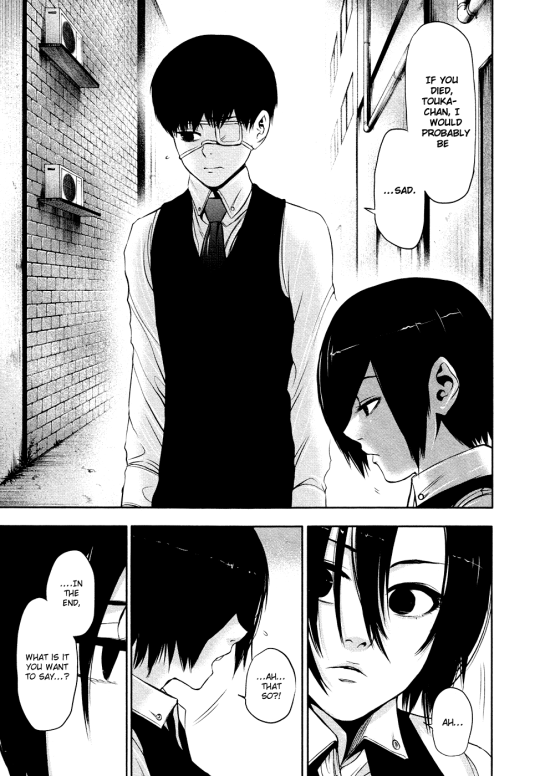
But Kaneki tells her even if she doesn’t value her life, he does. And he helps her, even though he thinks it’s wrong, because he empathizes. And when Kaneki can’t let Nishiki and Kimi die, Touka shows up to help. But they can’t be together in this terrible world. Like Ukina and Kuzen, they’re separated by the selfishness of humans and ghouls and the entire conflict, a conflict that makes strength the only way to survive. They both just want to be with the people they love, because they’re scared of being alone. And Touka sees Kaneki’s pain. She calls him on it, because she feels the same way, but she does it in the wrong way, and regrets it. Which is why it’s so important when they reunite and she calls him on it again, but doesn’t push him or force him.

It’s also important that it was on Kaneki to come back and not on Touka to go to him. As a human (sort of) he’s on the privileged side, and it’s more on humans to make amends at this point because they’re oppressing ghouls instead of seeking to talk to them. Kaneki can’t ignore ghouls for humans (Haise) or humans for ghouls (OEKneki).
And when Kaneki and Touka get together, it’s not perfect. Their relationship has codependent elements and they have communication issues because they are still both afraid of losing each other, of being alone. The human/ghoul alliance also has major communication issues and humans like Kaneki are still struggling to realize they aren’t better.
Touka doesn’t want to lose Kaneki: hence, why she tells him she’s pregnant and doesn’t go to save Yoriko. Kaneki knows who she is; Yoriko doesn’t, because Touka’s afraid of being known just the same as Kaneki is.


And Kaneki doesn’t want to lose Touka.


But Touka needs to learn to hold on a bit more now, because unlike before when Kaneki was Haise, this time he’s married her. They’ve committed. And she does, digging him out. A ghoul saves Tokyo.

However, now that they’re reunited, they’ve got to communicate better, and trust each other more. They’re having a baby. A life, as Yomo says, that gives him hope for the world. That’s why we saw the fetus panel in 160.

If Kaneki died, there would be no future. If humanity dies, there is no future for ghouls, and same for ghouls with humans.
The baby represents new life (since the main theme is live, life=hope) directly from an alliance between ghoul and human (a marriage). But the baby who is both human and ghoul represents the fact that they have to overcome it, that they have a chance to break out of the cycle their parents perpetuated and that the word perpetuated. As the alliance overcomes their issues, so will Touken, I believe.
Akiramon and Seiaki: Justice and Sacrifice
To start with, it’s impossible to discuss Akira and Amon’s relationship without Takizawa since he’s an integral part of their relationship, and it’s impossible to discuss Seiaki without Amon, so I’m discussing them together. Through Akira and Amon, we see the CCG’s two main sources of existence: traumatized orphans seeking to escape their legacies (Amon) and people seeking to honor their legacies (Akira). And then we have someone like Takizawa, who like Ui is neither and therefore an outlier of sorts, and hence is the one best able to have an honest perspective on the situation: it’s why he’s the most self-aware of the trio, though he has his own flaws.
Akira and Amon are both searching for justice, and specifically for answers. Takizawa from the beginning is a very stereotypical businessman, less about the noble aspects of the CCG. That’s why he’s the one who breaks down when facing the Owl Suppression Operation. He sees it for what it is and he doesn’t want to die.

Akira, in contrast, and Amon both believe the answer is to wipe out ghouls and therefore right the twisted world. Their idea of justice is black and white; there’s right and wrong, and they want desperately to be on the right side of it. So they don’t consider their place or role in the world. They are like Kaneki before the Steel Beam Incident, content to consider themselves separate from ghouls, yet unlike Kaneki they both choose to be a part of the conflict.
We also see the idea of sacrifice as it ties into justice in their relationship, and with their relationship with Seidou. Seidou is willing to sacrifice himself to save Amon–for Akira. Except both he and Amon wind up captured and tortured, and Akira believes them dead, and winds up alone. And then Akira sacrifices herself for Seidou, and Amon sacrifices himself for both of them, and Seidou sacrifices himself for both of them.


It’s. A sacrificial cycle lol. But Amon himself said what he thought of redemptive death, because really they are all seeking redemption–Akira for not stopping Seidou, Seidou for what he did as a ghoul, Amon for Donato: it’s trash.

Sacrifice is not justice. Justice is not served by looking outwards; it’s served by looking at yourself.

Their refusal to consider themselves as part of the problem is brought to the forefront when Touka talks to Akira and makes her hug it out with Hinami. The thing is, I don’t like this scene in many ways because I think it was disrespectful to Hinami, but like all things in TG it’s gray, so there is good in it too, and basically it’s that Touka was asking Akira to see herself in Hinami. The need to examine yourself is also tied to empathy, because it asks you to step into someone else’s shoes and see yourself there. An orphan who just wanted her parents, like Touka, like Amon. What is justice, then, if it just leaves hurting children, no matter what they are? As Akira says, whom should I be hating, then?

Akira and Amon both struggle with this, and they see that in each other and know that the other one understands this struggle. They empathize with each other, standing by each other’s side.
It’s convenient that Akira and Amon then get to disappear from the narrative while Touka and Kaneki get hunted by the CCG, because they’ve always represented the human privilege in parallel to the ghoul symbol of Touken. But everyone who’s been ignoring the ghoul problem–like, everyone in Tokyo–is then called on it by Dragon, and they have to go back to the CCG and face what they tried to ignore. The fact that they forgot what justice was.

And again, it’s gray, because it can also be seen as them returning to cling to their past safety, but Donato sees that that is shattered. And Amon faces him, and needs to realize that it’s not the answer he’s been seeking–no matter what his past is, he is the one who needs to examine himself to create justice. He needs to be honest with himself. And Akira needs to be honest with herself, and that includes taking this advice from Touka here:

And give those quinques back to Hinami, to allow her to mourn for her father as Akira mourns for hers.
Ayahina: Child Soldiers and Traumatized Orphans
Ah, our sweet lost children. One of TG’s main themes has always been how children suffer the most in any conflict. We see that through how almost every child in the series pays for their parents’ mistakes (Kaneki’s mom taking out her anguish on him, Eto’s abandonment, etc.), the Sunlit Garden, the Oggai. And then we have two sets of parents who love their kids: the Fueguchis and the Kirishimas, but neither are allowed to raise their children because the CCG hunts them down and murders/captures them. Both Ryouko and Hikari sacrifice themselves for their children.
Both Ayato and Hinami are traumatized orphans and child soldiers, but Hinami is initially presented as the former more so than the latter, and vice versa for Ayato. Hinami and Ayato both foil Touka in how they cope with trauma–Hinami grieves, but she isn’t allowed to grieve properly; Ayato is angry right from the beginning because no one allows him to grieve. Eventually both take a similar path in joining Aogiri both with the intentions of protecting the people they love. And it’s no coincidence the entire conflict is run on a diet of child soldiers in the Sunlit Garden. The conflict depends on hurting orphans like the Yasuhisas and Amon to populate the CCG and the soldiers created in the Sunlit Garden. And by creating orphans on the other (ghoul) side, they fuel the conflict on the other side as well, driving Hinami to join Aogiri as well as Ayato.
But the conflict doesn’t have to continue, as Ayato and Hinami’s relationship shows us. They both did terrible things as members of Aogiri, as it’s a terrorist organization after all, but they found a way out, and it wasn’t through learning to protect everyone and it wasn’t through fighting on their strength. It was through empathizing with each other.

Instead of fearing him as her superior, Hinami sees him for more than just a soldier. She sees him as someone with a sister (whom he’s desperately trying to protect in his own edgelord way). And so Ayato, who’s largely isolated himself from people who care about him, grows to empathize with her as well. They express the emotions the other cannot.
How can the world answer the wrong it’s done both of them? It can’t, not really. But they can find a way to live with each other.


The answer isn’t in Hinami hugging the daughter of her parents’ murderer; it’s in allowing her to mourn, and in empathizing with her loneliness. Which Ayato understands. He can’t fix her problems, he can’t fix what’s going on with Akira, but he can be there for her because he understands her pain. Even if the world never figures it out, they will have each other, and they can have hope in that.
However, that’s not enough, because the world keeps interfering in Hinami and Ayato’s relationship. Hinami almost dies sacrificing herself for other children against other children.

Because the cycle is going to repeat and repeat and repeat until someone says No. That’s why while Kaneki’s return was Bad for his personal development, it was good thematically, because someone was saying no to this child dying. That’s why Ayato is not going to get to sacrifice himself fighting kagune gremlins, either.
They find hope and comfort through their empathy for each other, but the world needs to be fixed in order for Hinami and Ayato to find peace.
Mutsurie: Duty and Compassion
Now let me talk about my favorite ship, Mutsurie. It parallels Touken (‘I don’t care if you die’ instead of ‘I don’t want you to die’ lol) and Ayahina (‘let’s go home’ and plans to save bae from death in Cochlea/Rushima) explicitly in terms of structure, but also brings elements of Akiramon and Ayahina’s themes. Mutsuki is a traumatized, exploited child turned into a child soldier like Amon, Ayato, and Hinami. Urie has a CCG legacy like Akira and prioritizes his job above anyone around him, shutting himself off and becoming cold. The first notion we have of what Urie thinks of Mutsuki is this:

A hypocrite. Worthless. Because that’s what the CCG thinks of Mutsuki as well, as we see when Matsuri then orders Mutsuki to go on a death mission and Tokage warns Sasaki about him. Mutsuki is worthless, because he has mental health problems and because he is physically weak. The irony is Urie is projecting onto Mutsuki his worst fear about himself: that he is worthless, not enough for his father to come home to.

That he is a hypocrite, because deep down he knows none of this CCG promotion strength stuff will make him happy. But Urie refuses to acknowledge this and projects it onto Mutsuki and Shirazu.
But the ship all starts in chapter 29. That’s where Urie fails. He’s following exactly what Matsuri wanted him to do, and he gets in huge trouble because he simply isn’t strong enough. He loses control, and he lashes out at Mutsuki, at the CCG’s weak reality. But instead of lashing out back at him, even though Urie endangered him for selfish gain, even though Urie hurt him by punching through Mutsuki’s stomach, Mutsuki reaches for him. Mutsuki tells him he is not alone. Mutsuki empathizes, the thing Urie refused to do with Mutsuki earlier though he knew inside that they were the same.


And that’s the answer for the entire series, isn’t it? Empathy. It’s not perfect–Mutsuki is behaving like an abuse victim in many respects because he wants the pain to stop, but the thing is, Urie does stop. Urie does change in how he treats Mutsuki from there on out, going to protect him from Hakatori, worrying about him on Rushima, etc.
Mutsuki does not want revenge on Urie for punching him because he understands him–in Urie’s pain, he sees his own, and that’s the answer for humans and ghouls and their personal relationships between each other as well. For example, if we get a Mutsuki-Touka talk, it’d probably be similar in that Mutsuki and Touka both fear abandonment, and can understand that in each other.
Later on, Mutsuki and Urie reverse their arcs just like how Kaneki clung to strength at the end of the first TG like Touka did at the beginning.. Mutsuki clings to the CCG, but his trauma is only growing worse the stronger he gets in the CCG. To the point where the difference between himself and a ghoul is no longer evident, even in what he eats.

And the more Urie’s trauma with his father repeats, the more unable to succeed he becomes: at work, and in everything. Symbolically, Mutsuki and Urie embody the alliance as well. The alliance is bound to an extent by ignoring wrongs, and there is good and bad in there. Urie blinds himself to Mutsuki’s faults (like Mutsuki didn’t acknowledge what Urie had done to him) and that leads to their issues boiling up and boiling over because issues have to be addressed, not swept under the rug. But what made the difference for Urie initially was that he took the lesson, and changed. Mutsuki is now showing that he, too, has changed. And that’s what the CCG needs to do: change. Accept that they hurt ghouls, and ghouls need to do likewise, and change. But no change comes unless there is empathy.
Mutsurie having a proper resolution would include a conversation, and also leaving the CCG I believe since the CCG is limiting Urie’s growth. They both need to leave in order to heal like the traumatized children they are.
Nishikimi: Desperation and a Holdfast
Nishiki and Kimi were introduced together and have always really shared an arc. Their entire relationship is blatantly about loneliness and empathy.

It’s interesting to me how they go to such opposite, and both wrong,
extremes post Anteiku Raid. Nishiki dumps Kimi, ostensibly to protect
her, but when he hears she’s working with Kanou he decides to search for
her. Dude, you shouldn’t have waited. If you wanted to be with her,
regardless of the dangers, that was her decision to make, not yours for
her. And Kimi goes too far in the other direction, committing atrocities
for the sake of creating a world where she can live with Nishiki. They
are both desperate people, as we see from their introduction:

The only thing they’ve had to cling to is the other, and that the other understands their loneliness. Kimi’s attempts to fix the world have brought more loneliness and pain into it, and exploited the loneliness of the Oggai orphans like Hajime. Nishiki’s attempts to avoid the conflict brought more loneliness to Kimi, driving her to do what she did.
Maybe working together, they can make a better world.
Yoriomi: Ignorance and Memories
I’ve jokingly called this a plot device more than a ship before but @aspoonofsugar wrote a great analysis of how Yoriko and Takeomi’s relationship contrasts Mutsurie, Touken, Akiramon, and Ayahina here. It is symbolic of how humans have a relatively easy time fitting in in society, in contrast to Kaneki and Touka, and also Urie and Mutsuki, even in terms of gender roles.

But like the entirety of Tokyo ignored the ghoul problem until Dragon erupted from below them, Yoriko and Takeomi’s relationship is not perfect and is founded in memories (childhood classmates) and what’s expected of them. They can’t escape the conflict, though, because Takeomi is a voluntary part of the CCG and even though Urie hates them for the fact that Takeomi’s father is still alive and he seemingly has it all as the perfect human, consequences start to hit Yoriko and Takeomi. Yoriko’s friendship gets her arrested and sentenced to die, and Takeomi loses his father.

Neither of them are major characters, and that’s why I find Mutsuki’s jealousy of Touka (that he projects onto Yoriko) and Urie’s jealousy of Takeomi a more interesting way of looking at their relationship. Yoriko even realizes how little she empathized with her friend, not realizing she was a ghoul, and empathizes now when she can’t even see Touka:

Takeomi still does not get it. He doesn’t understand Urie hated him for years, and to an extent, that belief in his friends parallels him to Yoriko, but it’s ignorance. He doesn’t get he helped create the culture that sentenced Yoriko to death. But he does do the right thing and springs her from prison, but returns to the CCG to fight. In the end, I would like Takeomi to empathize with Urie since they’ve both lost their fathers now and he can now understand the loneliness eating Urie, and I’d like him to empathize even with Urie’s love for Mutsuki because he’s going to have to face Yoriko’s platonic love for Touka soon. Now Takeomi will have to face someone who’s personally hurt him/tried to take away people he loved, and I hope he gives Urie encouragement even if he doesn’t ever forgive Mutsuki.
Utaren: Hope and Despair
Uta and Yomo’s relationship is subtextual but it’s definitely there so I’m including it ’cause I can. Their relationship was first categorized by anger and by a desire to be strong with each other. Firstly they used their strengths to fight each other, then united them in the hopes of taking down Arima for Renji’s sake, and then Yomo left when his strength got him almost killed by Arima. The fact that they were equal in strength is not to be dismissed; it’s symbolic of how they see themselves in each other, of how they can relate.


But they also suffer from terrible communication issues, and Yomo isn’t able to understand Uta beyond the physical strength aspect. Uta didn’t understand Yomo’s hope, how the world could be different, partially because Yomo completely failed to communicate to both Uta and Itori what it was about Anteiku, about ghouls and humans–and I think the reason for Yomo’s failed communication is because he was still clinging to the idea of living while losing. If Yomo can only find hope through watching others’ happiness (Touken) then Uta can only find it when watching others’ despair.

But don’t they both deserve some happiness themselves? Yomo doesn’t understand Uta, but he wants to live with him anyways. He wants to connect, because that makes them feel alive. I have hope they will learn to empathize with each other. Even if you can’t understand, living with each other, perhaps you can connect, perhaps that initial spark of empathy through even just physical strength can grow.
After all, they’ve saved each other.

Yomo was wrong, as he says now. There are things worth holding into, and he’s starting to learn that. And Uta was wrong. He can’t not live with Yomo and not live without him. He has to live with him. He couldn’t, after all, let Yomo die, no matter how fun it might have been, and yet Yomo counters his exact worldview that life is despair. Like Nishikimi, they offer each other something to hold onto, and slowly, I would hope, that would mean branching out to get to connect with others as well.
Uihai: Lies and Comfort
Ui loves Hairu, but she’s a mirage–or is she? Her personality is entirely hers, as far as we know. But she represents the Sunlit Garden, being the first character to introduce it to us. And Ui, being Ui (an Amon and Urie foil) is so focused on The Mission and justice it disrupts him showing his feelings to her, and his actions and assignments lead to her death.

Good job Ui. -__- And Hairu is the opposite. Her desperate desire for love and praise is what drives her to get herself killed:


Of course Hairu didn’t know Ui cared about her, and she was appreciated. Why would she? Ui never told her. And the thing about Ui is that after her death, he’s been unable to break out of his own pride, which keeps him trapped in loneliness. We see it here, when he cries:

Hairu is less of a lie than Ui is. Having people around convinced him that everything was fine, that he didn’t need to examine himself, but when they’re stripped away, he loses himself.


He sees no need for justice when he might just be able to get Hairu
back, because he misses her, he misses closeness, because that’s what Ui
craves. He doesn’t want to be known because like Kaneki, Amon, and more
he uses the idea of being Just to justify the fact that he exists and
deserves to be known, and yet paradoxically all he wants is for someone
to be with him, for comfort.

Ui’s slowly starting to learn that justice may not quite be what he thought, but I’m not sure he entirely gets it.

Is she still Hairu to Ui, if she’s only half-human, if he’s faced with the fact that justice was all a lie and he was never just? That’s the question the manga still has to answer. He can’t truly empathize with her until he knows who she truly is, until he knows what the CCG is. That’s why it would make so much symbolic sense for Hairu to be ET, for Ui to realize that he was not fighting against the “other” of ghouls the entire time: he was fighting against people worthy of love. He was fighting against himself. And Hairu who was always fighting against her own kind, what with her virulent hatred of ghouls:

…despite being a ghoul herself–well, it’d be fitting for her to be turned into the very Beast she comforted Ui after his fight with in the first manga.

And that’s why I would like to see a moment for Uihai in that, wherein Hairu sees she is loved, and Ui sees that he is accepted even by a half-human he fought against.
Nakimiza: Nostalgia and Freedom
Nakimiza is a ship I’m still bitter about how it ended so bear with me. The themes of nostalgia and freedom from that nostalgia are Everywhere in the manga. Like, everywhere. Nostalgia is understood, but dangerous, and clinging to it prevents the conflict from ever being solved.
Naki is a very caring individual, but he doesn’t seem to get how much Miza cares about him, because he’s focused on Yamori, even when he’s saving her.

They’re both leaders of various ghoul gangs, and they care about each other and understand each other (at least, Miza understands him), and Miza expressly has feelings for him. But Naki never gets to overcome his nostalgia. It kills him instead. It kills him, ironically, as he’s idolizing Yamori, despite the fact that he’s fighting to save the Aogiri kids:


When Yamori killed an Aogiri child. But Miza after his death shows that she wants to move on from nostalgia, that she still can continue:


That’s why I think Miza will find happiness, but I’m still heartbroken.
Shuuneki, Tsukikana, Hairima, and Mutsuneki: Obsession and Mirages
And now, let’s discuss the ships that also are one-sided canon, but that I think unlike the other ships listed above, do not balance each other out and were obsessions because they focus more on an idea of who the person is, on what the person represents to them, rather than whom the person actually is (there’s definitely idolizing going on in every single ship I discussed above too, but I think these ships are more… it was not going to work out, let’s just say that).
What do all these ships have in common? They’re one-sided and extremely unhealthy, and you could add Hinakane to it too because though I don’t think that one has a romantic element to it there’s still something not healthy there.
For Karren, Hairu, and Mutsuki, the reason they loved their respective crushes was because, well, they showed them the kindness as a child no one else did. (Kaneki called the Qs his kids; it counts.)


Rather than true empathy, there’s idolization and an encouragement of bad behaviors thanks to a lack of equal connection and communication, amplified by a power dynamic that sets these ships apart from the other ships even if the previously discussed ships have at times encouraged each other’s flaws too. Hairu aspires to be like Arima, her mentor and very likely her relative–by killing and is killed for it. Shuu is a master to Karren, and she dies serving him–though beautifully, he empathizes with her in the end and shows he values her life.


Kaneki is a king and a boss to Shuu, and he’s forgotten his family following him–though I do believe Shuu’s love of Kaneki is moving in a more healthy direction having planned Touken’s wedding for them, as he’s no longer desperate to keep Kaneki all to himself–but while it was romantic it was completely unhealthy.

Kaneki is a father to Mutsuki, and Mutsuki became like him in abandoning the Qs pursuing him.

(Notably other ships like Uihai and Ayahina wherein Ui and Ayato were respectively above Hairu and Hinami in work, the power difference is not present, which we see in how Ui allows Hairu to call him Koori and Ayato and Hinami are equals in every sense.)
So what’s Ishida saying with this? The human-ghoul conflict is not ever going to be solved by people staying in their lane, nor is it going to be solved by people idolizing the other (and we see a lot of humans wishing they had the strength of ghouls and ghouls wishing they had that privileges of humans) or sweeping issues under the bridge. You can’t write the wrongs of the past if, like Kaneki, you fail to communicate to your children, or if you are too afraid to directly counter the system like Arima, or if like Shuu you pretend it never happened. The reason these obsessions all lead to death and destruction is because of this lack of communication. Connecting is vital to creating a new world.
Fururize: Obsession and Control
Ah, the Disaster Ship that started this whole manga. But it parallels all these other ships, too. It’s obsessive, so it parallels the unhealthy one-sided ones I mentioned, but it also foils the canon/likely-to-be-canon ones even though Fururize won’t ever be canon except one-sided. The reasons why Furuta and Rize have thus far not had a chance at happiness is because neither of them is capable of empathizing.


And how could they? As Rize says, as Furuta says, they were created to be used, and unlike Hairu, never had a chance. It’s really not surprising Rize uses Furuta to escape. She’d only seen people be created to be used as breeders or as soldiers.


Furuta then uses everyone around him. He tells Kaneki he was just a pawn in his game. Even Rize doesn’t show much care for Shachi despite the fact that he loves her and is a Good Dad, and it’s Shachi’s love for Rize that gives me a smidgeon of hope for her, because Shachi is honestly the best dad in the series and that should be rewarded, I would hope.
Rize uses pleasure to distract herself from ever feeling lonely, and whether she does or not, we don’t know. But we know Furuta feels lonely. He’s consumed by it, by how alone he’s been since his birth.

Eto points out he doesn’t get to call his father, father. He’s furious that Rize can be with other people instead of wanting to be with him. He’s destroying himself with his own loneliness (like Kaneki), and the world around him (unlike Kaneki), because he’s so lonely, and can’t empathize.
That’s why, before the ending, I really, really, really want to see Kaneki show Furuta some compassion, and think it would be fitting for both their arcs.







 hamliet