I definitely don’t disagree with you that
his frustration being related to unfairness! The ideas are not mutually
exclusive; I believe another layer to that unfairness is that part of
the reason he thinks it’s unfair is he does view Pitou(understandably!
Completely understandably) as a monster. You don’t have to agree of
course, but do you mind if I explain why I said that?
The struggle of
humans and ants to empathize with each other instead of categorizing
each other as monsters to be eradicated or cattle to be eaten was a
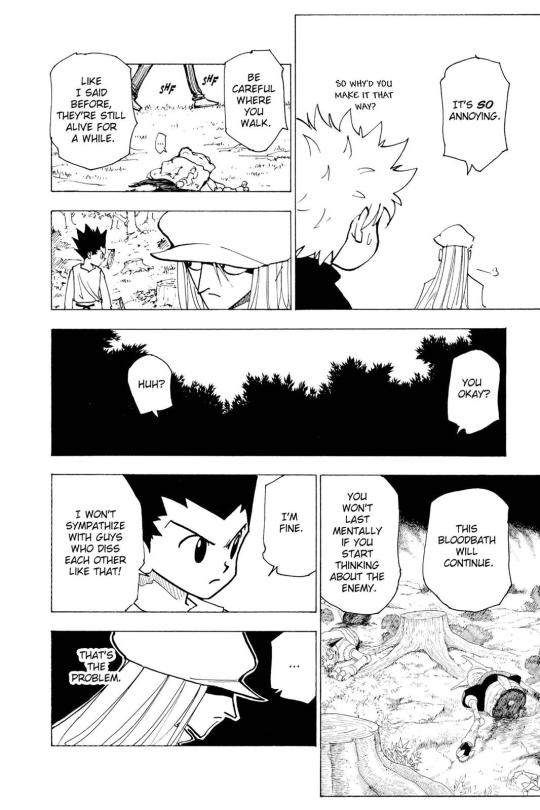
recurring theme. I don’t think Gon was concerned overmuch with the fate
of humanity, but Kite did warn him about this tendency of his here:
Gon did not want Pitou to be a creature who was capable of camaraderie, which Pitou’s actions with Komugi proved they were. I think that indicates that Gon did view Pitou as a lesser, eviler being, but was certainly frustrated when that was proved not the case. However, you are entitled to disagree!
I think Gon is not a fundamentally bloodthirsty person. He does understand killing is wrong, he just–makes exceptions for the rules according to his childlike mindset. He didn’t kill Genthru either, for example. His goal in those scenes I think was to survive, not to kill, whereas when facing off with Pitou it was to save Kite and then get revenge.
It’s also the case that Gon has a very egocentric, childlike mindset (and I’m using egocentric in the clinical psychological sense, meaning that all children focus on themselves and that is natural and not a criticism). He is not in this business of being a hunter, or even fighting in the Chimera Ant debacle, for the good of humanity or to save humanity. He’s in it for finding his father, and for saving Kite because he views Kite as a substitute for Ging. And he’s a child, so this isn’t wrong, but throughout the entirety of HxH, Gon is not really motivated by grand “for the good of the world” ideals, so his letting them go seems pretty consistent to me.
As for Pitou, I do think Gon is to an extent projecting his self-hatred onto them, and that is because his entire life he’s felt like he was not enough for Ging to stick around. Abandonment is really abusive and traumatic for a child, and Togashi really portrays its effects accurately. And then Ging goes one step further and essentially sets up a game Gon has to pass in order to find him and “earn” the right to meet him. So when Pitou kills Kite, someone he views as a Ging substitute, Gon is devastated because of two reasons: 1) Kite gave his life to protect Gon, showing Gon that he valued him in a way Ging never has, and he just lost that, and 2) Kite gave his life to protect Gon, meaning Gon was not strong enough to save his father figure and keep him with him, which is reminiscent of the root cause of his trauma: that he’s not enough for Ging to stick around.
For Gon’s specific rage that Pitou showed care for Komugi, I think it comes down to the fact that he wants to see Pitou as a soulless monster. It’s easier when we hate people who hurt us to see them as having no good in them. But seeing that Pitou does care for people brings up the same question Gon didn’t understand when he confronted Chrollo in the Yorknew City Arc: how can you care about your troupe but kill people you don’t even know so indiscriminately? And the irony is, of course, that that’s exactly what Killua’s entire family does. If Gon accepts that Pitou can care for people, then that challenges his assumption that Pitou is a monster, and if Pitou is not a monster, then he has to take a cold hard look at himself and see whether or not his revenge might, in fact, be unhealthy for him. But Gon again can’t give up on things, because if he gives up on something it probably exacerbates his fears of his lack of self-worth (thanks Ging), so it’s really terrifying for him, and tragic because he’s like a child.
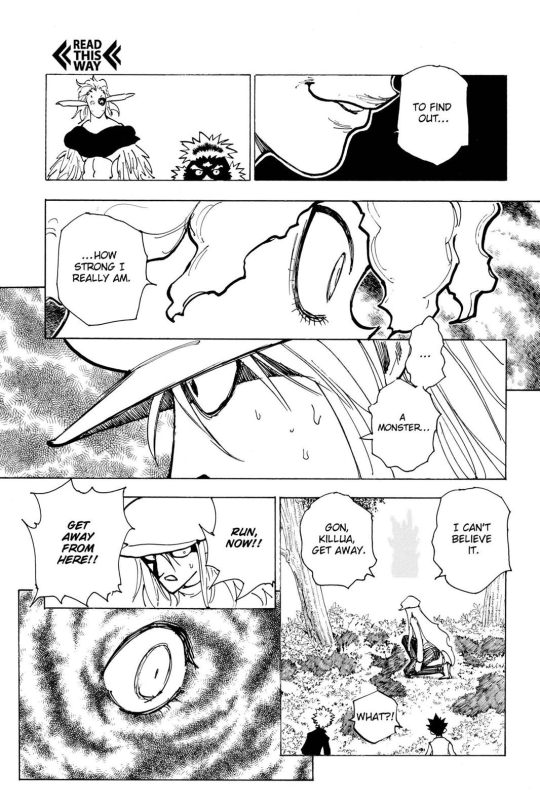
Neferpitou and Shaiapouf’s main point of comparison is underlined by Palm:
They are apparently both loyal to the same person, but actually Neferpitou is loyal to the person Meruem is, while Shaiapouf to the King he could become.
When it comes to this I would like to consider two points.
1) The two different ways in which their loyalty is channelled is another example of how the themes of the CAA concerning the discrepancy between the evolution of the species and the evolution of the individual are embodied by the characters and expressed through their arcs.
As a matter of fact Neferpitou’s loyalty is not useful to the species, but it is good for Meruem, while Shaiapouf’s one has in mind the best for the species, but it is hurtful for Meruem as an individual.
Moreover this discrepancy introduces another one between what a person is and what they should be.
Let’s consider the names of the three Royal Guards. Each guard’s name is born by the union of the name of an Egyptian god and the name of a character of a French children book titled CarolineandsesAmis. The book talks of the adventures of a girl called Caroline and of her animal companions. This choice of names underlines both what it is expected from the Royal Guards and Meruem (aka that they become gods and rulers of a new world) and what they actually are i.e. a child growing (Meruem) and three companions who are there to help him do so:
2) The reason why Neferpitou and Shaiapouf find themselves having opposite prospectives about what is the best for Meruem lets us explore another interesting theme i.e. what is empathy and if it is really worth anything without sympathy.
This analysis will try to explain and expand the two above-mentioned points.




 hamliet