TG has always walked the line between idealism and realism in an absolutely fascinating way, and it’s one of the main things I adore about this series. Both of these themes are explicitly explored through the characters of Furuta and Kaneki, and the reason people are not happy with what has been done with them is not because “I just hate Kaneki but Furuta’s an angel who deserved none of this,” (I LOVE Kaneki) it’s because the themes, depending on the person, may not have been satisfactorily addressed.
The series’ ending conclusion is that it tries to bring these two disparate pieces together in a way that was framed peculiarly, and because of that framing the message ultimately comes across as simplistic and, to some, confusing, because textually, it’s simply inaccurate to say Kaneki fought tragedy but Furuta did not. Instead of emphasizing individual responsibility and choices, the story seems to have emphasized choices made by others.
(It’s great that some find 177 optimistic, and this is not an attempt to convince people it’s not optimistic, but to explain that, even though we all agree Ishida was trying to send a hopeful message, many of us came away with the opposite message instead. It’s not correct to say that the message Ishida intended to say is the message he actually sent, nor is it correct to say that he did not send that message.)
We all know that TG wants us to live. It’s the most powerful line of the series imo: live, even if it’s not stylish.
That’s idealistic, and optimistic. Hence, the series sets up an expectation that it will deliver on this front. And in many ways it does just that. Even when things look hopeless, like when Mutsuki spirals, or when Urie frames out, or when Kaneki breaks into Dragon, these three characters are rescued by their loved ones, rescued from themselves. That’s beautiful.
However, the framing around Kaneki’s case in particular troubles me. He was told he did not have long to live.
We all wanted him to live, and the story granted it to us: he fixed his issue. Good. But fixing his life span came at
the cost of 100 kids’ lives: one hundred traumatized orphans who were experimented upon and legitimately called “100 Kaneki Kens” by the narrative, and the narrative has not explicitly acknowledged this. Which the story could have work… except it contradicts the
story’s earlier themes of having to truly grapple with the wrongs done
to children as the concept of wrongs done to kids has been reflected in just about
every characters’ arc, and even in the worldbuilding, starting from the Doves’ Emergence Arc.
The story has always emphasized this theme as highly important and influential for Kaneki personally and for the other characters as well, so if it was emphasized so much, it sets up an expectation in the reader that this should be dealt with explicily rather than never expressly acknowledged. I actually think Kaneki eating the Oggai is a good narrative decision for his lowest point, even if I personally find it triggering. The fact that it wasn’t then acknowledged, however, makes this theme of choosing to protect kids kind of fall apart. It also again stresses the idea of making choices for other people about the value of certain lives over other lives. And yes, Kaneki did not have a choice once in that scenario, but again, that emphasizes the idea that the world doesn’t allow for choices.
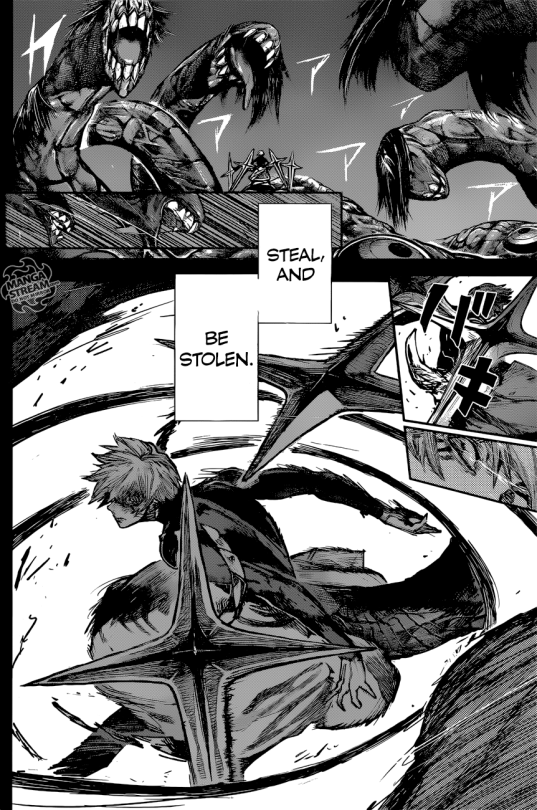
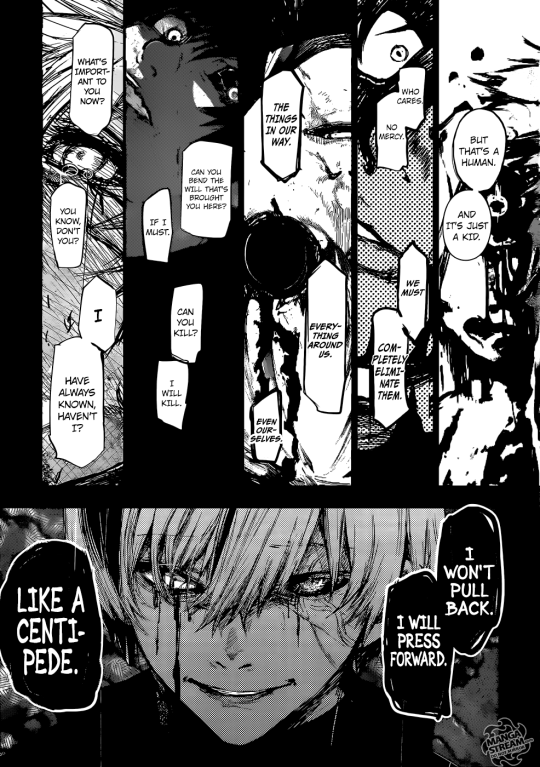
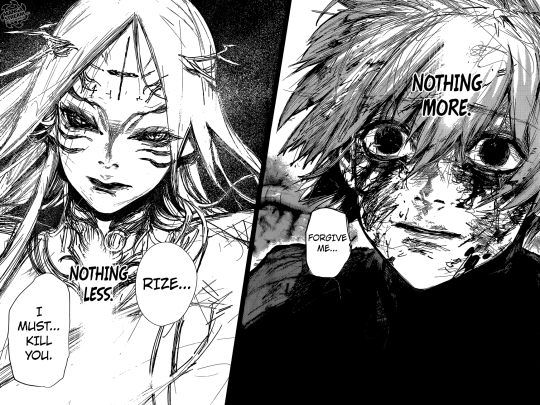
The story then also has Kaneki choose to kill Rize even though he does not want to (and it’s good that he doesn’t want to), but I don’t think anyone thinks that the way in which it was done was a good narrative decision. I actually haven’t seen anyone saying it was, lol. It would be one thing if he had not just been saved from the same exact situation, but he was. It would be one thing if he tried and then realized he could not. It would be one thing if Rize’s decision to stay at the Torii Gates was given more narrative emphasis rather than her commenting only on Kaneki’s decision, but it wasn’t.
Keep pressing on no matter what is a fine message, but to press on at the
cost of kids’ lives and the life of a girl in the same circumstances he
was just saved on frames this theme in a very uncomfortable way. Especially since Kaneki’s major flaw is criticizing behavior in other people that he also exhibits (that’s what Shironeki was kind of about).
Additionally, it can be interpreted as sending an “ends justify the means” message which I personally
find morally reprehensible, and, well, there
are lots of implications to Kaneki having to kill 100 orphans and a
woman with little current choice that are deeply unsettling. While I
totally agree that Ishida did not mean to imply what that implies, it
doesn’t change the fact that some of us are going to be more troubled by
how problematic that is than others. Intentions to communicate something important do not necessarily matter if the communication becomes muddled and the receiver hears something other.
I personally
root for Kaneki against Furuta and always have, but the entire framing
of this scene left me with a deeply pessimistic message. Accept the
world, yes, do what you can, yes. But kill or be killed, rather than
asking why anyone needs to die at all? That struck me as contradictory for the rest of the series’ themes. It is true that you cannot save the world, nor can you change it: you can only change yourself. The problem is that the narrative places emphasis on this when it comes to Kaneki’s character, but not with other characters, and allows Kaneki idealism in ways that it does not allow others. Of course, he is the main character, but thinking of himself as the center of everything has always led to disaster for him within the story. And it is not actually Kaneki’s choices that saved him, speaking textually.
It’s Touka’s. It’s Tsukiyama’s. It’s Hide’s. And it’s Furuta’s. They saved him.
I don’t think anyone would say Touka’s love for Kaneki is not idealistic. Most people would not wait three years and dig their husband out of a Dragon. I’m not saying this is bad in any way at all, mind you. I love Touken and think it’s beautiful, but I am saying it’s idealistic. And that’s good, but it sets certain expectations: namely, if Kaneki is on the receiving end of a lot of peoples’ idealistic forgiveness and belief that he can and will choose to make better decisions in the future (Hide, Tsukiyama, the Qs, etc. all share this perspective), it makes sense that we would expect him to then share this idealistic perspective with others, even if in they end they do not take it. But he does not. And this is actually not something new. He admitted to Takizawa he only cared about his loved ones (which is fine! But if you put yourself in a position where you are responsible for those people multiple times, as he has and as Ayato called him on, that’s less fine),
and he did not save Eto (the clowns presumably did) when he’d promised to: and she wasn’t trying to kill him then. She was lying there dying in front of him and had just saved Touka and everyone else and told him so. So it’s hard to see this Rize thing as growth when he’s done it before.
Again, this is where the rushing comes in: if Kaneki had offered this to Rize and she expressly rejected it, or if this was emphasized more in the Torii Gate scene, it could have worked, but it was truncated. To have the conclusion of “some people do need
to die” (which is Kaneki’s conclusion) told to us from Kaneki’s perspective rather than shown (especially when Rize’s issues tend to be about precisely not being allowed to share her perspective), and not explored when TG has a
habit of exploring its themes until Moon Hell, means that the themes ultimately come across as muddy. Is it Rize’s choice to die tragically? Or Kaneki’s to kill her? We’re supposed to see it as Rize’s most likely, but it simply isn’t clear, and to have it not clear when Kaneki is making a choice about someone else’s life is putting the onus on other people rather than on individual responsibility.
Continuing along those lines, the story early on tells us that connection is important. Interactions are chemical reactions; people are forever changed by them. People like Yamori, Arima, Furuta, and Rize, who do not connect with people, die without redemption (Eto is an exception, for… some reason. I’d say this is an inconsistency). However, the story also shows us that connection is hard. That’s a realistic view of connection, in that Kaneki struggles to connect with people and has actually deliberately severed himself from connection multiple times: first with Anteiku, then with the Qs, etc. It’s always been framed as something sad, because he doesn’t believe he can be loved, and Kaneki’s struggles to maintain connection are realistic and for me, highly relatable. However, the way in which people respond to his struggles to connect is idealistic and indeed beautiful, but also creates a dissonance with its contrast. It is honestly hard for me to believe that literally not one person would have expressed frustration or sorrow over Kaneki becoming Dragon, rather than just sorrow for him. That is not realistic. It’s beautiful in its idealism, but contrasts in an awkward way with the realism of Kaneki’s own struggles. It again puts the onus on other people rather than on oneself, which doesn’t work if we’re supposed to be interpreting Kaneki’s choices as what makes the difference. Such idealism also doesn’t work with Kaneki’s ultimate “kill or be killed” conclusion with the rushed pacing and framing the latest chapter had.
The conclusion of “I need to kill the Oggai/Rize to save everyone I love” struggles thematically because it is this entire mindset that has run the cruel world TG inhabits. The CCG agents (not the Washuu) kills ghouls to save the people they love. Like, I think what makes TG so interesting is that we can all relate to the notion that if there were terrifying people who had to eat humans to live, the world would not respond with empathy. The ghouls kill humans to stay alive and keep their loved ones alive. Essentially? While ghouls and humans may now be working together, that basic philosophy has remained the same. Making choices for other people about the worth of their lives is how this Tokyo runs in TG.
A lot of people find that pretty pessimistic. You can interpret that as “well, we can’t change the world, but we can still find happiness”–except TG has always offered a solution: changing the world via empathy. Empathy, putting yourself in the place of another. It’s what Touka offers Mado as a solution in the Dove’s Emergence Arc, and then she kills Mado because again, it’s kill or be killed there.
And yet the narrative does not let her off for this, because she deeply regrets it. So the scene in 177, without Rize being afforded a chance, suggests a cycle that is unbreakable, that the cage cannot be broken, and if you try to break it, you become a villain. The three characters who tried the hardest to break it are Furuta, Eto, Arima. That’s… an issue, especially when the story begins with this:
The only character who has tried to break that cage, who tried for revolution, is Furuta. Claiming that Furuta wanted to make things worse and Kaneki only wanted
to make things better is a false ditchotomy.
Kaneki only wanted a world that he could live in.
This is the entire point
of Kaneki hiding in the 24th ward arc. He would have probably stayed in
the 24th ward forever if he could rather than actually confront the
others. He admits as much inside his head: he had no plan, no intention
of fixing the world for ghouls and human, he only wanted a world where
he could belong, where he was needed and therefore he only acted on what
was directly in front of him. Maybe that’s the point, maybe he was never supposed to be born for love and revolution, but then I think it’s odd that everyone reading it thought it was supposed to be about freeing ghouls… because the story did set up those expectations.
This is in comparison to Furuta who has spent his entire life trying to
break the system from within, who dedicated his whole life to one
plan. All of Furuta’s actions are making things worse with a purpose.
We see exactly why this is necessary because every single person within
the CCG is simply so accustomed to the cruel way things are that they
barely even react. Torturers like Kijima and Tokage run free
with no repercussions. Saiko has consent forms for a life-altering
surgery signed by her mother and not her. Mutsuki is given a knife, and
then turned into a living weapon when they show both a predisposition
for violence and also come from a horrifically abusive family. The
entirety of the CCG is built on compliance.
They literally needed to be pushed to that extreme in order to break
free. The Oggai are the CCG’s method of taking child soldiers. The Washuu which control everything were slaughtered by Furuta who then went
on to replace them, and show exactly everybody how the Washuu acted in
his personality as “Kichimura.” Dragon literally drags humans into a
conflict that ghouls have been living and born into their entire lives,
and humans have the privilege of just treating like it’s an urban
legend.
All of these are targeted strikes against the system.
Kaneki, on the other hand, broke quinques and hoped for the
best.
Kaneki’s successes are all built explicitly on the back of Furuta’s work. If Furuta had not done
the dirty work Kaneki never would have even survived as king because
Furuta did all the dirty work for him. He never had to confront the CCG
because Furuta dismantled it for him from within. He never had to
destroy the Washuu because Furuta already took care of that and he did
it much better than both Marude and Hide.
Kaneki
wanted to talk to the Washuu. He had no plan.
When Furuta was not
directly challenging him, the only thing Kaneki did was move to save
investigators. When Furuta was directly challenging him, he hid to the
24th ward and then slowly starved to death. When Kaneki was presented
with the exact same limited life span problem Furuta dealt with his
entire life, Kaneki didn’t fight tragedy. He distracted himself. Kaneki
only fixed his lifespan because of something Furuta did once again:
because Furuta provided him the Oggai to eat.
Furuta acts, Kaneki reacts. That’s been consistent throughout the entire narrative. The fact that the story suggests that acting is wrong in Furuta’s case (and it hella is! Nothing he does is excusable, but his motivations=dismantle the system so that no one has to suffer what he suffered) and that it’s right in Kaneki’s case (his motivations=protect his loved ones from suffering) is… well, the line between them is really thin. Not wanting to do something (like Kaneki has seldom ever wanted to hurt anybody) doesn’t change the fact that he has, in fact, hurt someone, and as Yoshimura says, “the act of taking a life is always evil.” To have the significant choice of Kaneki’s, the choice that’s supposed to exemplify him taking responsibility, being to kill someone who has no choice, is strange.
You have to accept the world and decided not to twist it yourself. In theory, I like these messages from Kaneki and Amon. In practice, the framing of the story with pushing aside other themes and Kaneki still committing an action the story has always described as wrong against someone experiencing the exact same thing he just went through, makes it hard. It’s a tightrope between just what the difference between Furuta and Kaneki actually is, and I personally can see why people buy this chapter as inspirational, and why people do not.
I think this is the end of the story. I really, truly do. The story itself is indicating we came full circle. The chiastic structure is real.
As for me, I personally feel like this on TG… everyone knows I don’t like and felt hurt/even betrayed by the framing of the message thanks to the panel directly above, and I feel like its themes fell apart in the ending. I still feel this way. But that does not mean I don’t think the journey was worth it. TG really did save my life, and it introduced me to many wonderful friends (for real, some wonderful people even sent me a package after my father died, and everyone’s support over the past year–which has been one of the hardest of my life–means a hell of a lot. Internet can be good, and I am so grateful to Sensei for this story that brought a lot of beauty into my life). The story has been a really productive coping mechanism.
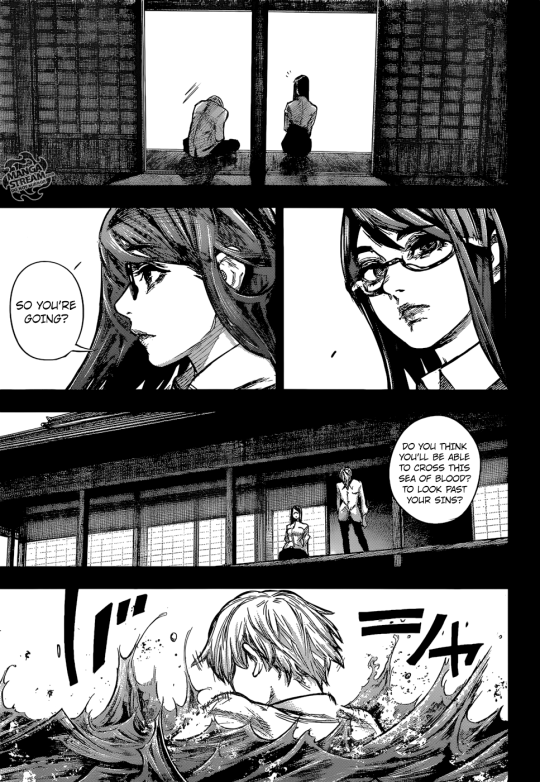
Anyways, Kaneki sums up how I feel about TG in 176, melodramatic though it may seem (but since it literally saved my life at one point I don’t care how melodramatic it sounds):
I’ve addressed this throughout the week and I don’t really want to argue about it, but you’re entitled to your opinion that she did, and I’m entitled to my opinion that her addressing it was unsatisfactory.
The reason I feel this way is because the entire manga was emphasizes the serious psychological harm a parent abusing or abandoning their child can do–we see it in Mutsuki, Kaneki, Suzuya, Furuta, Eto, Arima, Urie, Touka, Ayato, Amon–literally almost every character. The conflict itself was emphasized as harming children like Hinami, an orphan, or Ayato, a child soldier, and these themes were further explored in other characters in :re. If your MC’s lowest point is eating children, for me to buy a satisfying redemption and him solving his issues, more than a passing “this is what was done to me, Rize” and “we’re both [general] murderers” would be needed. Why emphasize the wrongs done to kids if in the end it isn’t a special kind of wrong, as the entire manga before it suggests? To me it feels as if Ishida rushed and so that theme was dropped. But as I’ve said, it’s fine to disagree, and I don’t really want to discuss this further as it’s triggering for me.
I do. Furuta’s arc is a tragedy. Tragedies end with the characters’ succumbing to their flaws but it doesn’t mean they don’t have arcs. An arc is basically: character has a goal. Characters flaws inhibit them from getting their goal. Character either changes to overcome their flaws or digs in and succumbs to them. Furuta digs in and succumbs.
The reason I think fruit’s arc is better done than Kaneki’s–and this is my opinion and ppl are welcome to disagree!–is that Kaneki’s flaws were precisely what I love about him as a character, but post OEK the story starts rushing and his flaws get swept under the rug rather than explicitly dealt with, like eating the Oggai, whereas until that point his issues were explicitly dealt with and addressed. That’s why kaneki dropped from like third to ninth in my fave character list though I still adore him and still love him more than I love Furuta because of my emotional attachment. I can’t relate to the concept of the entire world coming together to save someone who just killed thousands; it just didn’t strike me as emotionally realistic whereas Furuta’s emotions seemed more realistic to me the past few arcs. This is my opinion and I’m entitled to it and others are more than entitled to disagree!
I feel fairly confident we are at the world! I think the Torii Gates and alliance were the Sun–he had an important realization and there was a brief stall in fighting. Additionally Kaneki has made his Judgement decision that his life is not a tragedy, and it’s not a coincidence we see this:
I really think this is where Kaneki’s arc has been completed. He understands and feels fulfilled, which is what the world as a card is all about. With three more chapters, I do really think this is the world and the end of the story. Whether or not we get an extended epilogue, the main journey (driven by Kaneki’s internal conflict) is over, and it was a journey Kaneki himself says was worth taking.
Ah, well spotted! The transition from night to light demonstrates the change in Kaneki’s attitude.
In the first series and for much of the second this attitude was one of fated tragedy, that his life was scripted to be horrid and, struggle as he may, his suffering was guaranteed. Even rebelling as Shironeki he had the attitude that he must subject himself to gruelling conditions and isolate himself from friends if he didn’t want to be alone; submitting himself to one tragedy to avoid another, and ironically making him more alone in the process. Back then, his sense of inevitable misfortune was right, as in the first series he was indeed living inside of a tragedy.
For a time, this sense of fated tragedy persisted in his mind in :re.
But since :re liberates the characters from the bounds of the tragic genre, Kaneki has come to realise that the world is what we make of it. There is nothing inherently tragic about it. All is ephemeral, yes, but that doesn’t make their struggles futile.
Kaneki emphasises “eventually” to evoke that the present is no less important than the future, and is worth fighting for. It’s simply a matter of perspective.
We might ascribe the aspect of tragedy onto the world, but the world itself has no inherent moral quality.
It doles a great many things we find terrible, but a great many things we find beautiful too, so to say it is “wrong” is as mistaken as to say it is “right” – it’s just a neutral force with no consistent attitude or goal. It’s a blank slate to work off, and that makes it fair. Unlike the first series, :re never specifies its genre. It’s ‘clear’. A blank slate, thus opening the door to hope.
Like Kaneki, if we want to prevent tragedy, we must strive against it when it can be stopped, and accept it, cease to give it the form of tragedy, when it cannot – as with the fact of eventual death. The genre alteration is hinted in the chapter itself with these parallel scenes which neatly bookend the series:
In the first case, Kaneki went on to affirm that his world is a tragedy. In the latter, he denies it.
Placing this scene towards the end of the series really demonstrates Kaneki’s emotional growth and the themes of :re as a whole. It’s about realising there is no invincible numinous power holding you down, only people, circumstances and conceptions that can all be challenged and all be changed. And although we have death, we have life too.
So it means that he’s reached a point of acceptance! The world kind of does suck, and it’s been cruel to him, but life is what he made it. It wasn’t all good, and it doesn’t have inherent meaning, but life has meaning because Kaneki chooses to give it meaning. That’s existentialist, and he’s concluded that it’s worth it, and that his choices do matter. Which is a really powerful message and he is indeed living up to his promise of accepting responsibility!
Like, for examle, many of us probably wouldn’t choose the lots we have in life. But looking back at my life, as sucky as say, growing up in a cult was, I wouldn’t necessarily change it. I’d never want to repeat it, but I don’t want to change it. It is what it is. I think that’s a similar attitude to what Kaneki’s expressing this chapter, and that’s why it means a lot to me personally, and I cried reading it.
The Oggai, for one. If you spend an entire manga building up the evils done to children as an important theme and your protagonist’s lowest moment is eating 100 traumatized orphans, I think having someone just mention them rather than sweep it under the rug would be really important. He somehow took responsibility this time and like, good for him. I’m glad. But I didn’t see what was so different about this time in terms of–well, if the depths he’d sunk to were supposed to be important, why didn’t we see him contemplating this more? I don’t mean I wanted to see him suffer but rather that I would have loved to see how he resolved this internally and I don’t feel like we did. Even the Torii Gate scene was vague in how it was different from the past times. Some people might feel like they did, but for me I didn’t feel that way.






 hamliet