This analysys will be different from the usual ones because Kachou and Fugetsu’s story isn’t over yet and so I can’t draw a definitive conclusion on them and on what they are supposed to represent within the narrative.
So, this meta will contain several speculations and thoughts in reguards to these two characters.
First of all let’s consider this:
Both Kachou and Fugetsu’s abilities are mutual cooperation type powers and they both need the other twin in order to be activated.
The fact that Kachou and Fugetsu complement each other has been hinted through their names since Kachofugetsu is a Japanese saying which means “beauties of nature”. So the words kachou and fugetsu are meant to come together to form one single concept.
This obviously symbolizes the strong bond the two sisters have, but I think this bond might be a double edged sword.
I liked how the trolley problem was presented and it is
interesting that the choice between a country and one’s loved ones resembles
the choice Meruem was asked to make in the CAA.
The CAA treated the theme of evolution and more specifically
tried to explore the difference between the evolution of the species and the evolution
of the individual. All of this while trying to define what a “human” is.
The current arc seems to put the characters in front of a
similar choice, but here the danger doesn’t lie in another species potentially
stronger than humanity which might drive it to extinction. Here the danger lies
in society and policy both of which are human creations.
As far as your first question goes we unluckily don’t have Alma’s POV, so we can’t know for sure! It is possible that Rod and Alma’s relationship had its root in a mutual attraction.
As you said Rod felt understood by Alma, so it is possible she showed true sympathy towards him. That said, Rodd and Alma remain two people who are ready to put their own interests over the people they care about.
Alma tried to use Historia to become Rodd’s wife and improve her social status:
In the Uprising arc Historia and Levi are paralleled. Their parallel is used to discuss the parent-child dynamic (which is very important for both that arc and the series as a whole) in two different ways.
a) Levi and Historia are both children having to overcome unhealthy coping mechanisms they learnt from their parents.
b) Levi and Historia’s relationship reproduces to an extent a parent-child dynamic (at least narratively).
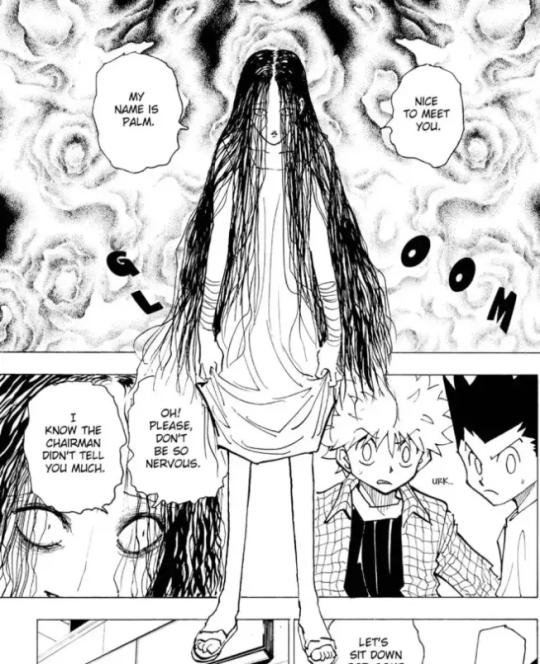
Palm Siberia is a character who has been given several designs and this may be something done willingly. This analysis will try to explore why and, starting from this point and using Palm’s nen powers as a mean to investigate her, will attempt to explain her character.
Here we have Ken Kaneki and Nimura Furuta, the protagonist and antagonist of Tokyo Ghoul. Let’s talk about the connection that these two characters share, and why the story revolves around these two.
As we already know, Kaneki and Furuta have long been built up as mirrors of each other, two sides of the same coin, black and white, vice versa. This connection is formed at the very beginning of the series, where Rize acts as the centre piece who chains these two characters together, forming a noose.
First let’s look at chapter one. From Kaneki’s perspective we have an unsuspecting man who only had the best intentions towards the woman who almost devoured him, which then led to her special organ being forced into him and infecting his body without his say in the matter, changing his life forever.
Then we have Furuta’s perspective, the man hunting down the woman whom he sought vengeance, robbing her of her free will and then ripping out that same organ which now rightfully belonged to him, taking it into his body without hesitation, which was only the first step of his plans.
Already you can see the polarity between Kaneki and Furuta which manifests itself at the beginning of the story.
I don’t need to list all of the parallels between these two characters to get my point across, as these have practically been shoved into the face of the readers several times now. However, the most transparent and defining parallel between these two comes from chapter 101 of :re, where the above image originates from.
In this chapter, Kaneki and Furuta have their first conversation as enemies, with Kaneki now being leader of all ghouls in Tokyo, and Furuta being the soon-to-be leader of the CCG. Two kings, a protagonist and an antagonist who directly oppose each other, two people who suffer from the same complex which ultimately builds up to this inevitable point.
Note that the number “101″ is a very obvious symbolism for the connection shared between Kaneki and Furuta, which is also referenced in the chapter itself. There is a deliberate reference to the movie “101 Dalmations”, which on the surface appears as a simple joke, but also holds other meaning. The dalmation dog breed in particular is distinctively known for its black and white fur, and the number 101 is also symmetrical.
In essence this chapter defines Kaneki and Furuta as two people who aren’t so very different from each other despite the fact that they are directly opposing forces. In this same chapter we are also told Furuta’s motivations for everything which now gives the readers the grand perspective of Furuta’s character, and it turns out that he shares the same complex as Kaneki.
The noose which ties Kaneki and Furuta together by the neck resembles their shared fundamental complex of wanting to be needed by someone. These two characters are narratively the same, with the only difference being that their circumstances in life have been flipped. Kaneki is the one who is loved by many while Furuta is the one who has and always will be alone.
If their circumstances were reversed, they very likely would have ended up in the respective position of the other, as they resemble Yin & Yang.
So what does this mean for them then? Well, this is Kaneki’s story, and with Furuta being the antagonist he represents the shadow of Kaneki. If Kaneki never had those people who cared about him by his side, he would have been the same hopeless and twisted person that Furuta is now.
Rather than seeking vengeance on Furuta for all of the hardships he put him through, Kaneki must reconcile with him and understand him, to expose the inner loneliness that Furuta feels and acknowledge him as a person, and acknowledge that they’re the same.
A’s Death is what stopped K from getting over A which is kind of a
subversion of the classical oedipus motif of the child overcoming the
father by Killing him. The problem is that K would have probably been
better than A if A had lived bcs K may have not felt forced to BECOME
like A bcs that’s what happened: K became the strongest and gave up all
the agency he was set up to have until he was able to really bring a
change only with his defeat, exactly like A himself. The problem of many
TG chr co
is that they try to grow up by either trying to become their parents
(Akira, U, K with A) or trying to avoid become like their parents (M, K
and his mother, Eto). Hwv, growing up means to be able to see one’s
parents as a person and neither a positive nor negative ideal like our
cast does. Back to E, if really her and A were supposed to receive the
same treatment then she should have at least been given a proper Death
scene and not 2 panels in a chapter which was abt K and not her. A’s
given con
several chapters. Plus, during Yomo’s fb we see the motif of the coffee
cup brought up again for the 1st time since the end of TG. It wouldn’t
made sense bring it up again if it’s decided that part of E’s arc is to
be left incomplete, at least imo. F and E’s fight more than a battle of
ideologies seemed to me a battle for the narrative. Up until that point
E’s books and story-telling had been the one predominant in TG, but
after the fight F took her place and the beautiful tragedy E had cont.
envisioned became a grotesque comedy. I think in TG there’re characters
who take upon themselves the role of narrators and story-tellers and are
mostly the ones which move the plot around and who challenge other
characters. E, F are both this and they conveniently use their plots to
avoid facing their personal arcs. E disappears when her tale is
completed and she would have to face personal matters she doesn’t want
to, still she’s still a character and can’t avoid consequences. Meta
anon
Thank you for laying it out so clearly what bothers me about that being Eto’s death. You’ve given me renewed hope that it’s more likely Eto’s alive, especially because if we’re going to deal with Arata in the lab we’re probably going to deal with Yoshimura, and I would think Eto would have to deal with that since that’s unfinished. She’s also connected to V, so if V’s starting to reappear, she may as well.
I also really love how you lay out how Kaneki’s OEK time subverts the traditional narrative of a child doing better than their parents, and I agree if Arima had lived it would have been better–Kaneki’s failure as the OEK is a way of showing us Arima should not have died.
(Meta anon, since I cannot send you asks, what do you make of Naki’s death? Is he dead? If so how does it fit narratively?)
As many people have noticed already, Rize’s line of calling Kaneki a murderer now that he’s killed human beings is a reference to Kaneki’s long held notion that killing ghouls was acceptable, while it was unacceptable to kill humans.
I’ve mentioned this vaguely before but let’s compile this all together in one post for my favorite follower amon 15. Anyway let’s talk about Amon for a second instead of Kaneki.
Amon’s arc is primarily about orphans, or specifically those who are orphaned by the current state of the world. Amon himself is an orphan even before ghouls came into contact with his life, he spent a great deal of time living at an orphanage, and even that small amount of peace came to an end because his caretaker turned out to be a ghoul who specifically victimized other orphans. (That’s Hajime up there for those who still don’t know, more under the cut).




 hamliet