It’s okay! For anyone who doesn’t want to see it, I am tagging my answers, so feel free to block the tag.
Suffice to say, I’m an ardent feminist, and I remember getting in trouble in the cult school I grew up in for arguing with people about this. #futureheretic
Context is my answer here 😉 I don’t want to delve really deep into the theology (though I did study it in one of my classes in college) but interpreting someone’s letter to their friends as being a proclamation for all women at all times is like… not good reading comprehension lol. It was a suggestion for a specific group at a specific time, and there are a lot of really wonderful articles written by woman theologians and scholars out there specifically looking at the context the writer of Corinthians was referring to, and it’s not quite as misogynistic as it sounds.
Which isn’t to say there aren’t misogynistic perspectives in the Bible because there sure are, but it’s also fairly on par for the norm for the time period in which it was written. You can believe the bible is inspired of God while still acknowledging the intent behind certain books (in this case, a letter to friends) and the time period and the fact that it was written by humans.
I think a lot of white American evangelicalism is inclined to say that the word of God is the bible, but they’re actually wrong according to scripture itself. The word is Jesus (John 1:1), not the bible. Which of course doesn’t downplay its importance since it tells us the story of the faith, but all that to say, sure, the word of God is inerrant because it’s Christ. The bible, imo, is inspired, but not inerrant, and saying it is downplays the whole point of the Christ story–Immanuel, God with us, coming to earth as a human and working with humans–and makes the bible out to be a god. When you have people taking 1 Corinthians and being like SHUT UP WOMEN and then you also have, in contrast, the very first proclaimer that Christ rose from the dead being a woman (Mary Magdalene) and they put weight on the first but not the second (because #power), I’m comfortable criticizing that interpretation of scripture.
Uggggh. I mean, I’m not a fan of how bnha treats its female characters and I’ve talked about that before, and how they’re drawn is indeed a part of that. The adult pro hero women all seem to have the same body type (abundant curves) and generally wear very skimpy outfits. Which is fine, nothing wrong with skimpy clothes, but I get skeptical when they’re almost all the exact same.
And then there’s Momo, probably the best written female character imo. I know ppl are like SHE NEEDS TO HAVE LITTLE TO NO CLOTHING FOR HER QUIRK ITS NOT SEXUALIZING as if the author had absolutely no choice in what Momo’s quirk and its rules were. Not the case. He invented those rules and that outfit to titillate the audience. Momo does have the best written mini arc and I would love to see more of her, but sigh.
I don’t mean to condemn Horikoshi either; it’s like hardly unique to him. Media sexualizes female characters in ways it does not sexualize its male characters and it’s rarer that media doesn’t do so. But it is a complaint I do have about BNHA.
Ah, time for one of my favorite princesses and perhaps the most common target of, for lack of a better term, haters. As a film, Cinderella is a surprisingly realistic portrayal of abuse and how abuse survivors cope, as well as an optimistic fairytale.
As a disclaimer, there is room for legitimate criticism of Cinderella and
this is not going to invalidate any valid criticism of her film, but
rather offer a different perspective on her film and specifically on Cinderella as a character.
Cinderella is too girlish! Cinderella waits for a man to save her! Or so the criticisms go. As for the latter, that’s blatantly not true according to the story, and as for the former, well… I’ll quote part of what I said in my Snow White analysis here, adapted for Cinderella:
If you… devalue her based on the strong presence of her
traditionally feminine traits while ignoring her very real and very
present strength[s], perhaps you should be reexamining your own sexism.
As for Cinderella herself, her defining traits are not that she cooks and cleans–she sings as she does so, but she also doesn’t voluntarily do any of it, unlike Snow White. She does however do almost everything out of compassion both for others and for herself. Why compassion is seen as a feminine trait is honestly another discussion all together and it’s disturbing that this does appear to be a common assumption. Compassion is good. The answer isn’t to not emphasize compassion in a female character (who, by nature of existing in a fairy tale for children, is going to be a relatively simple character), but rather emphasize it for male characters as well. Cinderella (1950) does also play with gender roles several times, notably with Lady Tremaine (the wicked stepmother) and with the Grand Duke.
This film goes out of its way to highlight Cinderella’s compassion as the trait that is most beautiful about her, though it’s certainly a valid criticism that the stepsisters are noted to be “awkward” (the film never uses the word “ugly”) and Lady Tremaine is noted to be jealous of Cinderella’s beauty–but also her charm, aka her personality.
It’s noted that Cinderella’s father married Lady Tremaine only because he felt his daughter “needed a mother’s care.” In other words, the man’s own insecurity and belief that he wasn’t enough led to him marrying the woman who would later abuse Cinderella. In other words, because he didn’t think he could be enough of a feminine influence on her, she wound up being abused. Damn you sensitive masculinity.
But it’s also notable that the father is noted to love his child very much, and that compassion is clearly very important to Cinderella’s journey. Under her father’s care, the chateau she grows up in is noted to be beautiful, but once he dies Lady Tremaine “squanders” the fortune on her daughter’s “vain and selfish” interests, letting the chateau fall into disrepair. The chateau can be seen as symbolic of Cinderella herself in some ways, but also of Lady Tremaine–the more energy and time she spends on her selfish jealousy, the more she doesn’t realize that her inner beauty is falling into disrepair.
Cinderella’s got a backbone. The girl is not a pushover even when she’s being ordered around. Starting from her very first proper scene, wherein she teases the birds for waking her up and tries to stay asleep. But she can’t, because she’s got to face the world, which is not as kind to her. She grouses at the clock, complaining that “even he orders me around.“ When Anastasia and Drizella accuse her of deliberately putting a mouse in her cup, she starts the conversation with her stepmother with “oh please, you don’t think that I–” She tells them “I’m still a member of the family.” She is smart. She is polite to her abusers, yes (often, unfortunately, that’s realistic and a survival strategy) and even kind to Lucifer, the privileged fat cat (and the best character). And yet Cinderella doesn’t take Lucifer’s bullshit, sarcastically telling him “I’m sorry if Your Highness objects to an early breakfast.” She has spunk.
However, Cinderella is also naive and prone to losing herself in dreams. Dreams are coded as positive in Cinderella, but also as something that doesn’t suffice as a long-term solution. Instead, dreams are tools that help you escape. For example, the Fairy Godmother’s illusion is basically a waking dream that enables her to reach her escape. But the Fairy Godmother also warns her the dream comes with a time limit, and she needs to pay heed to it (and almost doesn’t): “But like all dreams, it can’t last forever.” The next morning, Cinderella again loses herself to her daydreams, humming and singing and so lost in her dreams that she doesn’t hear her animal friends trying to warn her that Lady Tremaine is about to lock her in the tower. Which she does.
Yet without dreams, Cinderella could not have survived the years leading up to her dream becoming a reality for a few hours. As she directly states, while Lady Tremaine can take almost everything from her, no one can order her to stop dreaming. While Cinderella is trapped in an abusive situation, she desperately wants to leave, and she believes she will escape some day. A dream, for Cinderella, is escapism, because she can at least be free from something the film itself directly calls “abuse” and “humiliation.” Dreams are not silly; speaking as an abuse survivor myself, sometimes that’s all you have. In her song “A Dream is a Wish Your Heart Makes,” she sings:
In dreams you will lose your heartache
Whatever you wish for you keep
Have faith in your dreams and someday
Your rainbow will come smiling through
No matter how your heart is grieving
If you keep on believing
The dream that you wish will come true.
Is it simplified? Sure. But that’s a beautiful message to give kids suffering. And given the dual coding of dreams as being something you cannot lose yourself in either, it gives a practical message of acting on your dreams as well.
Cinderella’s compassion is primarily shown through her treatment of the pesky animals, the ones that disgust her stepsisters (like mostly mice, but also birds and Bruno, the dog whom Cinderella warns the stepmother wants to kick out). But she encourages the mice to be smart and Bruno to learn to like cats (aka Lucifer) if only for practical reasons (because they’ll throw him out otherwise). I think this reveals a good deal of Cinderella’s mindset: that she does what they want her to do because she wants to survive. She wants a warm bed and food, and running away all on her own would ensure she’d lose that. Abuse victims do genuinely weigh their options like this, and choosing to stay (especially as a dependent, like Cinderella is) is not something that should be condemned.
The moment Cinderella hears that a mouse (GusGus) is in the rat trap, she stops what she’s doing and rushes down the stairs. In other words, while she can’t yet escape, she’ll be damned if she’ll let someone else suffer abuse in a trap they can’t leave. Not only that, but GusGus is terrified and Cinderella notes as such, and asks for someone who better understands (Jack) to talk to him, and even though GusGus is aggressive at first, Jack’s insistence that they like him and Cinderella likes him coaxes him out of the cage. In other words, compassion and kindness enable him to make a courageous choice and leave the cage.
GusGus is the opposite of Cinderella in some ways: he directly wants to challenge Lucifer until Jack begs him not to. He wants to fight, but practically speaking, it’s just stupid for a mouse to go up against a cat, and Cinderella too lacks the means to go up against her stepfamily. It’s a realistic portray of abuse. GusGus also repeatedly makes naive choices, but in contrast to Cinderella, he tends to be more active (taking risks that aren’t exactly the wisest). For example he gets attacked by the more powerful chickens in a quest for food and they steal his food (it’s foreshadowing to the later scene where the stepsisters will tear Cinderella’s dress from her), but Cinderella intervenes and she gives a downtrodden mouse some food.
Like Snow White, Cinderella’s kindness is rewarded, in that the mice and birds are genuine friends to her (it’s a kids movie don’t take it too literally). They help her make her bed, shower, etc. in the morning, and they then make her dress for her when she doesn’t have time to do it herself. And again, there is a realistic portrayal of abuse in that the stepmother dangles a false hope/dream in front of Cinderella: finish all your chores and get something nice to wear, and you can come–but she fully intends to never let Cinderella come by giving her extra chores.
Despite being a fairytale, in Cinderella, compassion is not always rewarded by things working out. The stepsisters are not just jealous of Cinderella’s looks and her own compassion, but the compassion given to her. They don’t want the beads or the sash, but Lady Tremaine manipulates them into tearing them from Cinderella. Again, it’s realistic to abuse, because parents will often mobilize and manipulate other children to target one.
This is Cinderella’s nadir, in which she sobs, “It’s no use. No use at all. I can’t believe. Not anymore. There’s nothing left to believe in. Nothing,” That’s pretty dark for a kid’s movie, but honestly… don’t we all know that feeling? I certainly do. Cinderella’s arc is about learning to be courageous and take steps in that courage, and this is the moment all of it deserts her, because the one thing she has that connects her to others–compassion–appears to have all been for naught.
What gives Cinderella the push of courage she needs to leave the chateau? The compassion of the fairy godmother. And the fairy godmother makes the ordinary things, the despised things like mice and Bruno (an old dog at risk of being thrown out) into magical things, again reinforcing the theme that the ordinary can be extraordinary, and that the real magic is in the compassion and love she shares with her friends (who are animals because it’s a kid’s fantasy movie). In the end, though the dress they made for her was destroyed, she still couldn’t get to the ball without her friends.
So Cinderella is off to the ball, and that’s when she will meet the prince–who is having to deal with his own issues. The Grand Duke is not nearly so abusively coded as Lady Tremaine, but he is kind of unreasonable and threatening towards his vizier. He also plays with gender roles in that he is the father begging his son to marry and make babies because he wants to hear the little feet of his grandchild. He literally dreams about it, and again shows the potential danger of becoming too attached to dreams in that he’s not very nice and is pretty controlling in his wishes to make dreams happen (aka, there’s not a ton of compassion). That being said he’s coded comically and does want his son to genuinely fall in love. Also of note: usually the nagging parent desperate for grandkids in fiction is a mother, not a father.
At the ball, the Prince’s sees Cinderella wandering around, lost and out of place, and goes to comfort her. His compassion leads him to her.
they share a song together, which is Disney/musical theatre code switching for “romantic/sexual love.” Generally speaking, the big waltz that Disney’s romantic duos share at the end of the movie is their act of sexual consummation—sex without sex on Disney terms
Again, it is not sexual. It just conveys the same emotional meaning for the characters as sex would in a romcom. It’s a fairytale for kids so of course they fell in love in a few hours–that isn’t meant to be a recipe for real life love advice. She also doesn’t know he is the prince and says as much when she leaves, telling him “I haven’t even met the prince yet!” as an excuse to run. In other words, contrary to the common narrative that she went out looking for a man to save her, she did not. She went out looking to have a good time and happened to find a man.
The song they sing is “So This is Love” and includes the lyrics “My heart has wings/and I can fly.” Because Cinderella–she’s free now. And throughout the rest of the film, she is free. The guards try to stop her as she flees under the time restriction but she makes it through the palace’s gates. No one and nothing–not the royal guards, not the chateau she grew up in, not the cruelty of her stepmother and stepsisters–can hold her back now. Even though she does go back to the chateau as many abuse victims do, her compassion has enabled her to make connections that will have set her free, and she will run to physical freedom soon enough.
Her stepmother realizes it too: once Cinderella hears the man she was dancing with was the prince, she drops the trays (symbolic of her servanthood, as she’s repeatedly shown carrying those trays) in shock, and as Anastasia and Drizella threw clothes and orders at her to help them get dress, she dreamily shoves them back into their arms and goes to get dressed herself instead.
When the stepmother locks her in the room, it’s the mice who face off with Lucifer, but this time not for mere food, but for their friend, and they free her. The mice dive straight into the teacups to get the key from Lady Tremaine, which is also a callback to an earlier scene in which GusGus was trapped in a teacup to hide from Lucifer.
The man is also about to give up and is distraught when Cinderella is finally freed but Lady Tremaine smashes the slipper. But Cinderella pulls out another slipper, again showing herself capable of helping other people scared of people in power over them. Her compassion saves her, and saves others around her. When Cinderella gets married the mice and old horse and Bruno, who all played a role in freeing her from Lady Tremaine and also escorted her to the ball, are celebrating with her. Because Cinderella’s story is meant to give hope to the people in her story, and to the audience.
A dream cannot save you, but it can give you a chance to escape by giving you the hope you need. Compassion and courage is what will save you. I think that’s a beautiful message within Cinderella.
Thanks for reading! Up next, Princess Aurora from Sleeping Beauty–which was one of my favorite movies as a kid. For previous entries in this series, see here:
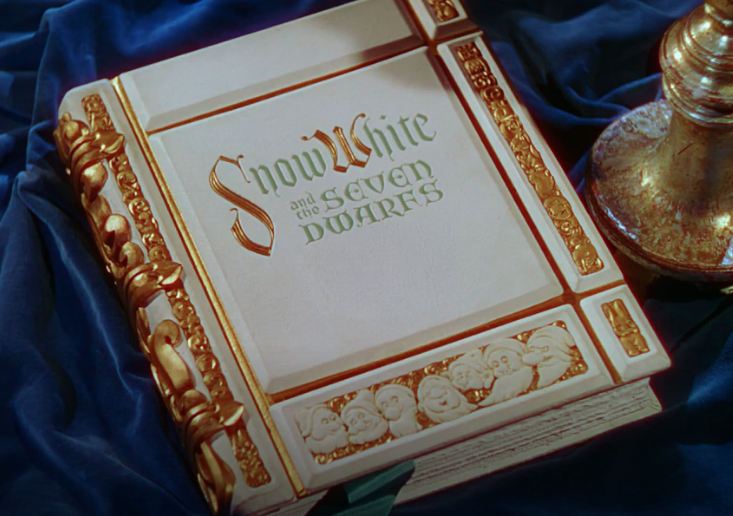
You know all the hot takes about how Snow White is everything wrong with Disney Princesses? Well, what if I told you the film makes it explicitly clear she saves herself with her belief in her own worth and her willingness to grow?
I’m finally getting around to something I talked about months ago: defending Disney Princesses as characters with a lot to offer besides poofy dresses and songs that will never leave your head. I’ll be writing a post for every princess, probably going in chronological order by film release year. I also plan to do a couple movies where the characters aren’t official Disney Princesses, but are so in my heart (Esmeralda, Megara, maybe Jane?), and I’m probably not going to do Merida, because she’s the only princess whose movie I don’t particularly enjoy.
There are plenty of legitimate criticism of Snow White and the Seven Dwarves. It’s very 1930s in terms of its view of women and portrays Snow White happy to cook and clean and take care of men. That’s a legitimate critique and this is not going to invalidate any valid criticism of her film, but rather offer a different perspective on her film, and specifically on Snow White as a character. She’s not an exceptionally complex female character, but I think she’s a good one who works excellently in the story she’s in. She does indeed have an arc–one of growing up. If you evaluate her and devalue her based on the strong presence of her traditionally feminine traits while ignoring her very real and very present strength, perhaps you should be reexamining your own sexism.
I’m going to reference this excellent article on Snow White several times in this meta; I highly encourage you to check it out! I found it after my rewatch and was excited because it talks about some of the same things I plan to talk about.
So let’s dissect this film and Snow White’s character.
At the start of the story Snow White is dependent on the queen.
She’s her stepdaughter and despite being a future ruler and displaying many competent traits of a leader, she is not yet mature enough for to be a leader. The story traces her maturation, and throughout her arc, one trait stands out: Snow White has a healthy sense of self-worth, a far cry from an insecure girl waiting for a prince to save her.
When the Queen asks that famous question–“Mirror, Mirror, on the wall, who is the fairest of them all?” and the Mirror tells her it’s Snow White, the Mirror also adds “rags cannot hide her gentle grace; alas, she is more fair than thee." He then does cite Snow White’s physical traits, but grace itself may not be just physical (as it is not in the original fairy tale). Snow White’s beauty comes from within, and the Queen has absolutely none of that. Her stepmother’s jealousy can also be seen as stemming from her dislike of Snow White’s internal beauty. Snow White is a mirror that exposes her flaws.
It’s not her physical beauty that’s so much the issue (as the Queen’s willingness to sacrifice her physical beauty in the end so long as she gets to poison Snow White reveals): it’s that Snow White never doubts who she is and her own value despite the Queen doing everything to take it from her, ordering a princess to be a scullery maid. In other words it’s the Queen’s own insecurity that dooms her, and Snow White’s self-confidence that saves her.
Pan to Snow White. She sings "I’m Wishing” for someone to come and save her. One line is “I’m dreaming of the nice things he’ll say!” So basically, Snow White knows she deserves better than the way she’s being treated now, even though she’s making the best of it. She wants someone to be nice to her. That’s actually a fairly healthy attitude, and she’s not the first abused kid to want someone to save her. The thing is? The Prince does not take her away from this abusive situation. Snow White takes herself away from it.
The Prince apologizes for scaring her and then waits for her outside, below her window. They share a song, and at the end of the song, a dove, a symbol of purity, kisses Snow White on the lips, flies to the prince, and then kisses the prince on the lips.
As the article I mentioned earlier states:
they share a song together, which is Disney/musical theatre code switching for “romantic/sexual love.” Generally speaking, the big waltz that Disney’s romantic duos share at the end of the movie is their act of sexual consummation—sex without sex on Disney terms
In a fairytale, this is the equivalent of the sex scene in a romcom. (I’m not arguing it’s sexual; it isn’t. It just conveys the same emotional meaning for the characters.)
(As for the criticism that Snow White and the Prince fell in love in one day… it’s a fairy tale, aka a simplified story made to encourage kids. It’s not meant to be a life rule book showing kids how to live and what to expect in life; it’s meant to encourage them, to teach that the world can be good and suffering doesn’t have to define your life which given that this was made as the US started to emerge from the devastation of the Great Depression might have been relevant to people’s lives. I’m not going to delve into a historical criticism but suffice to say a story is going to address the needs and questions of its age. There’s a reason Elsa tells Anna you can’t marry a guy you just met in a film made in 2013 vs a fairy tale made in 1937. But along those same lines, if a story remains popular with young kids after 80+ years I’m going to suggest it has something else to offer kids besides pretty dress kiss with a boy at the end. Like, for example, a message of hope that most fairy tales intrinsically have.)
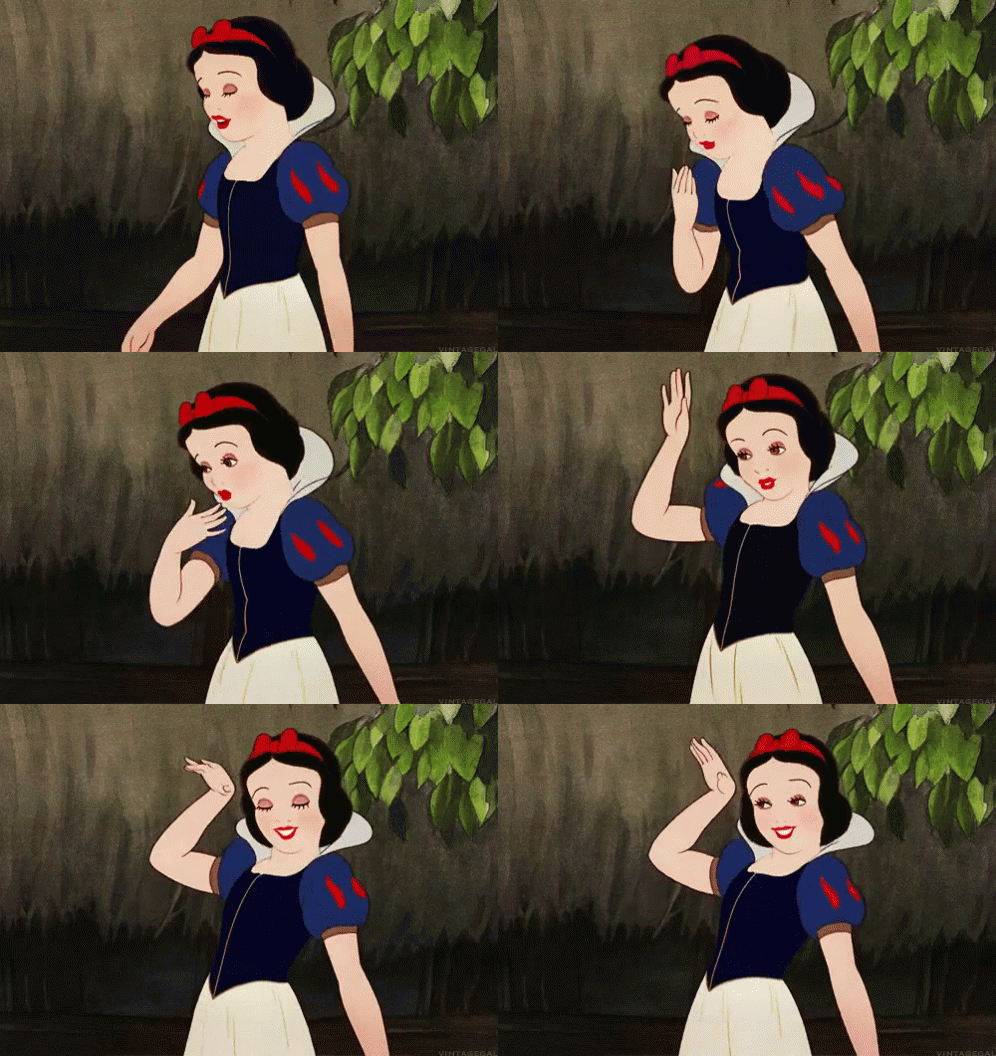
In order to kill Snow White, the queen commands the hunter take her to a place where she can pick wildflowers. This is kind of a Thing with Snow White. She finds beauty in the things around her, as the article says. That’s been consistent since her introduction where she’s scrubbing the stairs, sighs, and then gets up and sings about wishes and daydreams. I don’t think it’s a bad thing to encourage someone to find beauty/worth in the things around them, or to dream, because Snow White pretty clearly also sees herself as having worth.
While out with the hunter, she finds a baby bird crying. The bird has lost its parents and is symbolically a lost child, aka Snow White herself, looking for the people to make it safe. And she reaches out. Her kindness, her compassion for a lost bird (aka her self-compassion which she extends outward) enables the bird to fly away to safety, and is what prevents the hunter from killing her.
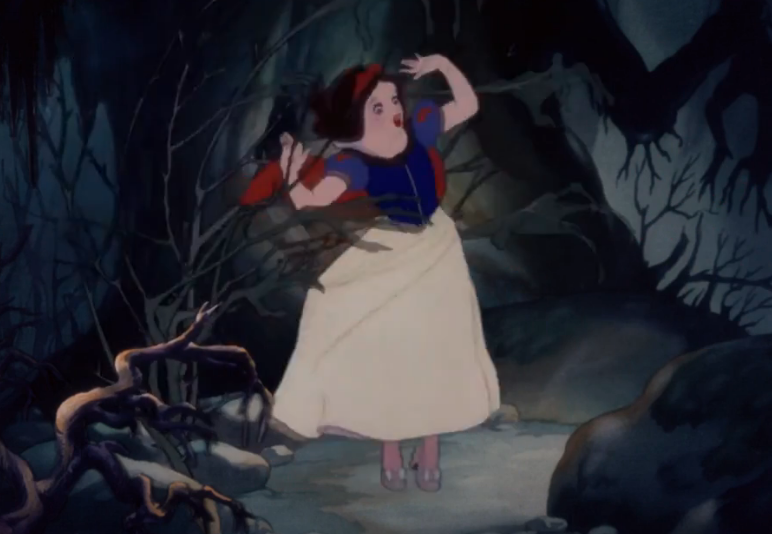
She’s naive but not stupid. At the warning from the huntsman, she doesn’t insist he’s wrong. She runs. She runs into a forest where everything is ugly and the branches transform into hands grasping at her, symbolic of how the best she was trying to make of her world has now been shattered, and ugliness has entered.
I think she’s earned a good cry. But all the eyes that were so terrifying to her turn out to be woodland animals, not terrifying monsters, and they come to her to check if she’s okay. The ugliness was an illusion created by fear. She frightens them when she sits up but assures them she won’t hurt them and tells them how she’s been afraid and befriends them all. Basically, this is showing that sometimes even though the world looks terrifying, it looks that way because of the fear inside you; there is still good in the world. And acknowledging fear is not a bad thing inherently, though she does then denigrate it a bit.
The song she sings is “With a Smile and a Song,” and some of the lyrics go:
There’s no use in grumbling When the raindrops come tumbling Remember, you’re the one Who can fill the world with sunshine
I mean, I think grumbling is just fine. But the statement that “you’re the one/who can fill the world with sunshine” again reveals what Snow White thinks of herself. She does not think of herself as someone who is worthless, a bad person, despite what her stepmother has done for her. Snow White has good self-esteem.
When Snow White goes into the dwarves’ house, she worries they have no mother (before she meets them) as she herself has no mother (again with the self-compassion directed outwards), and asks the animals to help her clean. She doesn’t do all the work on her own, in contrast to common criticism. She delegates, like a good leader. Also of note? She’s not the only character in the story who takes joy in her work and sings in it. The dwarves do as well, and they’re male.
The dwarves are also much more worldly-wise: they are nervous and fear Snow White is a monster when they discover her in their house. In other words, while Snow White has much to teach them about… cleanliness, but specifically also beauty in the world, they have to teach her about how to be an adult about it. Wise as a serpent but innocent as a dove, really. The dwarves have the wisdom but not as much of the innocence as they could have, and Snow White has the innocence but not all the wisdom she needs to grow into a woman and therefore truly escape her stepmother’s control. The dwarves know that the Queen is evil from the moment Snow White mentions her, though Snow White naively insists the Queen will never find her in their house. And then the dwarves will warn her not to let anyone in the house. But she does. Sigh.
It’s also worth mentioning that when the dwarves try to send Snow White away, she begs them not to, telling them that the queen will kill her–she is naive, but not ignorant, and values her own life. Snow White also negotiates being able to stay in exchange for cooking–essentially, she’s again redeeming the abuse she suffered by using the skills she gained from her abuse to survive. Yes, she seems to enjoy cooking and cleaning and looking after people. It’s still a skill we were explicitly told the queen forced her to learn as a scullery maid.
Snow White and the dwarves’ relationship is great. She is motherly, yes. She’s firm and not a pushover, proving that her sense of self worth does not stem from her ability to do these things. It’s also yet another example of her looking at the good in people and focusing on that rather than on evil. She knows she can accomplish good in the world, even banished to a cabin and away from the throne. She has confidence in this and exercises it. She’s the one who can fill the world with sunshine, and she knows it, and she’s also confident enough in who she is to learn and grow. It’s not as if Snow White has no insecurities–she does, as shown when she prays for her dreams to come true “and please make Grumpy like me” to God. She does want to be liked. She just doesn’t take her hurt over people not liking her out on others.
So let’s discuss “Someday My Prince Will Come,” the song that’s always taken out of context. Snow White isn’t talking about some hypothetical rando. She’s talking about someone she’s met and already fallen in love with. Idk I think when you’re forced to run away and thus can’t be with someone you love because someone is out to get you for a trait you’re born with, hoping that they will find you is rather understandable. Perhaps even, dare I say it, admirable. As the article says:
She isn’t sighing, passively hoping that some nameless, faceless “Prince” will appear and whisk her away. She’s not just waiting for a man to rescue her. She is fantasizing about her prince, her love, the man she already knows and adores, making good on the implied promise of their song and marrying her. It’s cheesy, but it’s a lovesick fantasy, as so many lovesick fantasies are.
Snow White still has faith in her loved ones to treat her well despite being treated terribly by someone who should love her. Basically this is a simplified version of Sansa and Cersei’s struggle in Game of Thrones, but told to be appropriate for kids. The good aspects of Snow White’s innocence are present here. Despite being betrayed by her stepmother, she still has faith in people who claim to love her.
In contrast, we have a return to a smug Queen. She realizes she’s been tricked with a pig’s heart and in a scene paralleling Snow White’s run into the forest, where she’s forced into a world with some ugliness to it, the queen literally makes her own descent into the horrific ugliness of the palace dungeons.
She climbs down a spiral staircase and the beady eyes of menacing rats watch her, but she’s not scared. She scares the raven in her study, as opposed to befriending creatures like her stepdaughter. The queen is naive like Snow White in some ways, but she doesn’t have the confidence to save her. Her fury that she’s been naive enough to be deceived causes her to rely only on herself, in contrast to Snow White’s good leadership via delegation. She declares “I’ll go to the cottage myself,” and she gives up the thing she’s been supposedly so jealous of Snow White for–her beauty–just to be able to kill the girl who points out all her flaws. Being the extra witch she is, she demands that the wind make her hate stronger. She revels in hate and in jealousy and ugly things.
Hence, why she makes a poison apple. It’s a symbol of who the Queen is. As she even says to Snow White, it’s a most beautiful apple, but it’s really poisoned. And she knows Snow White will be alone and will help “a harmless old peddler woman.” She uses Snow White’s insecurities–her desire to be liked–and her strengths–her ability to find beauty in everything, and specifically not physical beauty which Snow White has never shown any preference for as well as her desire to help the abused (as the queen is attacked by birds who know what she’s going to do), and her hopes for a better future (the queen tells her it’s a wishing apple “to make all your dreams come true”)–to convince her into letting her into the house and then taking a bite of the apple. Abusers do indeed prey on their victim’s insecurities and strengths, twisting them to serve their own purposes.
It’s explicitly not Snow White’s fault. But her naivete has consequences, and she can only be woken up by true love’s first kiss (are married ppl screwed), aka an adolescent symbol. Snow White is leaving her childhood naivete behind and growing up. As for the “He kisses her without her consent!” argument–like I do get it, don’t kiss an unconscious person, but that’s simply an incorrect understanding of the film in context. They’re in a relationship by fairytale film genre standards, and it was also going to save her life. That’s a seriously out of context argument. Snow White’s not getting buried because of her beauty is also a symbol again for how Snow White’s philosophy–being the sunshine–lingers even in the darkest of situations, like death, and is greater than herself, but also springs from herself. Like, the sun literally shines on her casket alone.
And her happy ending gives hope to her subjects (the forest animals) and is supposed to give hope to the audience as well.
And oh look, her happy ending–the castle they go off to live in–literally emanates from the sun too, a callback to the line from “With a Smile and a Song” about how you are the one who can fill the world with sunshine. Snow White created her own happy ending.
As for the queen, she climbs with difficulty a mountain (symbolic again and a contrast to her descent earlier) and tries to wrestle with a boulder in the middle of a storm–a callback to her request that the wind and thunder strengthen her hatred earlier in the film. She dies because of her own insecurity, because of the hatred she asked for. It’s tragic.
So in conclusion:
Snow White is an abuse victim who decided to still appreciate the beauty in the world and wound up saving herself and inspiring people along the way. Legend. It’s her sense of self-worth and confidence that is precisely what makes her such a good fairy tale female character.
^^me to opinions chalking Snow White up to a weak-willed girl with no sense of self-worth except for a man. She earned her trophy husband, who, for the record, is not really any less developed than half the girlfriends of superheroes.
I will be looking at Cinderella next! It may not be up for about a week since I’m rewatching the movies to analyze them, and that will take time. Thank you for reading this, and feel free to let me know your thoughts!
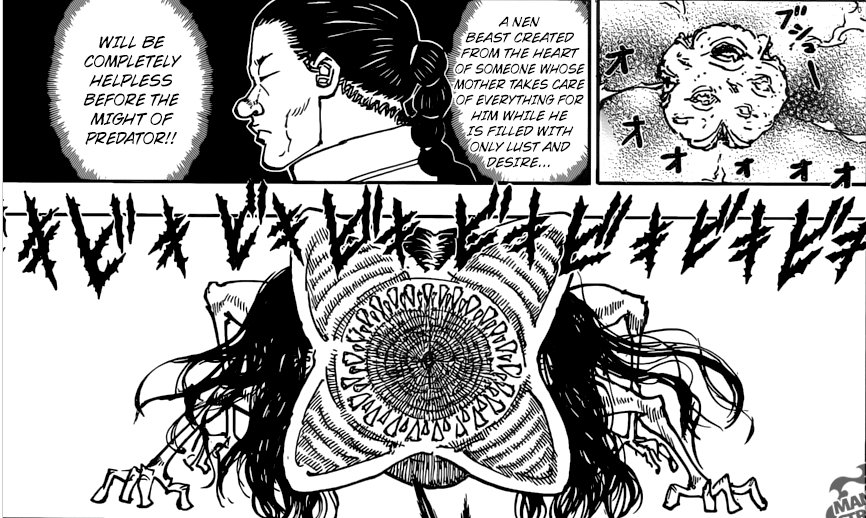
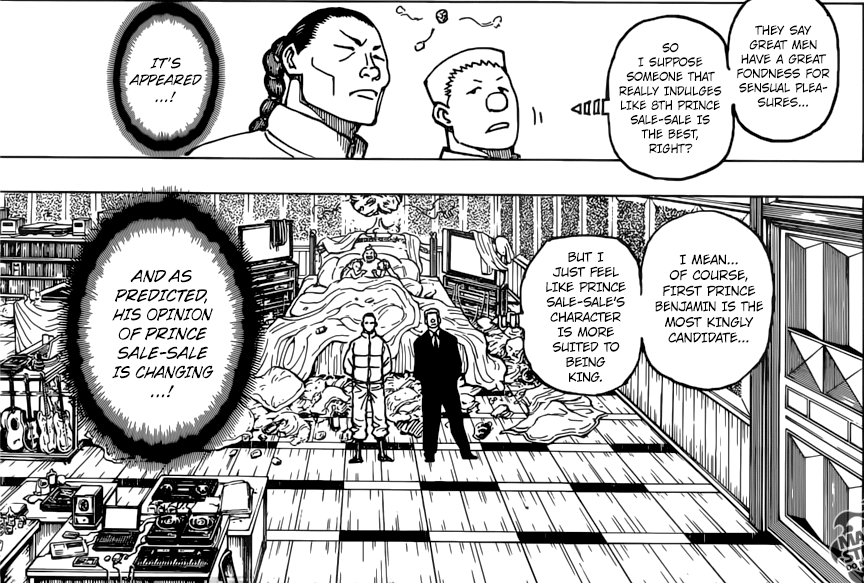
But in actuality it kind of is fitting that predator takes on a yonic appearance here. Sale-Sale is a womanizer, and this entire arc has undertones of male chauvinism in that Nasubi has eight wives, Tserriednich is quite frankly a sexual predator, etc., and our MC Kurapika is helping a single mom with a baby girl. Therefore it works that predator takes on the appearance of something that the men in this arc are, well, seeking to prey on, and turns it around to fight back against them: their chauvinism is going to destroy them. (Yes, I know Benjamin is the one targeting Sale-Sale but the thematic points still stand,)
Sale-Sale loses his nen beast, and as is observed, he’s likely going to die swiftly thereafter, possibly off-screen before the next chapter.
It’s also noted that Sale-Sale expects his mother to do everything for him so he can do as he likes (particularly sexually).
Speaking of Sale-Sale’s nen beast, going off of @aspoonofsugar‘s theory that the nen beasts represent that subconcious desires of the princes, Sale-Sale’s nen beast’s design hints that he wants to consume but also wants to be admired, and also that he has no particular substance to him. It’s a shapeless creature with so many mouths on it, and its ability moves the hearts of people to like him, to want to be him, as is observed.
But when Predator takes the nen beast down, everyone is left wondering what on earth they were thinking in admiring him: because there’s nothing to really admire. There’s no substance; there are only desires themselves.
And so the prince who wants to consume is not even going to live to the banquet in all likelihood.
And then let’s go back to part 1, because it has a less flashier subtitle, where Melody deals with Fugetsu and Kacho. At least someone thinks killing kids is bad.
But Kacho and Fugetsu’s sisterly relationship really contrasts with the other sibling relationships we’ve seen among the princes. Tserriednich and Benjamin as well as Camilla and Halkenburg have pretty antagonistic relationships with each other, whereas Fugetsu and Kacho really just want to save each other’s lives, but because of their asshole father, they’re instead supposed to kill each other.
Instead of traveling to a new land as part of a fun game, they’re being forced to travel to a new continent as part of a killing game. It’s really just tragic all around and if anything happens to either of them I’m gonna die with them.
Also: what is foreshadowing, I sincerely doubt anyone in this arc will win what they want by killing anyone (not that I don’t think many princes and Spiders are going to die; I definitely do) but my guess is what will get our main cast out of dodge is an alliance, not striking down everyone around you.
Going off the notion that I’m defining feminism as “the radical notion that women are people” yes I’d say so. Like, honestly that’s what feminism is for me: just the idea that women are as fully human as men are.
So, Monster has a cast with two female main characters (Nina/Anna and Eva) who are just as complex and interesting, motivated by their own goals and flawed, as the male characters. There are other female characters as well who impact the story and have important roles and are women of color, like the immigrant doctor, who are also wonderful and complex (though they aren’t main characters which I think could be critiqued). Also, Eva gets a redemption arc–at first when reading I thought she was a stereotype of the jilted lover bitter woman and was annoyed by her, but Urasawa deconstructs that assumption and she gets an amazing, satisfying redemption arc (which like never happens; female characters are usually forbidden redemption). Nina/Anna and Eva are not there for fanservice/the male gaze, and there’s literally like. None of that.
Anyways, of all the mangas I’ve read, it’s probably the one I’d say I was most satisfied with the portrayal of female characters in, so.
I mean tbh I would caution about blaming fujoshis though I definitely see that a lot, like with Hidekane shippers hating on Touka, etc. But like I also see people hating on Lizzie Midford in Black Butler just because she’s girly (like, that’s. Very. Misogynist). I see Mikasa hate from Erekuri and Ereani shippers just as much as I see it from Eremin or Ereri shippers, so I think it’s more just people reducing Mikasa to her flaw than anything else–perhaps motivated by shipping but not necessarily because of fujoshi fetishism (also it’s fine not to like Eremika as a ship; I get why people don’t and why Mikasa’s flaw might turn people off to it, but putting her down to promote a ship is ugh). In Noragami people hate Nora just because she’s a well written female antagonist and one of the best written characters in that series (and if her and Yukine’s roles were genderswapped–if Nora was a guy, an abused child antagonist kissing a girl!Yukine with hope of manipulating but then girl!Yukine developed a crush on him, let’s be honest: the fandom would eat that for breakfast lunch and dinner; it’d be a god-tier ship). I hope she gets some kind of redemption.
Like let’s be real: name me a female character who has gotten a well written redemption arc in any media. Eva in Monster (best one I’ve read by a long shot), Touka in the first TG, I have hope for Gabi and Annie in SnK, and then it’s basically nonexistent.
I feel like society has a problem in that it encourages everyone to empathize with male characters, but not with female characters, from the very beginning. Female characters are more often than not plot devices used as rewards for the men (most Marvel films) or to fix the man with her love rather than be a complete person on her own, and so even when they are portrayed as complete complex people, fans are more societally conditioned to hate them for their flaws or reduce them to them rather than empathize like they do with male characters. Like, it’s really sad that if a story had to have well written female characters, or even female characters just on par with the male characters in terms of development, I would be able to enjoy next to no movies, shows, animes, mangas, books, etc.
Sorry for the rant, lol. I have… a lot of feelings on this.
Oh, the portrayal is not offensive by any means and I want to clarify I didn’t mean to imply that! It just leaves something to be desired; that’s what I meant. It’s pretty on par for most media standards I think? Mineta as comic relief, and the fact that all the pro hero females have the exact same body type (thick thighs, big prominently drawn boobs) is… mrrrrr for me as a woman who therefore kind of likes to see females portrayed complexly. While many shonens have done way worse, you’re absolutely right, many other shonens have done much better, as well. SnK and HxH both have fantastic female casts, for example, even though proportional to the men HxH is lacking. Just, compared to the male characters the female ones don’t have the same complexity, and Uraraka’s defining trait currently is future love interest, despite having the set up for a complex arc with her motives to be a hero. I do think she’ll get a good arc like Iida did (and Uraraka is one of my favorites regardless because of that delicious potential), but it’s not really what she could have in comparison to, say, female love interests who have their own long-running arcs like Mikasa Ackerman, Touka Kirishima, Komugi, Lizzie Midford, etc. I have very much enjoyed Jirou and Momo’s mini arcs, though, and think that the fanservice is probably a victim of editorial issues. The female characters aren’t bad and it doesn’t ruin my enjoyment of the series in any way, but they’re just not a strong selling point of the series.
Ahaha… okay. So to begin I’ll say that I’ll briefly discuss each of these series, and that I define a good female character as just a character. I do not like it when common culture seems to assume that a good female character must be kickass and cold–aka traditionally masculine. Show me the feminine girls, too. Show me the masculine ones. Show me the ones who really want marriage and kids and those who prefer their careers. Just, show me that they are people.
SnK
Let’s start with SnK, as of these four I’d say it’s the best with 1) consistent representation, 2) complex characters, and 3) not reducing them to stereotypes.
In SnK, Mikasa, Annie, Gabi, Ymir, and Historia are all complex female characters never defined by their gender. Sasha and Hitch are not as complex, as they are side characters, but they’re both really well done side characters. I’ll briefly discuss each of them.
My biggest complaint about the female characters in SnK is actually a minor complaint just about Mikasa, in that I think as the female deuteragonist she deserves more focus. That being said, she’s developed really well throughout the story, and I don’t agree with claims that she has not developed. She’s developed as much as Armin has. She could fall into the badass stereotype, but she avoids that because she has a kind, caring, and extremely vulnerable side. Her devotion to Eren is clearly framed as a beautiful thing–but also as a flaw, one that is holding her back and one that can lead her into a really bad place.
Mikasa is a very well done female character. She is about so much more than just Eren–she carries the themes of living beautifully in a cruel world, the struggle to let go of loved ones, and the struggle to remember the loved ones you’ve lost.
Annie, too, could be considered a stereotypical badass who is cold to boot, but we see that she’s not always cold, as she’s kind to Armin. Her coldness she uses as a shield to protect her own shame over not being able to speak out.
That’s realistic. That’s flawed, and that’s human.
Gabi is literally female Eren, Ymir and Historia were a canon lesbian relationship that was never sexualized, and Historia’s decision to use herself to bear children is clearly framed as BAD. She’s miserable. Sasha has a beautiful mini-arc, and Hitch does as well. The men who tried to make it seem like Hitch was just a flighty girl using sex to get into the Military Police–we see that she is also a very caring, kind person who worries deeply over Annie, her friend, and Marlowe, her crush. Essentially: none of these women are defined by their romantic relationships or how well they fit into stereotypes for female characters.
HxH
Yes, I’m putting HxH second. My major complaint–and it is major–is that until Yorknew, we don’t have any female characters of substance. But, I do think that all the female characters thereafter are done really, really well. Additionally? Many of them are not traditionally beautiful.
Pakunoda is the first one with an arc, and while her arc does concern her sacrificing herself for Chrollo, it’s not romantic, and male characters in the Phantom Troupe (Nobunaga for example) also rely on Chrollo too much, despite the fact that Chrollo doesn’t really think he has worth to them. But we see her arc as a deliberate choice she makes.
The other female characters of note presented here are Machi and Melody. Melody in particular is an excellent character and a good friend not afraid to point out Kurapika’s selfishness.
Biscuit Krueger is the mentor of Gon and Killua, and while she doesn’t have her own arc per se, mentor figures usually don’t. Characters who often mistake her for a young girl who they can dismiss suffer for it.
And then the Chimera Ant Arc, Election Arc, and Dark Continent Arc present us with many great female characters. Komugi is a disabled girl, but she is never defined by her disability nor her gender. She is physically weak, and vulnerable as she has no sense of self-worth. She gets a love story, and it is beautifully done in that she is clearly not shown as saving Meruem, but shown as helping open his eyes just by being herself, vulnerabilities and all.
And Palm. Palm. She’s like, the best female character ever. @aspoonofsugar wrote a meta on her here. At the beginning we think she’s a crazy yandere, and she is in love with love, but her entire arc is a refutation of the men who would try to pinpoint her as a yandere or a sex object, as Bizeff treats her and as her own allies think she’ll copulate with the king, when in reality Palm is never defined by that. By the end of the arc, she’s grown the most of anyone. Her love is not told it’s silly and needs to be discarded, but rather transformed through her own decisions into something beautiful rather than toxic.
Alluka Zoldyck is transgender and great representation. She’s complex and while I wouldn’t say she has an arc quite yet, she probably will, and her family’s objectification of her and shame about her is clearly condemned.
Oito is a single mother who is also not defined by her status as a mother or as a queen, and I’m very excited for where Oito’s arc is going to go.
TG
If this were the first TG alone I would rank it higher than SnK but because the ending for :re was literally that bad for female characters I rank it pretty low. However, one good thing I will say is that it was not shy about showing female sexuality and celebrated it rather than condemning it.
But, for real, all the women who survive and end up happy in the ending were, at the end of their arcs with the exception of Hakatori (a minor character) defining themselves by their relationship to men. And many of them weren’t lucky enough to get arcs, like Touka, who went from being the best female deuteragonist ever in TG to literally just being a love interest in :re (I’ll fight ppl who say she’s useless, but she honestly was just a love interest in :re despite having the set up for an amazing arc because only her relationship with Kaneki was ever given focus. And that makes me sad because I think Touka is an amazing character). Saiko and Hsiao who were just essentially magical boobs.
We know Ishida can write female characters excellently. He did it in the first TG and through much of :re, but the ending was truly terrible for most female characters. Though to admit, it is worth clarifying that the male characters largely got pretty poor endings too so many it’s just the ending itself that’s bad. I wrote about this here as well.
BNHA:
Sadly, I think I would agree with whatever post was floating around that BNHA leaves much to be desired with its female characters. I still love the story though.
Uraraka is by far the most complex, what with her motives to be a hero, and far stronger than everyone thinks, yet that’s never really been explored so far (I do have hope it will be, though! I do think it will be but I can’t judge a story based on what I think will happen) Most of what’s been explored so far is her crush on Deku. I just want more Uraraka regardless of her feelings on Deku (it’s clear they’ll wind up together in the end); she is one of my favorites.
Himiko, too, is kind of a typical crazy yandere defined by her twisted love. Momo and Jirou had great mini arcs, but I personally don’t like how Momo in particular is sexualized. I’m sure Mina and Hakagure will get mini arcs as well eventually (most of UA 1-A I think will), but meh.
I’m also reaaaally not a fan of how the story plays Mineta for comic relief. Like, it’s clearly condemning him for his sexual harassment, but it’s also framing it as something to be laughed at when what Mineta does is like, actually seriously Bad and not remotely funny.
It’s hard to say. Societal/cultural shifts are haaaaard and often, way too slow. I think the best thing to do is to focus on what you yourself are able to control, which is only your life, and to live your life in such a way so as not to contribute to that kind of misogynistic culture (because it’s easy to find yourself in that trap without even meaning to!) and to encourage empathy for all people, men and women and nonbinary.
I think when people are engaging in that kind of culture it’s good to educate them first and foremost as a peer not as someone condescending telling them they’re awful or whatever because that’s not going to encourage them to want to change. But also evaluate when it’s safe to do that and when people are just looking to be toxic and it’s not worth engaging.










 I still love the story though.

 hamliet