I think this conversation is especially relevant to Kaneki, because as a book nerd he has a tendency of trying to fictionalize the events happening to them and view them as a straightforward narrative in order to cope.
This is something we see all throughout the narrative. Kaneki literally reads a book telling him what to do next as One Eyed King, specifically written by Eto for that purpose. Then he goes and does exactly what was written in the book, even being called ‘Nameless’, like the protagonist of the book itself.
The interaction between fiction and reality is an important underlying theme in Tokyo Ghoul, and why most likely a lot of the major characters are readers, authors or have their life impacted by fiction in some way. Tokyo Ghoul shows us that fiction itself can be symbolic for empathy, Eto writes a book to try to get the masses to understand the plights of ghouls and it works for a little while.
While I really don’t think personality tests are really able to capture who a person (or a character!) is, I think they’re fun and can sometimes offer insight. The Enneagram classifies people based on their motivations and their fears into nine basic “types,” and each type also comes with a “wing” to an adjacent type (in other words, someone who is Type 1 can have a 2 wing or a 9 wing, etc.) Each type also has “arrows” meant to depict that as they grow, they grow in the direction of another type, and as they grow more stressed, they disintegrate towards yet another type. There are also “levels” of health within each type.
Basic Fear: Of being corrupt/evil, defective Basic Desire: To be good, to have integrity, to be balanced
Key Motivations: Want to be right, to strive higher and improve everything, to be consistent with their ideals, to justify themselves, to be beyond criticism so as not to be condemned by anyone.
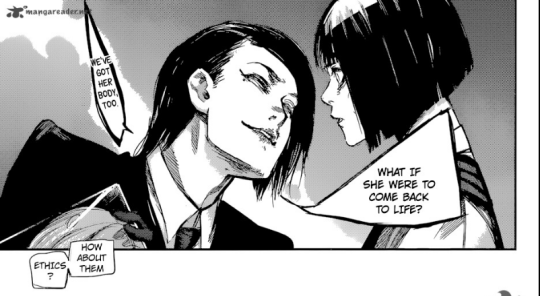
The two characters that best fit a Type One profile are Amon Koutarou and Ui Koori. Both are primarily motivated by their sense of right and wrong, and Amon in particular is always seeking to justify himself. This desire to justify himself makes him more of a 1w9 “The Idealist” to me, whereas Ui is more of a 1w2 “The Advocate”–Ui really believes the CCG is helping people by exterminating ghouls. Or, well, Ui did anyways. But his desire to help people and connect with them is something Furuta notices and exploits to manipulate him (i.e. through resurrecting Hairu).
It’s also noted that in the effort to stay true to their principles, Ones resist being affected by their instinctual drives, consciously not giving in to them or expressing them too freely. That seems like Amon to me.
As for their arrows, the Enneagram Institute states that when moving in their Direction of Disintegration (stress), methodical Ones suddenly become moody and irrational at Four. However, when moving in their Direction of Integration (growth), angry, critical Ones become more spontaneous and joyful, like healthy Sevens.
Through Furuta’s manipulation, Ui seems to be moving towards irrationality, breaking with his own principles in the desperate (and which will probably prove illusory) hope to get Hairu back. Amon accepting Akira’s kiss in :Re 121 could be seen as Amon growing more towards a spontaneous, healthy Seven.
Basic Fear: Of being unwanted, unworthy of being loved
Basic Desire: To feel loved
Key Motivations: Want to be loved, to express their feelings for others, to be needed and appreciated, to get others to respond to them, to vindicate their claims about themselves.
There are four characters who seem like Type Twos to me: Kaneki Ken, Nagachika Hideyoshi, Karren von Rosewald, and (probably) Kimi Nishino. All of these characters seem to be motivated by a desire to love and be loved. Kaneki’s tragic flaw is that he’s desperate to protect the people he loves, and accepts the role of One-Eyed King simply because the people he cares about mostly happen to be ghouls, as he tells Amon.
Kaneki is a very unhealthy Two, though hopefully he’s (slllowwwwllllyyy) moving towards becoming more healthy. Hide, on the other hand, is a far healthier Two. Like Kaneki, he would still do anything, such as joining the CCG, to protect Kaneki, but unlike Kaneki, his insecurities didn’t drive him into paranoia.
Both Kaneki and Hide are 2w1s, aka “The Servant.” I think Kimi is also a 2w1, as she is motivated by her love for Nishiki, which came just as she lost her family. She seems to have a strong One wing, acknowledging that if she were born a ghoul, she would probably have eaten people and therefore cannot judge him.
In contrast, Karren appears to be a 2w3: “The Host/Hostess.” Karren is an unhealthy Two, and her basic motivations come from her tragically unrequited love for Shuu. The Three wing comes into play in that part of the reason she lives as Kanae is out of a desire to carry on her family legacy, which seems like more of a Three-oriented goal than something based on morality, like a One-oriented motivation would be.
As for their arrows, it’s noted that when moving in their Direction of Disintegration (stress), needy Twos suddenly become aggressive and dominating at Eight. This description of a Two moving in the direction of Eight sounds very much like Shironeki (albeit Shironeki is like the most extreme version possible), as Kaneki’s then utterly desperate to control everything to protect the people he loves. However, when moving in their Direction of Integration (growth), prideful, self-deceptive Twos become more self-nurturing and emotionally aware, like healthy Fours. For all their flaws and unhealthy bits, Kimi and Hide are far more emotionally aware than Kaneki is.Karren is not, at least initially, but when Karren asks Shuu to call her by her real name and reclaims her real identity, she moves towards emotional awareness like a healthy Four.
Key Motivations: Want to be affirmed, to distinguish themselves from others, to have attention, to be admired, and to impress others.
Takizawa Seidou and Urie Kuki both strikes me as Threes, although I think Seidou is more of a 3w2 “The Charmer,” whereas Urie is a 3w4 “The Professional.” Both of them during their CCG days are motivated by their achievements–Seidou is bitter at Akira for besting him in their class, and Urie is consumed with the relentless drive to be promoted.
It’s noted that Type Threes typically have problems with workaholism and competitiveness. Both Urie and Seidou certainly are competitive, but Seidou seems to be more focused on what people think about him, as he desperately wants to be a hero (hence the Two wing), whereas Urie is more motivated by his own self-set goals of promotion, and damn anyone who gets in his way.
And now for arrows: when moving in their Direction of Disintegration (stress), driven Threes suddenly become disengaged and apathetic at Nine. However, when moving in their Direction of Integration (growth), vain, deceitful Threes become more cooperative and committed to others, like healthy Sixes.
The above panel of Urie is him becoming apathetic towards his comrades’ lives (and even hateful), and Seidou’s descent into villainy also seems to be, in part, brought about by a feeling that it’s hopeless to even keep trying. We do see Urie, after the Auction arc and his encounter with Mutsuki, starting to become more committed to Shirazu, Mutsuki, and Saiko, much like a healthy Six.
Basic Fear: That they have no personal identity or significance
Basic Desire: To find themselves and their significance (to create an identity)
Key Motivations: Want to express themselves and their individuality, to create and surround themselves with beauty, to maintain certain moods and feelings, to withdraw to protect their self-image, to take care of emotional needs before attending to anything else, to attract a “rescuer.”
I think Uta is a 4w3 “The Aristocrat,” and Kureo Mado is a 4w5 “The Bohemian.” Uta is known as “No Face” and seems to enjoy taking on the identity of others in order to mess with their loved ones (Uta, I love you, but you’re also awful). It’s noted that Fours see themselves as different from others, [but] they do not want to be alone. Additionally, they often report that they feel they are missing something in themselves.
Fours are also noted to have a familiarity with their own darker nature makes it easier for them to process painful experiences that might overwhelm other types. Both Uta and Mado are completely aware of their darker nature, but neither of them care. Uta also seems to be motivated by his desire to feel worthwhile, hence why I think he has a Three wing, whereas Mado leans more towards a Five wing in his crazed determination to exterminate ghouls and take their kagunes for his quinques. He’s motivated by his own desires, and his desire to be useful in exterminating ghouls (a key Five motivation is wanting to be useful), but this desire has no roots in principles of justice like Amon, or promotion like Urie–he kills ghouls because he wants to do so.
As for their arrows, when moving in their Direction of Disintegration (stress), aloof Fours suddenly become over-involved and clinging at Two. However, when moving in their Direction of Integration (growth), envious, emotionally turbulent Fours become more objective and principled, like healthy Ones.
Neither Uta nor Mado can claim to be objective in any sense of the term, though Mado would like to believe he is. Uta constantly tries to manipulate other people’s lives (as with Kaneki and currently Mutsuki). While we never see Mado at his best within the manga, it’s easy to imagine that he would be like Amon, principled and focused on doing the right thing. (It may also be worth noting that Mado possesses an inability to let anything go, and may have used his wife’s death as an excuse.)
Basic Fear: Of being useless, helpless, or incapable
Basic Desire: To be capable and competent
Key Motivations: Want to possess knowledge, to understand the environment, to have everything figured out as a way of defending the self from threats from the environment.
I think Eto is a 5w4, aka “The Iconoclast,” whereas Arima Kishou and Mado Akira are both 5w6s, “The Problem Solver.” The Enneagram Institute mentions that when [5s] get verification of their observations and hypotheses, or see that others understand their work, it is a confirmation of their competency, and this fulfills their Basic Desire. All of them focus on using the knowledge they have to help themselves become capable and competent. Akira focuses on gaining knowledge since the world (and particularly
ghouls) have taken both of her parents and (for awhile it seems like
anyways) Seidou and Amon. Arima, too, focuses on gaining knowledge, but is also more drawn to people, as seen in his parental-like relationship with Kaneki. Eto differs from Akira and Arima in that she has more of the internal focus on her identity than they do, and she uses her knowledge about people to manipulate them.
For Fives’ arrows, when moving in their Direction of Disintegration (stress), detached Fives suddenly become hyperactive and scattered at Seven. However, when moving in their Direction of Integration (growth), avaricious, detached Fives become more self-confident and decisive, like healthy Eights.
Akira seems to be moving in a healthy direction, as she appears very self-confident and decisive after her chat with Hinami. Eto certainly exhibits the scattered enthusiasm of Sevens at times.
Key Motivations: Want to have security, to feel supported by others, to have certitude and reassurance, to test the attitudes of others toward them, to fight against anxiety and insecurity.
Both Mutsuki Tooru and Yasuhisa Kurona appear to be 6w7s, “The Buddy.” While it might seem strange to think of Suzuya Juuzou as wanting security, I think he is also a Six, but a 6w5, “The Defender.” Big Madam used praise to motivated Juuzou, but Shinohara as a father figure is the one who showed him what it really meant to be loved and supported by someone, and as Juuzou’s encounter with Uta wearing Shinohara’s mask showed, Juuzou still craves this.
To an extent, Juuzou’s squad and his friends now provide him with security. He’s also motivated by the idea of being useful, as shown in his skill as an investigator–hence the Five wing.
As for Kurona and Mutsuki, they both want to be safe and secure, which is why Kurona and Nashiro trusted Kanou, and unfortunately for Kurona, is part of why she struggles to accept Nashiro’s death. As for Mutsuki, he really wants to feel safe and secure, and part of that meant having the Quinx and Sasaki around. Since Shirazu’s death, his own captivity by Torso, and Sasaki’s abandonment, he’s been spiraling.
When moving in their Direction of Disintegration (stress), dutiful Sixes suddenly become competitive and arrogant at Three. However, when moving in their Direction of Integration (growth), fearful, pessimistic Sixes become more relaxed and optimistic, like healthy Nines. Since Shinohara’s influence, Juuzou is shown to be more relaxed and optimistic..
Mutsuki even moved in this direction post-Auction arc and before Shirazu’s death. Now, ever since Torso’s captivity, Mutsuki is feeling competitive with Touka (early panels indicate that he was jealous of Touka from the beginning, but it’s now become extreme). Coupled with his dissociation issues, Mutsuki is heading down a very unhealthy path.
Basic Desire: To be satisfied and content–to have their needs fulfilled
Key Motivations: Want to maintain their freedom and happiness, to avoid missing out on worthwhile experiences, to keep themselves excited and occupied, to avoid and discharge pain.
Tsukiyama Shuu is a very obvious Seven. His obsessive fear of missing out, his desire to savor unique flavors, all make him a Seven, probably with a Six wing (“The Entertainer.”) Because as much as Tsukiyama loves life’s experiences and flavors, he also really craves human connection and the security that comes with that.
Ihei Hairu might also be a 7w6, and Nishiko Nishiki is a 7w8, “The Realist.” It’s noted that as long as Sevens can keep their minds occupied, especially with projects and positive ideas for the future, they can, to some extent, keep anxiety and negative feelings out of conscious awareness. Tsukiyama clearly does this, trying to focus on the goal of eating Kaneki (at least initially, as later this becomes a clear smokescreen for getting to know Kaneki), and Hairu does this at the moment of her death, when she thinks warmly of Arima (technically this is moment in her past).
It’s also observed that on a very deep level, Sevens do not feel that they can find what they really want in life. Nishiki is a clear example of this: he, like Tsukiyama, wants connection with other people, but does not feel he can have this (at least at first). But compared with Tsukiyama, Nishiki is more inclined to try to control the world around him; at the same time, he doesn’t want to miss out on life’s experiences.
It’s also noted that as Sevens speed up their pursuit of whatever seems to offer freedom and satisfaction, they tend to make worse choices, and they are less able to be satisfied… the result is that Sevens end up anxious, frustrated, and enraged… They may end up ruining their health, their relationships, and their finances in their search for happiness. This is basically what happens to Tsukiyama after he believes Kaneki died.
When moving in their Direction of Disintegration (stress), scattered Sevens suddenly become perfectionistic and critical at One. Hairu’s vicious and tragically ironic hatred of ghouls could be seen as an example of this critical behavior, though in truth I don’t think we know enough about her to say for sure. However, when moving in their Direction of Integration (growth), gluttonous, scattered Sevens become more focused and fascinated by life, like healthy Fives. Since Karren’s death, Tsukiyama has become far healthier, focusing on serving his king. Nishiki, too, after they defeat Tsukiyama, save Kimi, and he starts working at Anteiku, moves in a more positive direction, taking joy in life.
Basic Fear: Of being harmed or controlled by others.
Basic Desire: To protect themselves (to be in control of their own life and destiny.)
Key Motivations: Want to be self-reliant, to prove their strength and resist weakness, to be important in their world, to dominate the environment, and to stay in control of their situation.
Kirishima Ayato and Furuta Nimura are clearly Eights, specifically 8w7s “The Maverick.” Kirishima Touka and Yomo Renji are also Eights, but I think they’re 8w9s, “The Bear.” Ayato curses weakness, specifically cursing his father and Touka for his perception of their weakness. Furuta is obsessed with controlling not just his story, but Rize’s, Kaneki’s, and more. Touka and Yomo are also motivated by control, but are also motivated by their desires to not lose the people they love (for Touka, Kaneki, and for Yomo, Hikari). I also think Shirazu Ginshi is an 8w9 as well–like most Eights, he is a good leader, although he seems to be in a healthy place. He does, however, make the effort to keep the team together, even if it means dragging a still-sleeping Saiko to a meeting on his back.
Yomo was far unhealthier in his youth, when he’s described by Uta as having been incredibly violent. Touka, too, was far unhealthier at the beginning of the manga, and now seems to be in a healthy place. She’s not seeking to control Kaneki, but she is seeking to be close to him.
When moving in their Direction of Disintegration (stress), self-confident Eights suddenly become secretive and fearful at Five. However, when moving in their Direction of Integration (growth), lustful, controlling Eights become more open-hearted and caring, like healthy Twos.
Shirazu seems to be a very healthy Eight, and his care for his friends is always evident. An Eight’s movement towards a Two is also evident in Touka’s attitude towards Kaneki in :re, where she hopes he will return, but if he doesn’t, she’s content (and when she became consumed with revenge for Ryouko’s death, she was moving in an unhealthy direction). When Ayato begins to care for Hinami and break away from Aogiri, he grows. Yomo, too, experiences this when he works with Yoshimura and watches over his niece.
Basic Desire: To have inner stability, “peace of mind”
Key Motivations: Want to create harmony in their environment, to avoid conflicts and tension, to preserve things as they are, to resist whatever would upset or disturb them.
Yonebayashi Saiko and Yoshimura Kuzen are 9w8s (Saiko with a strong Eight wing), “The Referee.” I think Fueguchi Hinami is a 9w1, known as “The Dreamer.” Saiko is very much motivated by her desire to do what she wants to do (as evidenced by her laziness at the beginning of :re), but she also cares deeply about those close to her, as shown when she sobs when a clone of Kaneki’s is executed, and when she refuses to let Urie die a ghoul despite Hsiao’s warnings.
Hinami, too, just wants the fighting to stop. She never cares about revenge, but she does care about losing the people she loves. When she chooses to protect Kaneki in the auction, she knows that he may not ever remember her, and he may not be the same person Kaneki was. But for her own peace of mind, she has to protect him.
It’s noted that more than any other type, Nines demonstrate the tendency to run away from the paradoxes and tensions of life by attempting to transcend them or by seeking to find simple and painless solutions to their problems. Yoshimura, as admirable as he is, falls prey to this method of thinking a bit, both in his abandonment of Eto (he always loved his daughter, but in his thinking that he wasn’t able to raise her, he created a tragic situation for both of them) and in his refusal to take an active role in working for a more peaceful world between ghouls and humans (he ran a wonderful place in Anteiku and helped many, but his passivity was not in everyone’s long-term best interest).
And for their arrows, when moving in their Direction of Disintegration (stress), complacent Nines suddenly become anxious and worried at Six. However, when moving in their Direction of Integration (growth), slothful, self-neglecting Nines become more self-developing and energetic, like healthy Threes.
Saiko has moved in a more healthy direction since the beginning of :re in some respects, but she’s also stagnating as a character in other areas because she wants everyone around her to be safe, but aside from saving Urie, hasn’t made an effort to push ahead with asking uncomfortable questions (i.e. when she confronts Mutsuki over smelling human blood, and when she cries over fake-Kaneki’s execution but thus far hasn’t been shown examining her own potential culpability in working for an organization like the CCG–though this is possibly due to the fact that she never chose to work for the CCG; her mom did it for her). Hinami was in a less healthy place at the start of :re, but after she made her decision to protect Kaneki at the auction, she’s become far healthier.
So, that’s it! This isn’t meant to be taken terribly seriously; it’s just a fun and (for me) interesting way of thinking about the characters and their personalities/motivations. What I find funny/interesting is how our three remaining original Quinx overlap in terms of their arrows.




 hamliet