Chapters: 4/15 Fandom: Banana Fish (Anime & Manga) Rating: Mature Warnings: Creator Chose Not To Use Archive Warnings Relationships: Ash Lynx/Okumura Eiji, Sing Soo-Ling/Lee Yut-Lung Characters: Ash Lynx, Okumura Eiji, Lee Yut-Lung, Sing Soo-Ling, Shorter Wong, Blanca (Banana Fish), Max Lobo, Ibe Shunichi, Nadia Wong, Charlie Dickenson (Banana Fish), Lao Yen-Thai, Jessica Randy Additional Tags: Alternate Universe – High School, Bullying, Implied/Referenced Sexual Assault, Depression, Friendship, Redemption, Angst with a Happy Ending, Angst, Hurt/Comfort Summary:
When exchange student Eiji Okumura arrives at his American high school for a year abroad, his worries about fitting in and earning As are quickly swept aside when he meets Ash Lynx, a genius rumored to have spent time in juvie last year. Between Ash, his friends Shorter and Sing, and the mysterious younger brother of the school’s principal, Eiji finds himself drawn into a power struggle that he realizes is more familiar than he thought. High School AU… (like, where they’re actually in school + there’s a chance of healing).
Well, I don’t read or speak Chinese, so I can’t go very in depth with what his name means, but it does literally mean “moon.” And of course, Yut-Lung is associated with the moon, a shadow of Ash in many respects, the yin to his yang, amethyst to his jade (in the anime). So I can talk about his character in relation to Ash, if that helps, since I’ve been wanting to explore their foiling a bit more, and also Yut-Lung’s foiling with Eiji, and with Blanca.
Of course, the moon only shines because the sun’s light reflects on it. To an extent you could say this is symbolic of how Yut-Lung is kind of desperately scrambling for a new purpose in life post-revenge.
This is kind of true but also kind of a lie as we know. He wants to destroy the Lee conglomerate and himself with it because, like Ash, he’s suicidal.
So after he succeeds at this, and to succeed at this as well, he decides to make Ash his enemy because he’s petty and is mad Ash has someone to love and love him, while he thinks he has no one. He’s living for Ash, a reflection of Ash, but not in a healthy way because what happens if he actually won against Ash? Would he be happy? (The answer is no.)
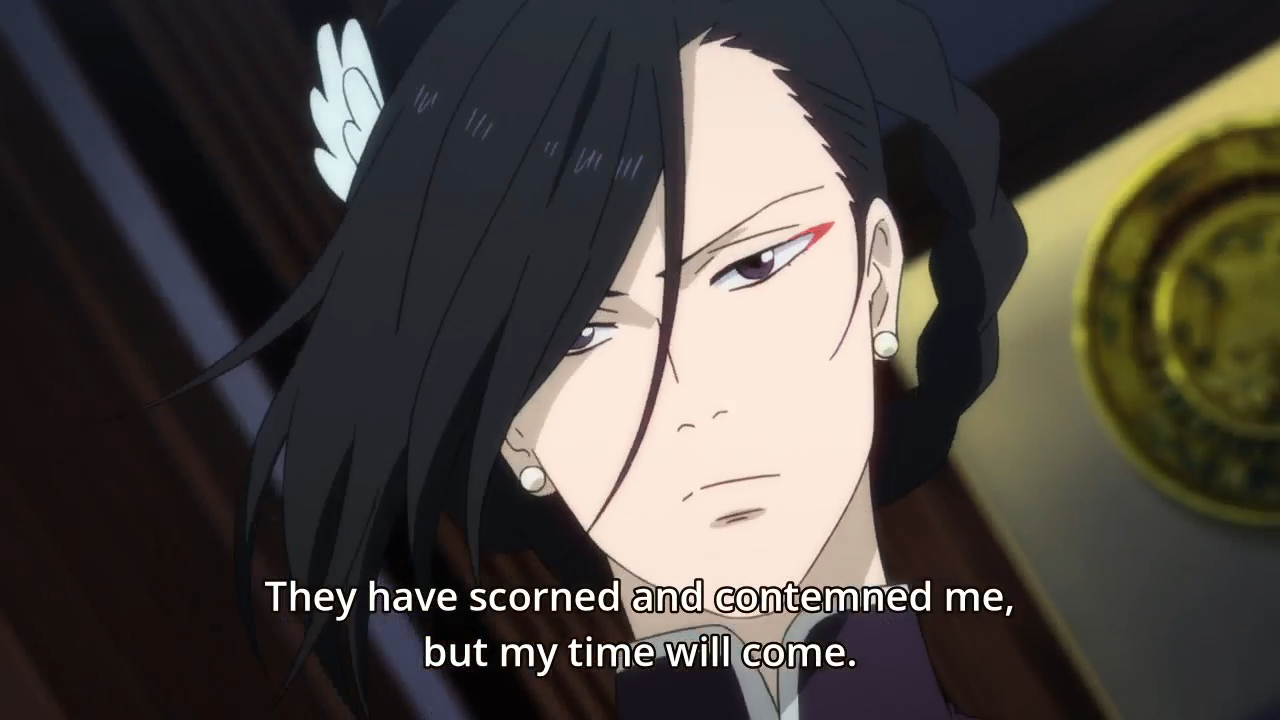
Because Yut-Lung wants to be loved, deep down, and he truly believes he has no one, but that’s not true. He has Sing (again I’m not arguing this is romantic textually, but their relationship does in some ways parallel Ash and Eiji’s). But he can’t see that because he’s too blinded by focusing on the sun/Ash/Eiji/trying to be both Ash and Eiji. Like, he literally in the above scene walks off in Eiji’s direction after Eiji leaves, while Sing is right there asking him why he wants to die, and Sing says that he can’t just leave him.
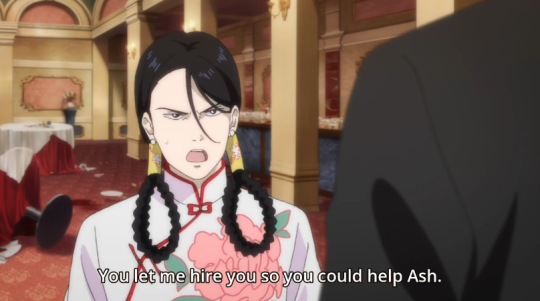
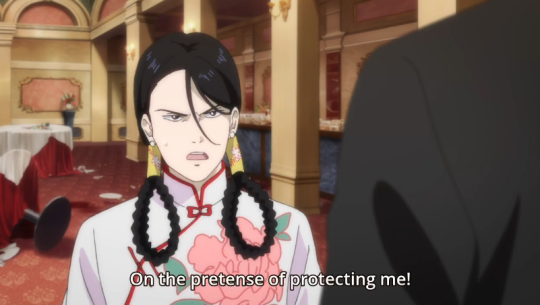
And like, in the most recent episode, Yut-Lung clearly feels betrayed when he realizes Blanca only took the contract to protect Ash, and Sing helped him escape. He lacks the self-awareness to realizes Sing does care about him, and honestly so does Blanca in whatever broken way Blanca cares, but he’s pushing them away because of his obsessive focus on Ash. And in the latest episode as well, in the end he just says that he’s still focusing on Ash and wanting revenge on Ash now–and cue me screaming REALLY DUDE REALLY someone sit this child down and tell him to focus on himself and not on his failings.
Seeing himself as the moon could also be reinforcing that he sees himself as inferior to Ash, but also the same as Ash at the same time. It’s the same light, but it doesn’t emanate from him, or maybe this is overthinking but it does work so.
Despite seeking to destroy the Lees, Yut-Lung’s also still ironically putting a lot of weight on the name given to him, instead of seeking to create his own destiny and fate. It’s tragic. Ash is fighting tooth and nail to escape the system; Yut-Lung has already given up on that.
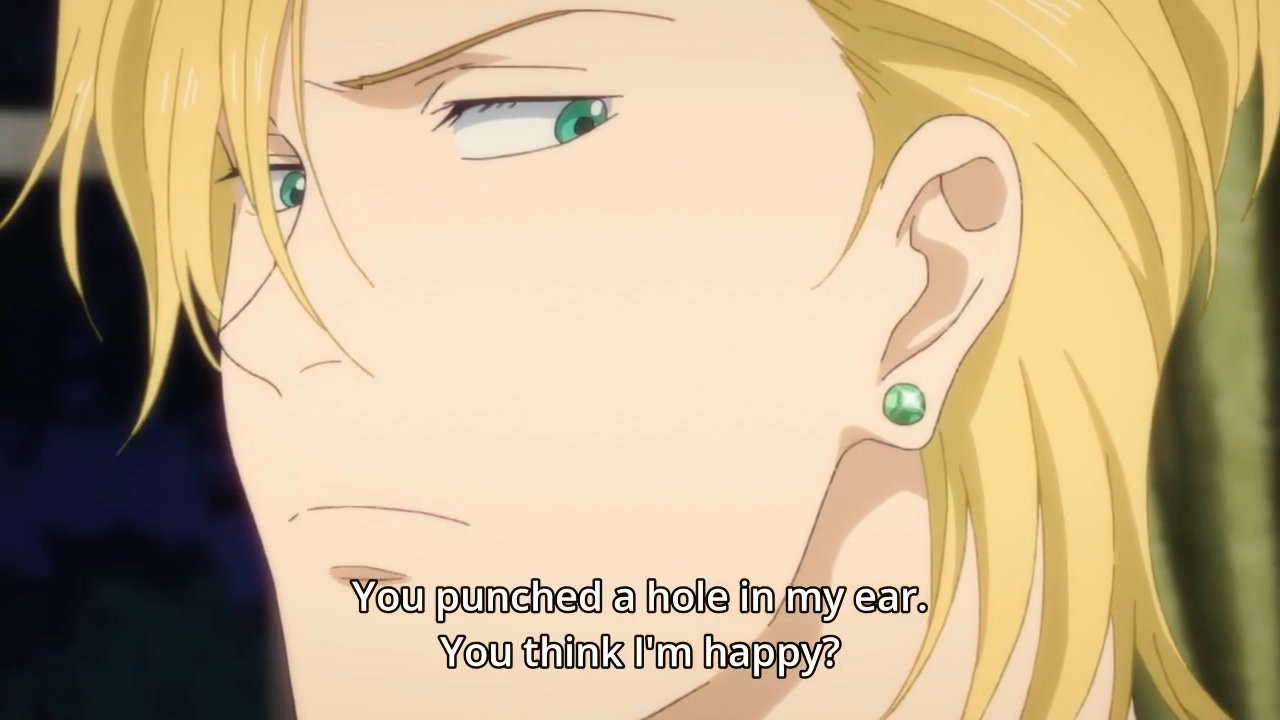
As another piece related to that and to Ash’s middle name… Ash does not want to be seen as an object. He hates that he’s treated like a commodity. Yut-Lung, on the other hand, true to his philosophy of taking things down from the inside, commodifies himself to an extent. Dino punches a hole through Ash’s ear unwillingly, and Ash gives up the jade as quickly as he can. Yut-Lung willingly adorns himself in amethysts or some kind of purple stone (which match his eyes, a la how Ash’s jade matches his eyes).
Again this speaks to Yut-Lung’s extremely low sense of self-worth (which is ironic because he puts on a haughty facade), and how he sees himself inherently as inferior, not just to Ash. He hates that his brothers treat him as inferior for having a different mother, but he also seems to believe that, and like Ash, is more than willing to become what he hates to destroy everything he hates and punish himself.
However, Ash isn’t the only one associated with the sun. So is Eiji.
And we’re also pretty clearly supposed to be comparing Eiji and Yut-Lung given his utter hatred of Eiji and determination to kill him because… he loves Ash and Ash loves him, or because Yut-Lung is jealous of Eiji getting to live how he always wanted to live.
He pretty clearly despises Eiji for precisely that reason: Eiji is a helpless little kid, and so is Yut-Lung. Like, he’s throwing actual tantrums. He can’t defend himself worth anything. But Yut-Lung doesn’t want to be seen as a helpless little kid in some ways (and yet paradoxically I’d argue he does in other senses, given how he behaves). He wants to be seen like Ash in many ways.
So let’s talk Blanca, who is the reason Yut-Lung’s dastardly scheme worked and Ash was taken back to Dino, and Ash and Eiji were separated. Given both characters’ association with the sun, this line of Sing’s is interesting:
Sing’s the adult in the room again, calling people out without even meaning to 😛 But going forward, Blanca is already kind of standing between Ash and Yut-Lung. He joined Yut-Lung to protect Ash, which hurts Yut-Lung, but he also does take his duty to Yut-Lung seriously and does care about him like he cares about Ash. I’d wager Yut-Lung isn’t entirely correct here: I think Blanca joined him to protect both of them.
Otherwise there was no need to take down an assassin and try to keep said assassin alive to interrogate. I think Blanca’s genuinely wanting to protect both of them, but he’s unwilling to fight the system to do it, which means he’s inherently bad at it. Like, honestly, Blanca. But again Yut-Lung can’t see it because not only is Blanca bad at it, but he focuses too much on Ash.
Blanca is of course an Ash foil, and exactly what Ash fears becoming: someone who has completely given up fighting the system, and thinks it’s pointless to do so. Blanca is blocking the sun because his lifestyle is literally something that would kill Ash and Eiji…
But at the same time, together with Sing, he’s one of two people who actually do care about Yut-Lung and therefore has the potential to help Yut-Lung realize his own worth doesn’t come from opposing Ash or killing Eiji or anything of the sort. So he could block the sun in a good sense, too.
In the end of this scene, symbolically, Mr. Helpless Child lands in a fetal position at Blanca’s feet. I know in the manga Blanca catches him. I honestly think it’s fitting he didn’t here, because Blanca is failing to protect Yut-Lung from himself, which is where he really needs the protection, just like Blanca failed Ash. Hence it’s fitting and also sad that Ash is the one throwing Yut-Lung at Blanca’s feet, because the narrative therefore challenges Blanca to do something, but he doesn’t act in time to prevent immediate pain.
Anyways both these boys are walking basket cases and I need someone to give Ash and Yut-Lung a hug and therapy stat. I volunteer.
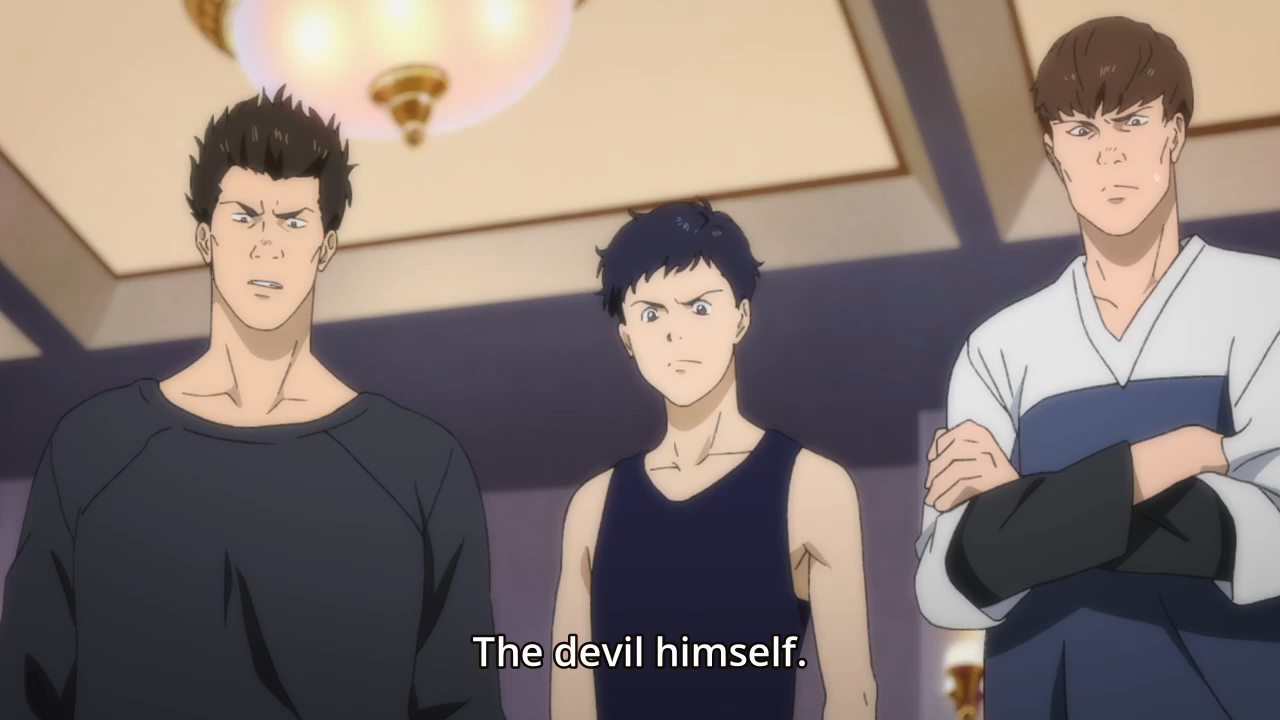
Yeah, this. Golzine refuses to see Ash as a human. He’s a devil. A wild beast. A lynx. A leopard, a lion. A sex object. But Ash is a goddamn kid, a human being with feelings and dreams, and Golzine’s dehumanization is so horrifying. Ash and Eiji truly see each other as people outside of the roles they’ve been prescribed, beyond just powerful gang leader or dude in distress who lost his talent. They’re people to each other, and that is what is so beautiful and healing about them.
Of course, if Ash actually were a Ferrari, he would probably be treated better. Golzine treats Ash like a thing, but also hurts him, and most people wouldn’t harm a fancy car.
Chapters: 16/16 Fandom: Banana Fish (Anime & Manga) Rating: Mature Warnings: Creator Chose Not To Use Archive Warnings Relationships: Ash Lynx/Okumura Eiji, Sing Soo-Ling & Lee Yut-Lung, Lee Yut-Lung & Shorter Wong Characters: Lee Yut-Lung, Sing Soo-Ling, Shorter Wong, Ash Lynx, Okumura Eiji Additional Tags: Implied/Referenced Child Abuse, Implied/Referenced Sexual Assault, Redemption, Friendship, Hurt/Comfort, Alternate Universe – Canon Divergence Series: Part 1 of Stray Phoenix Summary:
Yut Lung grew up as a pawn in the Lee family. Determined to topple his brothers and grasp a new role for himself, he is accustomed to playing every person he knows. When he is warned about Golzine’s intentions to inject Shorter with Banana Fish, he chooses to free Shorter instead, and then finds himself in a new game, one he may not know the rules to.
Chapters: 15/16 Fandom: Banana Fish (Anime & Manga) Rating: Mature Warnings: Creator Chose Not To Use Archive Warnings Relationships: Ash Lynx/Okumura Eiji, Sing Soo-Ling & Lee Yut-Lung, Lee Yut-Lung & Shorter Wong Characters: Lee Yut-Lung, Sing Soo-Ling, Shorter Wong, Ash Lynx, Okumura Eiji Additional Tags: Implied/Referenced Child Abuse, Implied/Referenced Sexual Assault, Redemption, Friendship, Hurt/Comfort, Alternate Universe – Canon Divergence Series: Part 1 of Stray Phoenix Summary:
Yut Lung grew up as a pawn in the Lee family. Determined to topple his brothers and grasp a new role for himself, he is accustomed to playing every person he knows. When he is warned about Golzine’s intentions to inject Shorter with Banana Fish, he chooses to free Shorter instead, and then finds himself in a new game, one he may not know the rules to.
*presenting a rambly wannabe meta that i hope makes some sense but i. am sleepy*
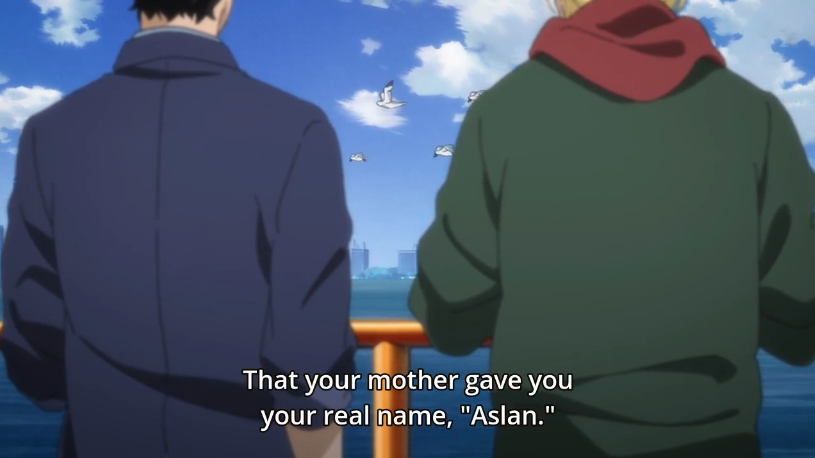
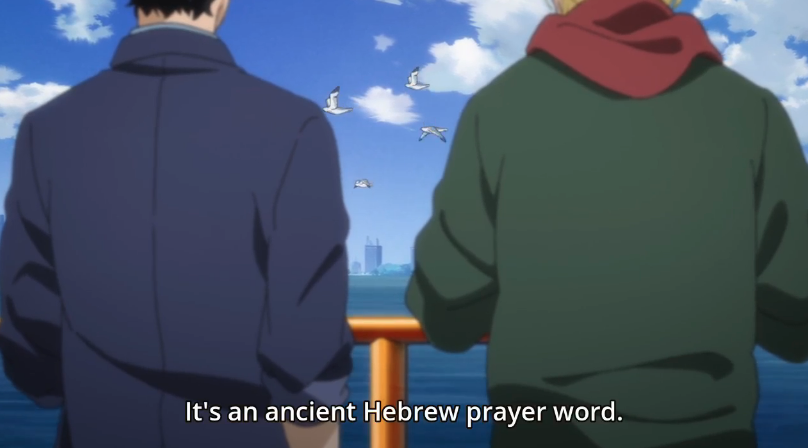
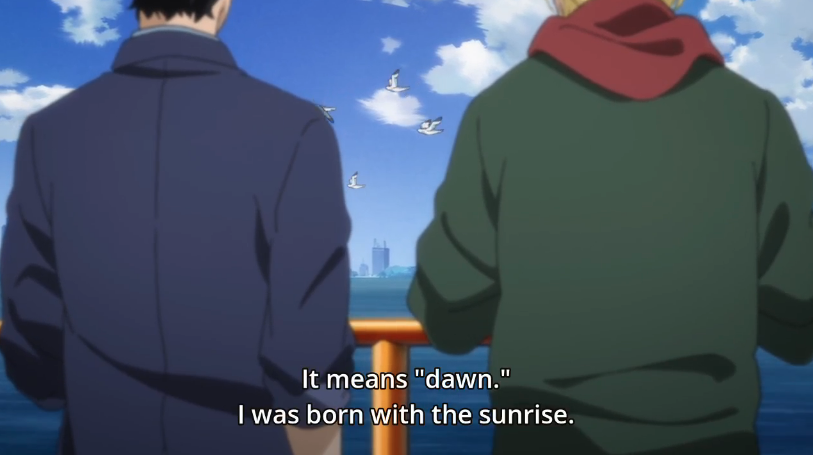
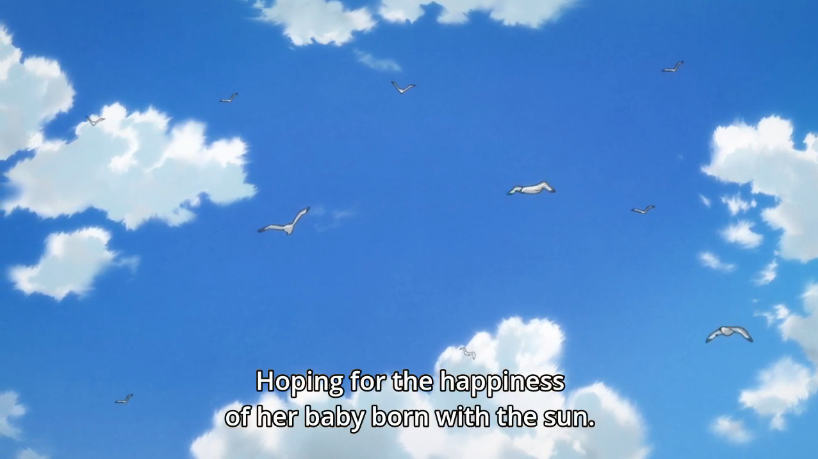
One of the saddest conversations in Banana Fish, for me, was this one.
Eiji is completely pure-intentioned and trying to comfort Ash here, and he might genuinely believe it, but Ash expresses doubt and the viewer also probably doubts it. Even if she did wish for the best for her son, which is certainly possible, it still doesn’t erase that she left him, ultimately deeming him less valuable to her than her free city life.
But I want to talk more about the implications of Ash’s name and the symbolism associated with “Aslan” in particular–which makes the name seem more like a curse than a gift, a double-edged sword in many ways just like Ash’s other innate talents (intelligence, leadership skills, good looks). (“Jade” has its own implications–it’s a commodity, for one thing, and Dino literally gives him a $400,000 piece of jade to execute him in, and his foil Yut-Lung is associated with wearing amethysts with the same implications, but that’s for another time.) Aslan as a name, in particular, is associated with religious symbolism. There’s repeated heaven/hell imagery in Banana Fish, always associated with Ash and/or Dino, and almost always contributing to other characters dehumanizing Ash.
For starters, there’s what Ash says “Aslan” means–though I can’t find any verification of that (most sources say it means “lion” in Turkish): a prayer associated with dawn. But it’s also–and most people will know this–the name of the lion character in C.S. Lewis’s The Chronicles of Narnia, which is an allegory of much of the Biblical Christian stories. Aslan is in particular Jesus. It’s not subtle; he willingly takes the punishment of someone who betrayed him and his siblings (Edmund Pevensie) and is executed for him, but resurrects at dawn.
The rising of the sun had made everything look so different—all the
colours and shadows were changed—that for a moment they didn’t see the
important thing. Then they did. The Stone Table was broken into two
pieces by a great crack that ran down it from end to end; and there was
no Aslan.
“Oh, oh, oh!” cried the two girls rushing back to the Table.
“Oh, it’s too bad,” sobbed Lucy; “they might have left the body alone.”
“Who’s done it?” cried Susan. “What does it mean? Is it more magic?”
“Yes!” said a great voice behind their backs. “It is more magic.” They
looked round. There, shining in the sunrise, larger than they had seen
him before, shaking his mane (for it had apparently grown again) stood
Aslan himself.
~”The Lion, The Witch, and the Wardrobe”
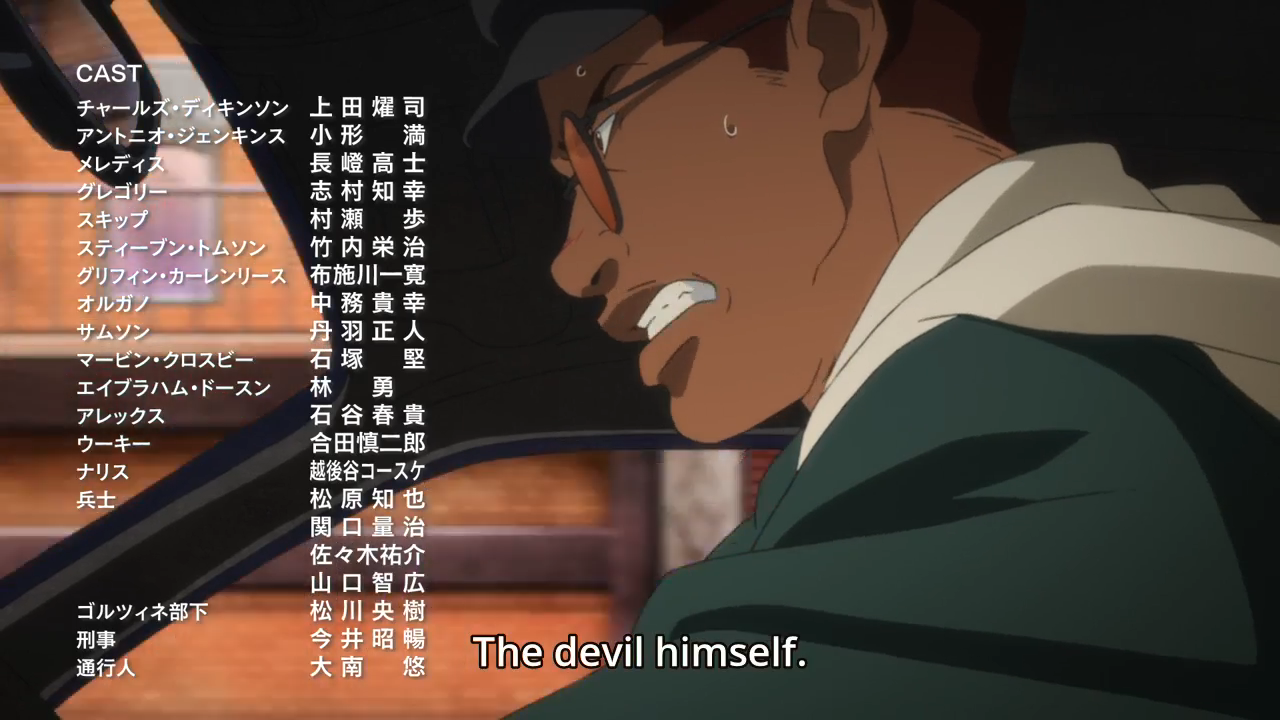
Throughout Banana Fish we see Ash repeatedly compared to both a devil and an angel/Christ/God, often with the two concepts conflated. From the very first episode…
(the bike resembles a traditional devil’s mask. #subtle), to the scene in which he saves Eiji and burns down Golzine’s mansion…
What’s interesting is that these scenes are characters misunderstanding Ash by projecting the blame for what is happening onto Ash. The blame for all these incidents are on Dino. Ash isn’t motivated for pure revenge or seeking it out in any of these scenes: he’s trying to save friends. Skip and Eiji in the opening episode, Eiji and then Shorter’s body (where he happened to come across Abraham and killed him for killing Shorter) in the scene where they flee Golzine’s mansion.
But then there are these scenes: firstly, the scene where he’s escaping the hospital and Golzine is a proud evil monster pretending to be a father.
To the most recent episode:
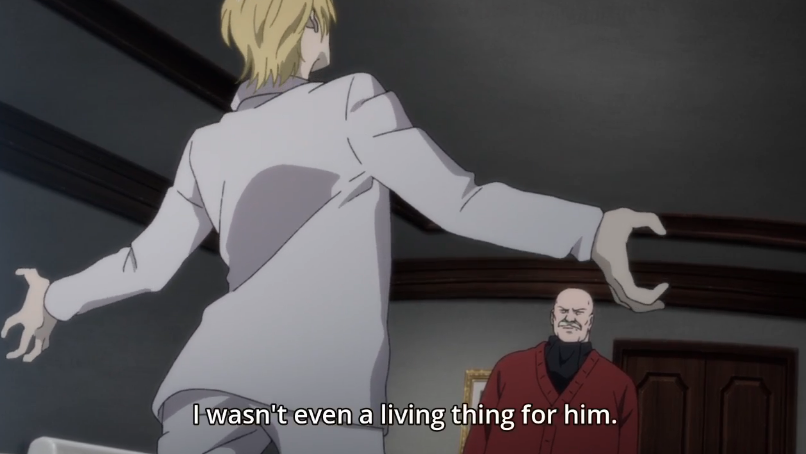
Golzine is wrong: he hasn’t created Ash, and Ash is not one of a kind (Yut-Lung exists). Basically, people try to force Ash into the role of devil when that isn’t what he is. But this gets at the heart of Golzine’s character: he’s projecting himself and how he sees himself (an all-powerful mix of the devil and a god) onto Ash. Hence why he lashes out at Ash when Ash calls him out on treating him like something other than a human being this episode:
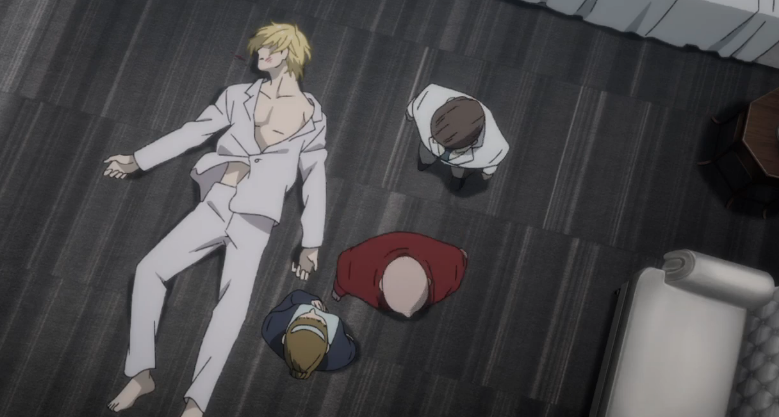
Ash’s comments reinforce the reality that he’s no god and no devil: Ash is a broken child at this point, and Dino played a massive role in breaking him by raping him, forcing him to kill, and trying to turn him into a devil/god creature. And Dino does not want to accept that he, a devil/god, can have created a broken thing. So he beats Ash and threatens him to show up to his party.
And about that party. Planning a party to celebrate his rebellious son’s return is pretty clearly a twisted version of the “Prodigal Son” parable in the Bible. Jesus tells it, and the father in this story is supposed to be God (Luke 15:11-32, NIV translation):
11 Jesus continued: “There was a man who had two sons.12 The younger one said to his father, ‘Father, give me my share of the estate.’ So he divided his property between them.
13 “Not long after that, the younger son got together all he had, set off for a distant country and there squandered his wealth in wild living. 14 After he had spent everything, there was a severe famine in that whole country, and he began to be in need. 15 So he went and hired himself out to a citizen of that country, who sent him to his fields to feed pigs.16 He longed to fill his stomach with the pods that the pigs were eating, but no one gave him anything.
17 “When he came to his senses, he said, ‘How many of my father’s hired servants have food to spare, and here I am starving to death! 18 I will set out and go back to my father and say to him: Father, I have sinned against heaven and against you.19 I am no longer worthy to be called your son; make me like one of your hired servants.’ 20 So he got up and went to his father.
“But while he was still a long way off, his father saw him and was filled with compassion for him; he ran to his son, threw his arms around him and kissed him.
21 “The son said to him, ‘Father, I have sinned against heaven and against you. I am no longer worthy to be called your son.’
22 “But the father said to his servants, ‘Quick! Bring the best robe and put it on him. Put a ring on his finger and sandals on his feet. 23 Bring the fattened calf and kill it. Let’s have a feast and celebrate. 24 For this son of mine was dead and is alive again; he was lost and is found.’ So they began to celebrate.
25 “Meanwhile, the older son was in the field. When he came near the house, he heard music and dancing. 26 So he called one of the servants and asked him what was going on. 27 ‘Your brother has come,’ he replied, ‘and your father has killed the fattened calf because he has him back safe and sound.’
28 “The older brother became angry and refused to go in. So his father went out and pleaded with him. 29 But he answered his father, ‘Look! All these years I’ve been slaving for you and never disobeyed your orders. Yet you never gave me even a young goat so I could celebrate with my friends. 30 But when this son of yours who has squandered your property with prostitutes comes home, you kill the fattened calf for him!’
31 “‘My son,’ the father said, ‘you are always with me, and everything I have is yours. 32 But we had to celebrate and be glad, because this brother of yours was dead and is alive again; he was lost and is found.’”
Instead of a benevolent father forgiving his (wrongful) son, Ash is trying to escape a cruel devil father figure in Dino, and Dino’s projecting that devilish/demonic imagery onto Ash. Celebrating his return to literal enslavement is a sickening twist on a lovely, redemptive story.
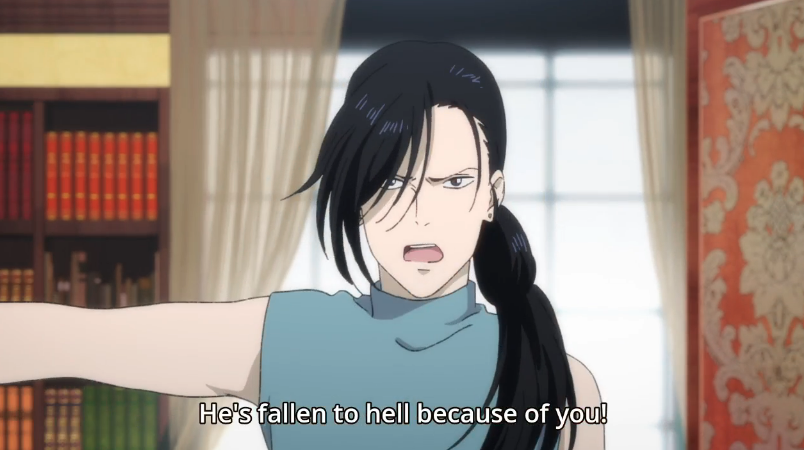
Yut-Lung sees this as well:
Golzine’s city is nothing more than a hell, and Yut-Lung can’t escape it, so doesn’t want Ash to escape it either.
But Ash, fortunately and yet (differently) unfortunately, has heavenly symbolism with him as well. “Angel Eyes,” the prequel in which Shorter and Ash meet, has Shorter telling Ash he looks like an angel from a Christmas card Nadia mailed him–yet importantly, Shorter never looked at Ash like anything other than a person.
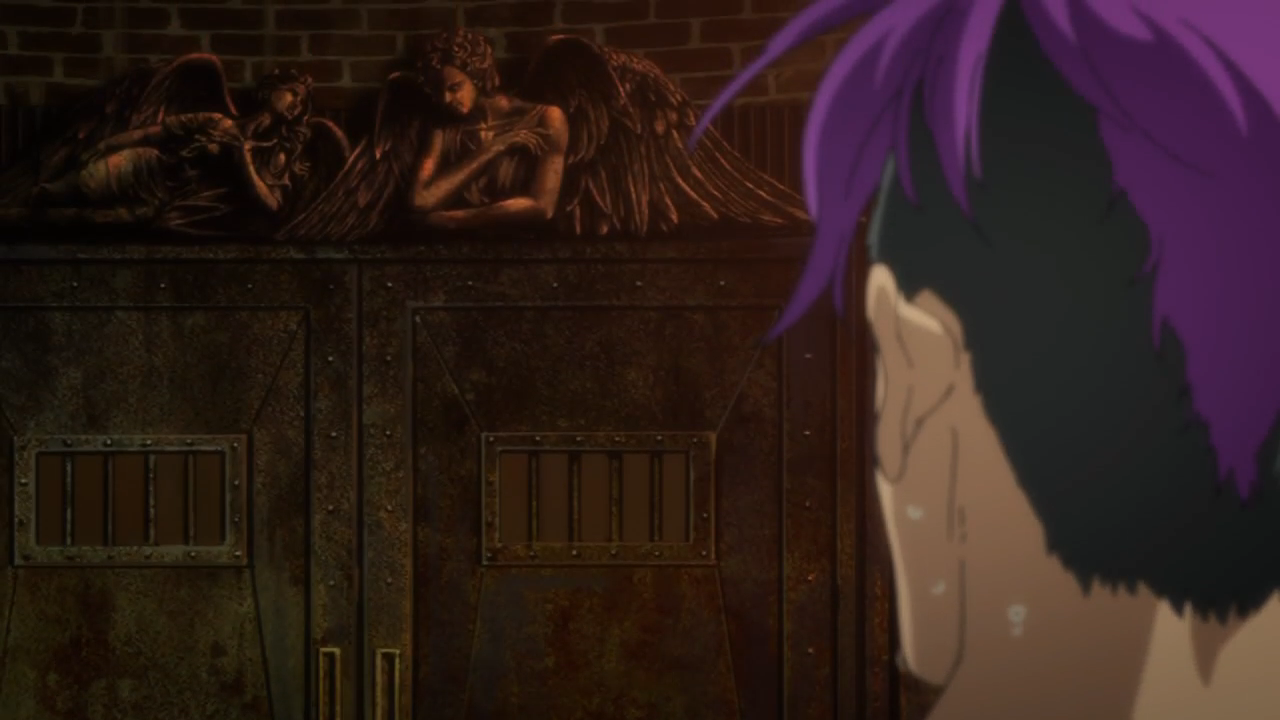
There’s then this horrid scene in which Shorter is killed, which takes place in Dino’s so-called execution room, and there’s distinct Christlike imagery in this scene (fitting for the name Aslan). Ash has been betrayed by friends (however, even that has been staged by Dino since Shorter did not want to betray Ash, and Ash did not fault him) and is hung in a crucifix position:
With angels on the wall, angels that tease Angel Eyes and remind us how Shorter sees Ash as opposed to the cruel mockery of how Dino is portraying Ash. The angels are also above the barred door to escaping the execution chamber, because death=freedom for Shorter and again, in the biblical tale and in Narnia, Jesus/Aslan’s death leads to freedom for humanity/Narnia.
The scene results in a sacrifice of Ash himself when he mercy-kills Shorter, because that’s another calling card of Ash’s character: he doesn’t see himself as having value, which leads to him making sacrificial decisions like shooting a gun into his head only to find out it was empty, going back to hell with Dino, etc, all for the sake of Eiji and the other people he loves. It’s a crucial difference between Ash and Dino: Dino only thinks of himself. Ash thinks of others, too. But Ash’s sacrificial tendencies, while stemming from genuine love, comprise a tragic flaw.
Additionally, it’s important to note that this scene is again something cruel Dino has set up. Dino sees himself as an arbitrator of life and death, as a god/devil. Ash never chose these god/devil roles. The fact that he goes by “Ash” instead of “Aslan” implies, again, that he does not see himself as a god or as a devil, but also struggles to see himself as a person.
Which is something all the bad guys do to an extent. Most characters refuse to Ash like a normal child because of his talents and gifts, which his name is symbolic of. Like Wang-Lung Lee:
But not, however, Max.
Or George.
Or Charlie.
And most especially, not Eiji.
Ash is not a devil, but he can do devilish things (and he does, like murdering begging people). He is not an angel, but he can do angelic things (like saving his loved ones).
He’s just a child. And he’s a friend for these people, and they are all going to save him from the disgusting party Golzine has planned. They know he won’t be able to fight for them this time, but they’re going, because they value him as a person. Because they love him and care about him, not because they want him to adopt a particular role.
Chapters: 14/16 Fandom: Banana Fish (Anime & Manga) Rating: Mature Warnings: Creator Chose Not To Use Archive Warnings Relationships: Ash Lynx/Okumura Eiji, Sing Soo-Ling & Lee Yut-Lung, Lee Yut-Lung & Shorter Wong Characters: Lee Yut-Lung, Sing Soo-Ling, Shorter Wong, Ash Lynx, Okumura Eiji Additional Tags: Implied/Referenced Child Abuse, Implied/Referenced Sexual Assault, Redemption, Friendship, Hurt/Comfort, Alternate Universe – Canon Divergence Series: Part 1 of Stray Phoenix Summary:
Yut Lung grew up as a pawn in the Lee family. Determined to topple his brothers and grasp a new role for himself, he is accustomed to playing every person he knows. When he is warned about Golzine’s intentions to inject Shorter with Banana Fish, he chooses to free Shorter instead, and then finds himself in a new game, one he may not know the rules to.























 hamliet