Character development and themes. Plot and worldbuilding are cool but I don’t really care about them. The story matters to me most, and what I’m probably going to be thinking about after an anime is over isn’t “neat powers” or “what a twist that was” but its commentary on human nature, the world, hope, despair, etc., as well as any characters I connected with. Characters are slightly more important than themes as well to me–like BNHA isn’t so strong with its themes, but its characters are great.
Visually, nice animation is also good, but it has to be like… powerpoint levels to really bother me, but even if it is if the themes are strong enough it can kinda get away with it to an extent (NGE I’m looking at you). And colors. A great color scheme is also going to help–the first season of Tokyo Ghoul had excellent colors and I loved that. Hunter x Hunter 2011 and Banana Fish also use a great color scheme to add vibrancy. The story matters to me far more than the aesthetics, though, so aesthetic appeal is like… a bonus, but not a huge factor.
I generally don’t watch very much of anything I don’t like haha. If I’m not enjoying it, I’m probably not putting the time into it.
With the one exception being Tokyo Ghoul re season 2. I guess you could say I am enjoying (parts of) it, but that’s because my expectations were low anyways and I just wanted to enjoy seeing certain parts animated like 0 Squad, etc (and yet somehow, I am still disappointed at times). It’s a bad adaptation that’s poorly animated and really fails on just about every level as an anime, so I guess I’d say that one. But I’m not like hate watching it; it’s not good, but it’s fun for me to see a story I cared deeply about be adapted especially since we’re probably not getting another chance to see those characters.
In the recent arcs, on and off, yes. The majority of the Pro-Hero Arc, the Remedial Hero License Exam, etc–Endeavor is kind of the main character and hero of this, and we see his pain and suffering that led to him lashing out, which is fine if you’re going to redeem a character (it’s actually necessary if that’s the goal).
But when we get the other family members, we focus on how Rei feels about Endeavor, not about how Rei feels about herself. Her thoughts are filtered through a lens of Endeavor-focus, which is kind of squicky because the point of abuse is that people make it all about themselves and punish other people for their pain. Fuyumi and Rei are framed as being in the right with Natsuo in the wrong through the fight with Endeavor, because we’re encouraged to root for Endeavor in the fight against the Noumu. Because we’re rooting for him in another part of the chapter, it makes little sense to imply that the author intends for us to root for Natsuo’s dislike of him in the other pages of the chapter.
Until 192, wherein the framing is really, really good, showing the complicated reality of coping with abuse and how everyone copes in different ways, and that’s not necessarily wrong. (The only one I’d say is coping in a maladaptive way is actually Touya/Dabi.) And then it swings back to showing Todoroki’s pain and anguish in the current arc, which is good except when you’ve just been building up a character for redemption in the same chapter it feels a bit whiplashy.
So I do think Horikoshi is trying, but it’s a difficult topic to write about and it’s not perfect, and sometimes he’s succeeding and sometimes he’s struggling or even just–not succeeding at being sensitive. I can critique that aspect of the story while still admitting the Todoroki family drama is my favorite part of the story, I was super excited for each chapter of the Pro-hero Arc, and at this point I’m very interested to see how Endeavor’s redemption plays out, since it certainly ties into one of my favorite characters’ arcs (Dabi’s).
RIGHT okay the church I grew up in viewed Left Behind as like, great literature. And we had to constantly be on alert for the Rapture (WHICH ISNT IN THE BIBLE). And the antichrist was totally coming. And climate change and environmentalism did not matter because the entire world was going to end in fire anyways. And on and on I could go because that’s not even the tip of the iceberg of what I was taught 😛 I had so many nightmares as a kid about the apocalyptic fear mongering that I just–ugh.
Yeah, I think it’s a very beautiful book (Revelation) written to communicate with other people who were like, being persecuted, tortured, and killed for their faith. It promises a beautiful ending, and offers hope. But the imagery is just that–imagery. Powerful, but a literary device, which doesn’t negate its power but does mean maybe it shouldn’t be interpreted so literally.
Aladdin is a movie that I didn’t watch much as a kid (the tiger cave of wonders eating the guy in one of the first scenes terrified me), but is honestly one of my favorite Disney films now. Definitely top 5. Probably top 3. But even as a kid, I was a huge fan of Jasmine, so I’m excited to talk more about her.
As per my requisite disclaimer, there is room for legitimate criticism of Aladdin, especially around its portrayal of culture (that opening song is really… no), and this is not going to invalidate any valid criticism of the film or of Jasmine, but rather offer a different perspective on her film and specifically on Jasmine as a character.
The whole film really centers on this idea of justice and injustice, and the way society dictates who has worth and who does not. Jafar, Genie, Aladdin, and Jasmine all foil each other, and through their foiling we see how Jasmine is learning how to be a good future ruler, and learning what justice and personal responsibility really mean. Jasmine and the Genie define worth as the freedom to make their own choices, Aladdin waffles between that and power, and Jafar purely in avarice and power.
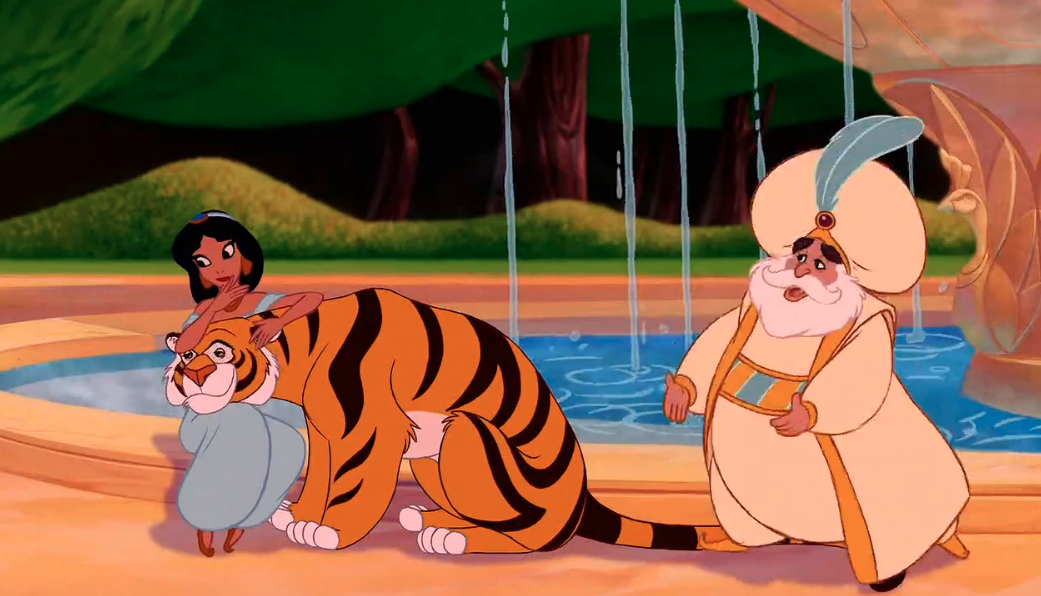
Jasmine is introduced to us with Raja, her pet tiger who is loving and protective of her, contrasting with the first giant sand tiger/Cave of Wonders we see in the beginning that eats people who aren’t worthy to grab the treasure (aka Genie lamp) within.
This sets up an expectation that Jasmine’s heart is a treasure to be won… except as she bluntly tells us later in the film:
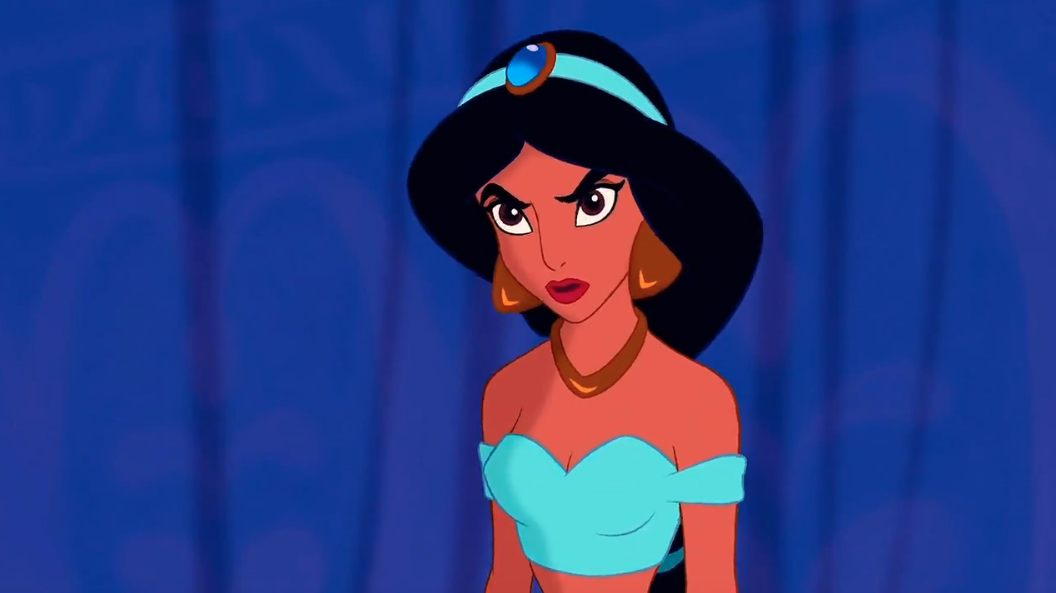
“I am not a prize to be won!”
The film constantly shows people trying to objectify Jasmine and treat her like she’s nothing more than her station in life: princess and future wife. (Which is why while people criticize her outfit as being too sexy for kids–wtf midriffs aren’t sexy at all in various cultures–it’s certainly… ironic.) She’s told she has three days to find a prince (to marry before her 16th birthday) because according to society she’s a princess and that’s what the law dictates for princesses. Viewing someone only as the role they occupy–street rat, princess, genie–is something the film condemns. It’s precisely Jafar’s insistence on defining himself purely according to the role he has in society and its power (grand vizier, sultan, then finally genie himself) that leads to his down fall.
But just because the law says something has to be one way doesn’t mean it’s right. As she tells her father after she rejects another suitor in her introductory scene,
“The law is wrong… if I do marry, I want it to be for love.”
And she doesn’t just pay lipservice to this, which ties into Jasmine’s arc about learning personal responsibility (aka growing up). She takes matters into her own hands and sneaks out of the palace and plans to never return, telling Raja:
“I can’t stay here and have my life lived for me.”
Jasmine meets Aladdin when, in a parallel scene to his introductory scene, she grabs an apple to give a hungry child.
However, she didn’t realize she needed to pay for it, showing her naivete in understanding how the world works and the concept of consequences for her actions. According to society, she’s just a thief in that moment, and the law is overly harsh, forever branding someone as a thief by cutting off their hand. But Aladdin intervenes.
Aladdin, too, is introduced to us stealing bread and then after a lengthy chase, gives the bread to a pair of hungry kids.
Aladdin sings a song with the lyrics:
Gotta eat to live, gotta steal to eat
Otherwise we’d get along
Meanwhile the people chasing Aladdin shout names at him. Street rat. Scoundrel. Like Jasmine, he’s defined by his role in life (”worthless street rat” according to a prince Jasmine rejects who tries to whip two kids who stumble into his path), a role Aladdin was born into, and that’s why after they connect they both admit they feel trapped. (This is a tie-in to the Genie’s lot in life as well, as he’s trapped too.) Aladdin has no power; Jasmine and the Genie have infinite power, but that very power traps them too.
And Aladdin is still prone to some of society’s ideals in that he wishes for power, thinking it will grant him freedom, and as he finds out it does not. In his opening scene, he tells Abu that someday "we’ll be rich and… never
have any problems at all,” which of course isn’t how it turns out.
After Jafar (a corrupt politician, a fitting villain for this tale) has Aladdin arrested, Jasmine vows to get Aladdin released, but Jafar tells her he was executed for kidnapping her. She’s devastated, and of course it isn’t true, but it’s a way to show Jasmine that she does bear personal responsibility for her role as a princess. Even if she never asked for it, she’s got it, and she needs to take her power seriously. So she immediately responds by telling Jafar that when she’s Sultaness, she’ll have the power to get rid of him. Which is a good move but not necessarily a wise way of using her power, because Jafar then uses that as motivation to change the law so that Jasmine has to marry him (in other words, societal laws are flimsy).
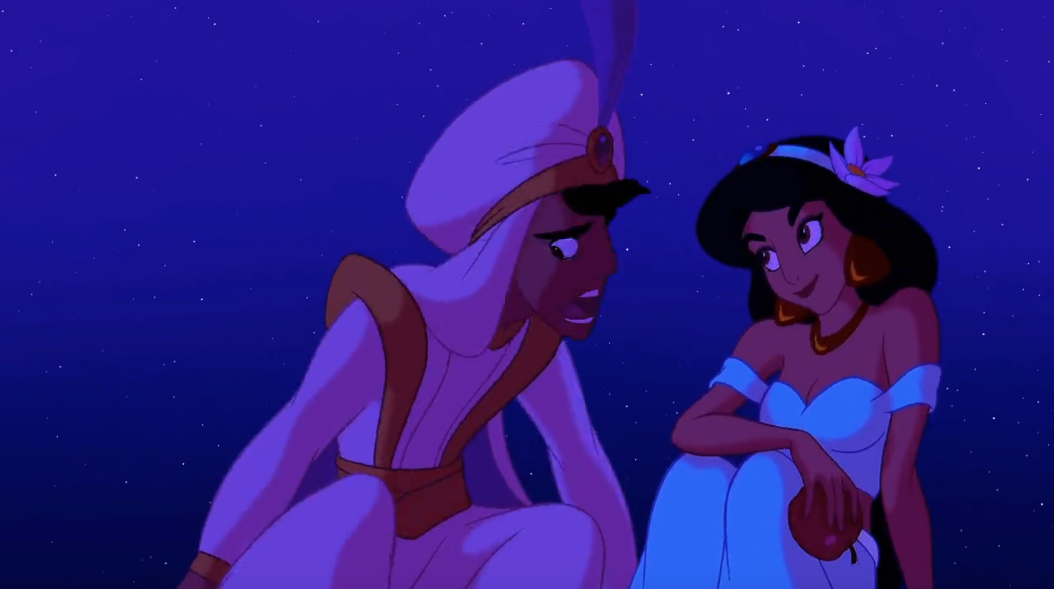
When Aladdin arrives under the guise of Prince Ali, she tells him off for treating her like an object, like just a princess, and the only reason she gives him a chance is because when she tells him off, he confesses that she’s “right” to tell him off. In other words, finally someone is listening to something Jasmine says, empathizing with her.
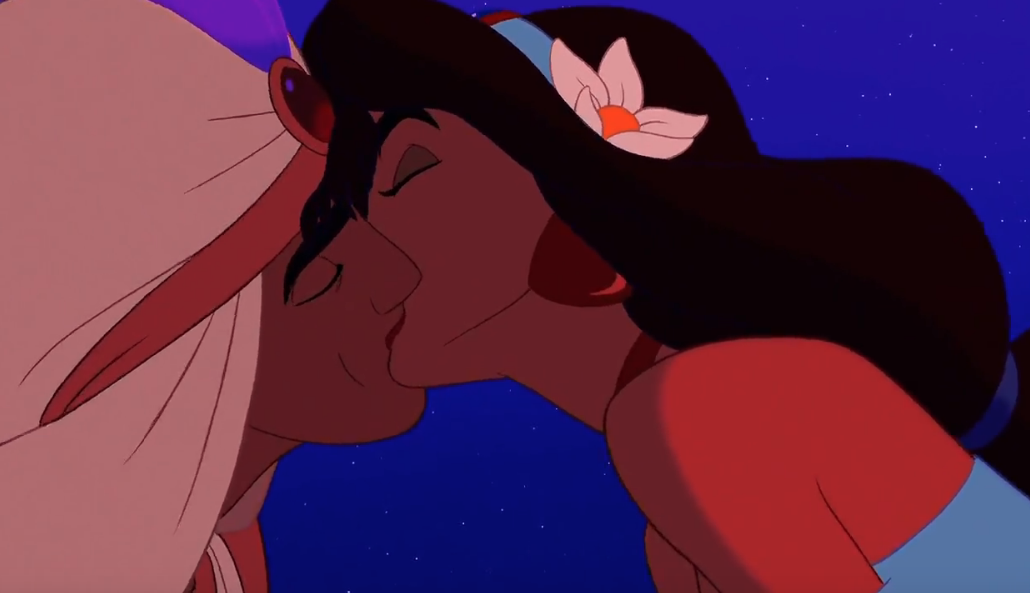
We also don’t have a Little Mermaid situation. Jasmine quickly figures out who he is. Throughout the film, actually, from the marketplace acting to the end scene, Jasmine is portrayed as intelligent and quick-thinking, someone who seeks to be in charge of her own romantic interests and sexuality as well (Jasmine and Aladdin almost kiss in the marketplace and kiss before they’re engaged). Jasmine and Aladdin explore the world together, literally, which shows her learning to escape her own bubble and seeking to understand those born into different lives, which is important for creating a good ruler. Because what helps Jasmine and Aladdin, and late the Genie as well, escape from their societal trappings is connecting with people from different lots in life.
But society still seeks to thwart her. When Jafar takes over the kingdom (literally having the Genie uproot it), he demands to have Jasmine fall in love with him. It’s really not any different than what her father was trying to force her to do, though the Sultan clearly loves his daughter and expresses multiple times that he doesn’t want to force her to marry someone she hates.
But this time, Jasmine’s learned how to be crafty and wise with her power. She pretends to fall in love with Jafar to allow Aladdin time to sneak in, in contrast to her naive telling him off earlier. It works.
Then Jafar traps Jasmine in a literal hour glass, showing again the unfairness of the situation she’s been in since the beginning of the story–in which she has three days to find a prince to marry (before her birthday) and now her time is literally running out. Again, it’s kind of karmic to show that society is stupid and the roles people are trapped in can literally kill them. But fortunately Aladdin helps Jasmine break the glass, because connection saves.
And after that, the Sultan learns to take responsibility, proclaiming “am I sultan or am I Sultan?” and gives Jasmine and Aladdin their happy ending by literally changing a law.
The Genie is set free by the fact that Aladdin could relate to his feelings on being trapped. Empathy is true justice in the film, and a path to freedom and love.
Up next, Pocahontas! Which is def a problematic film but again, I’ll try to focus on her as a character because there is a lot to like there. If you’re interested in checking out the other metas in this series:






 hamliet