Chapters: 15/16 Fandom: Banana Fish (Anime & Manga) Rating: Mature Warnings: Creator Chose Not To Use Archive Warnings Relationships: Ash Lynx/Okumura Eiji, Sing Soo-Ling & Lee Yut-Lung, Lee Yut-Lung & Shorter Wong Characters: Lee Yut-Lung, Sing Soo-Ling, Shorter Wong, Ash Lynx, Okumura Eiji Additional Tags: Implied/Referenced Child Abuse, Implied/Referenced Sexual Assault, Redemption, Friendship, Hurt/Comfort, Alternate Universe – Canon Divergence Series: Part 1 of Stray Phoenix Summary:
Yut Lung grew up as a pawn in the Lee family. Determined to topple his brothers and grasp a new role for himself, he is accustomed to playing every person he knows. When he is warned about Golzine’s intentions to inject Shorter with Banana Fish, he chooses to free Shorter instead, and then finds himself in a new game, one he may not know the rules to.
I feel for her, in that she seems to be naive and not a cruel person by any means, but instead, she is someone who desperately desires love. Her holy book (the one she wrote) “The Book of Tyson” offers love as the answer to everything:
She’s very innocent and childlike in some ways, but her nen beast suggests that perhaps that isn’t all there is to her.
If we go off the theory that the nen beasts represent the subconscious desires of Tyson, we see that she really does want to make people happy, but she also wants respect and esteem. Her followers are punished if they don’t obey her, and in exchange for happiness she takes their aura. Which is not exactly a subtle parallel to religious leaders even irl.
Tyson foils Chrollo and Illumi most obviously. Like Chrollo, she carries a book and takes people’s aura, whereas Chrollo’s book contains specific peoples’ abilities. Tyson is not an intellectual person; she’s very feelings-based. Like Illumi, she craves love but interprets it as doing her will and therefore being happy as a result, when in reality that’s not what love is at all. She has an extremely childlike understanding of both love and power, and I don’t anticipate that ending well for her. My heart does break for her, though.
I am not going to make a direct comparison, but I will say that the concept of “untouchables” is one I’m most familiar with in the specific context of the Indian caste system (I have friends who are Dalit rights activists). Apparently Japan has its own untouchable caste as well (burakumin), but I don’t know anything about it, so no idea if Togashi will be drawing from that history or not, but the underlying principle: that there are outcasts in society who simply are not considered human for whatever arbitrary reason, is probably the same.
Even though the practices associated with the untouchable caste in Kakin are no longer at play, the problem remains because changing the hearts of people is a lot harder.
It’s a really dehumanizing idea, the concept that someone is less than human. Kudos to Camilla for directly contradicting that. However, it’s also really tragic that even the so-called eradicated part of this tradition is returning:
It’s really horrible. I am interested to see where Togashi takes this, because it does tie into the theme of society and outcasts that is very much a part of this arc with the Phantom Troupe, Morena, and Hisoka.
We’ll know Sunday. I doubt it is anything very spoiler-y (like, I wouldn’t be shocked if there are no characters in it). While I still am thinking/hoping for a couple more volumes, I definitely don’t expect it to still be going at this time next year. But we will see! Maybe they’ll give a more concrete timeline, or maybe that’s the announcement coming in December the editor tweeted about yesterday.
Oh, Anon, that’s a really painful situation. You obviously love your brother deeply, and he is clearly making some poor decisions. Sending hugs if wanted to you.
If he is underage (or even if he is not, but it’s somewhat easier if he is still a minor) I’d encourage you to reach out to a trusted adult in his life, if there is one–a parent, a mentor, etc.–and perhaps share your concerns with them. It’s not tattling once violence and drugs are involved, and you can make it clear you are not telling them in the hopes of getting him in trouble, but because you’re concerned, and that because you are no longer in the country, you’d like someone else to be aware and able to reach out to him, to be an active, present example of care and love in his life. If this is a sudden change, there might be something else going on as well that he might need help dealing with. He’s clearly hurting and lashing out at himself (drugs) and at others (violence) in response. But violence and drugs too are really serious. If there is not a trusted adult in his life, I’d suggest asking him if there’s someone he can talk to, if he feels lonely, in hopes he might seek out someone.
And my other advice is to take care of yourself, too. I have loved ones in similar situations, and it’s truly agonizing. You love them so, so much, and watching them walk these kinds of paths is grueling. Try to find someone you can lean on as well, someone you can talk to and cry to if you need to–a counselor, a friend, a mentor yourself. The harsh reality is that you cannot make him understand what he’s doing is wrong–it is not on you. It’s on him to understand and he might not want to yet (or really, he may perfectly understand but may not currently have a better coping mechanism for whatever he’s going through), and it’s not a failure of you to be unable to make him understand. I’d also say insofar as your relationship with your brother is concerned, make it clear to him that you love him unconditionally, that no matter what he’ll always be your brother, but also take care of yourself–meaning, if it upsets you to talk to him when he’s high or to talk about more violent things, don’t talk about them with him or when he’s high. That doesn’t mean you’re ignoring a very real problem–you’re not necessarily–but just that you are trying to make sure you are in a good place mentally yourself to be able to help him when he wants it.
Edit: One more thing! From my experience working with kids who were troubled, sometimes the best way to help them is to keep communication channels open by finding something to talk about that you both enjoy talking about. People tend to respond better to the concern of people they know like them, and he might come to you with his concerns then. But it really depends on the situation as well, of course.
I hope things improve, Anon. I’ll be keeping you & your brother in prayer
Thank you!! They are a wonderful couple with a great story, and I hope it’s not over yet despite Ymir’s death. Both of the characters are among my faves.
*presenting a rambly wannabe meta that i hope makes some sense but i. am sleepy*
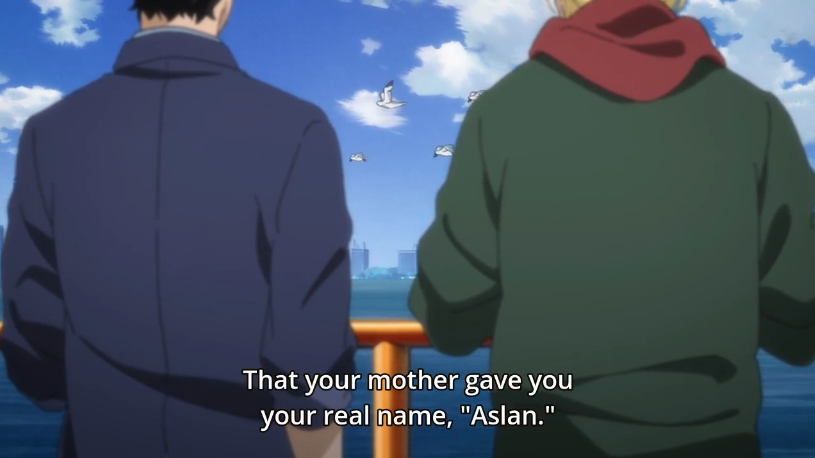
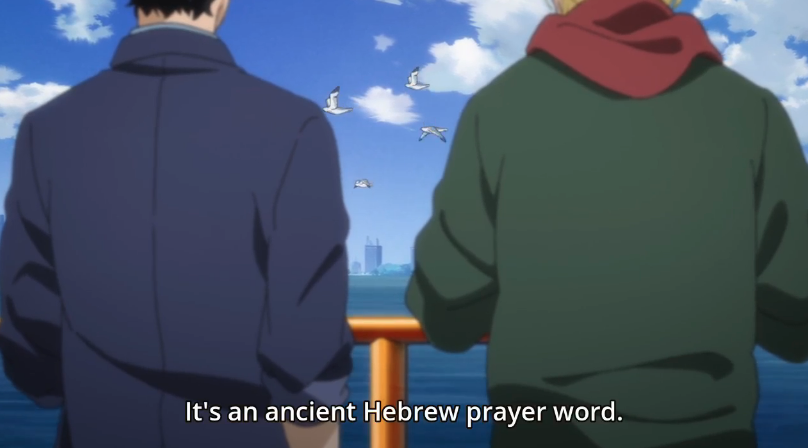
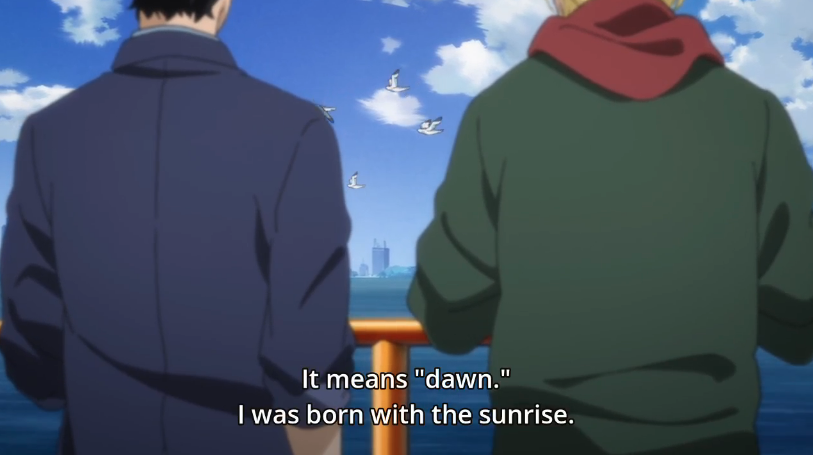
One of the saddest conversations in Banana Fish, for me, was this one.
Eiji is completely pure-intentioned and trying to comfort Ash here, and he might genuinely believe it, but Ash expresses doubt and the viewer also probably doubts it. Even if she did wish for the best for her son, which is certainly possible, it still doesn’t erase that she left him, ultimately deeming him less valuable to her than her free city life.
But I want to talk more about the implications of Ash’s name and the symbolism associated with “Aslan” in particular–which makes the name seem more like a curse than a gift, a double-edged sword in many ways just like Ash’s other innate talents (intelligence, leadership skills, good looks). (“Jade” has its own implications–it’s a commodity, for one thing, and Dino literally gives him a $400,000 piece of jade to execute him in, and his foil Yut-Lung is associated with wearing amethysts with the same implications, but that’s for another time.) Aslan as a name, in particular, is associated with religious symbolism. There’s repeated heaven/hell imagery in Banana Fish, always associated with Ash and/or Dino, and almost always contributing to other characters dehumanizing Ash.
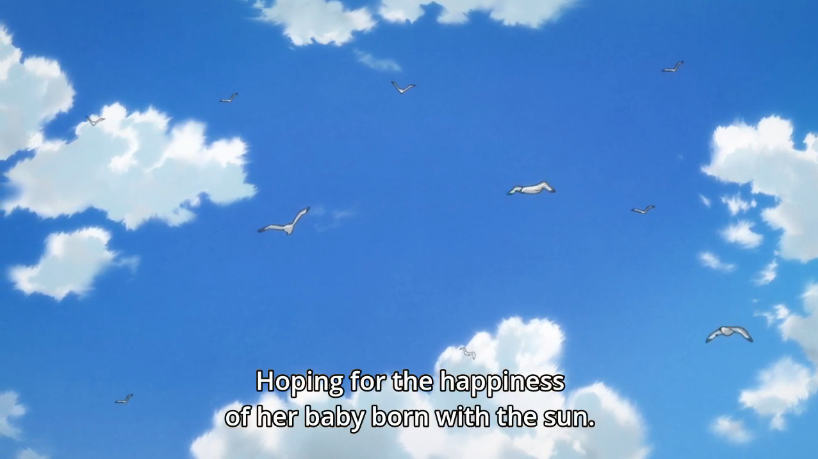
For starters, there’s what Ash says “Aslan” means–though I can’t find any verification of that (most sources say it means “lion” in Turkish): a prayer associated with dawn. But it’s also–and most people will know this–the name of the lion character in C.S. Lewis’s The Chronicles of Narnia, which is an allegory of much of the Biblical Christian stories. Aslan is in particular Jesus. It’s not subtle; he willingly takes the punishment of someone who betrayed him and his siblings (Edmund Pevensie) and is executed for him, but resurrects at dawn.
The rising of the sun had made everything look so different—all the
colours and shadows were changed—that for a moment they didn’t see the
important thing. Then they did. The Stone Table was broken into two
pieces by a great crack that ran down it from end to end; and there was
no Aslan.
“Oh, oh, oh!” cried the two girls rushing back to the Table.
“Oh, it’s too bad,” sobbed Lucy; “they might have left the body alone.”
“Who’s done it?” cried Susan. “What does it mean? Is it more magic?”
“Yes!” said a great voice behind their backs. “It is more magic.” They
looked round. There, shining in the sunrise, larger than they had seen
him before, shaking his mane (for it had apparently grown again) stood
Aslan himself.
~”The Lion, The Witch, and the Wardrobe”
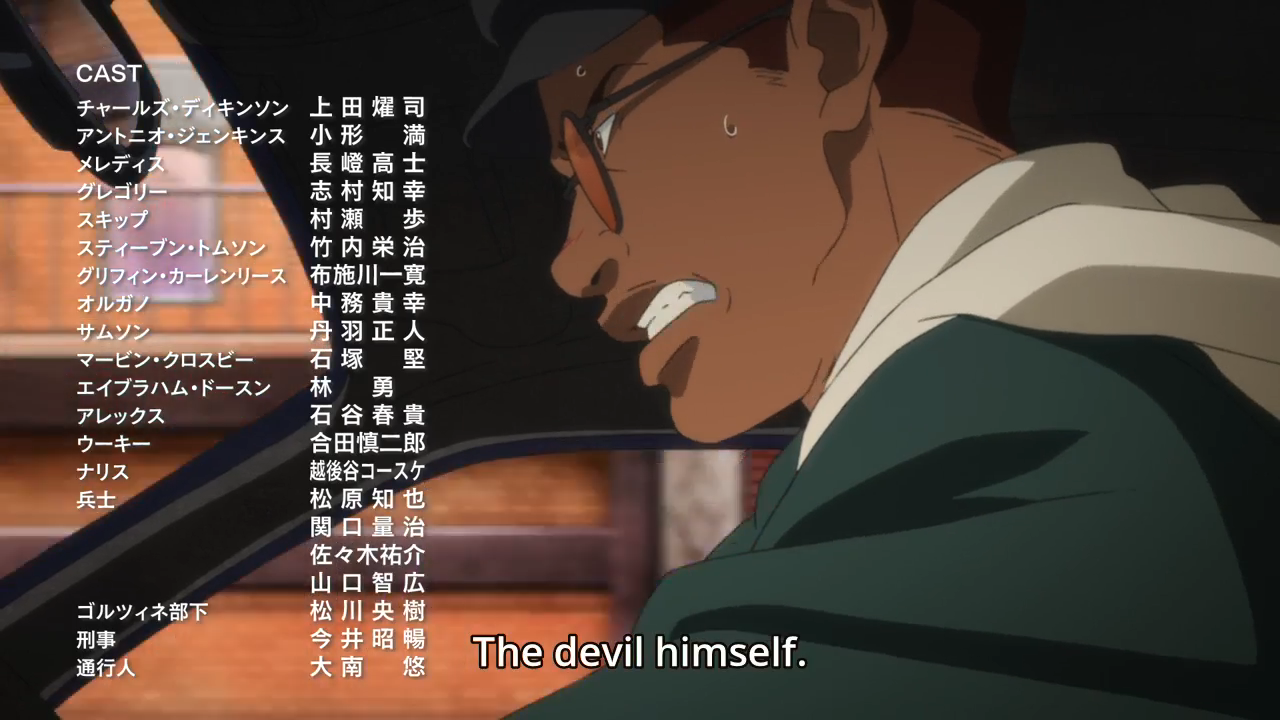
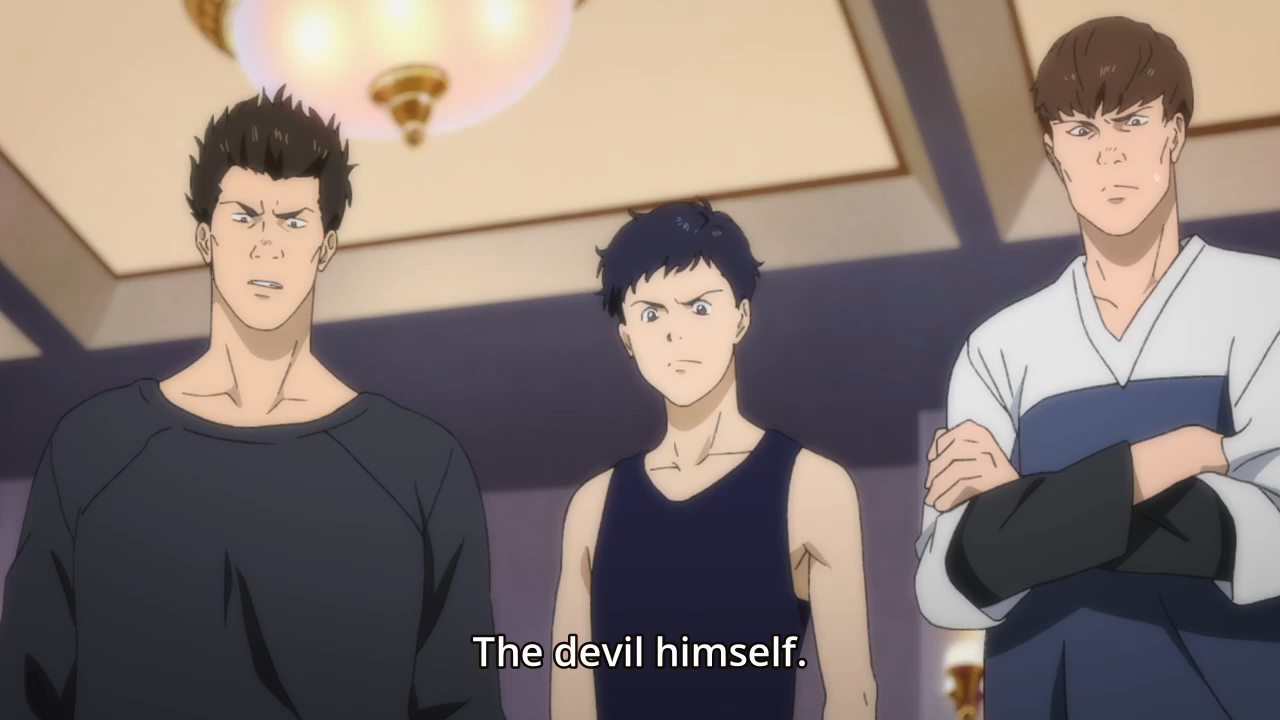
Throughout Banana Fish we see Ash repeatedly compared to both a devil and an angel/Christ/God, often with the two concepts conflated. From the very first episode…
(the bike resembles a traditional devil’s mask. #subtle), to the scene in which he saves Eiji and burns down Golzine’s mansion…
What’s interesting is that these scenes are characters misunderstanding Ash by projecting the blame for what is happening onto Ash. The blame for all these incidents are on Dino. Ash isn’t motivated for pure revenge or seeking it out in any of these scenes: he’s trying to save friends. Skip and Eiji in the opening episode, Eiji and then Shorter’s body (where he happened to come across Abraham and killed him for killing Shorter) in the scene where they flee Golzine’s mansion.
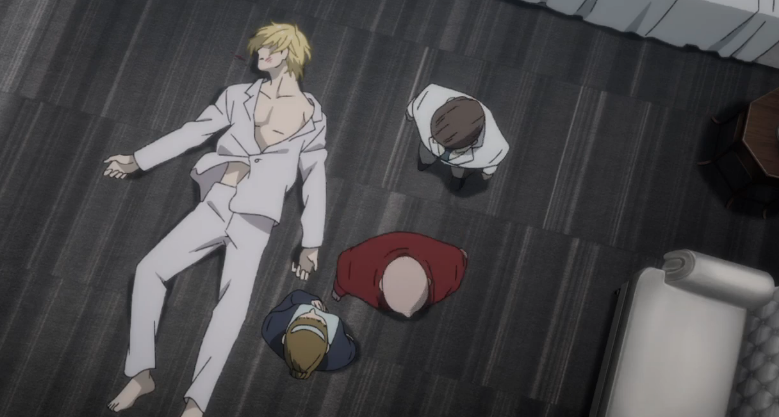
But then there are these scenes: firstly, the scene where he’s escaping the hospital and Golzine is a proud evil monster pretending to be a father.
To the most recent episode:
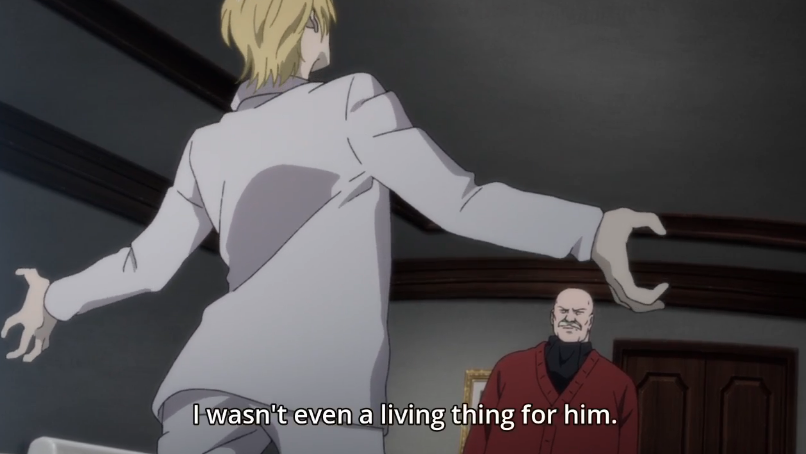
Golzine is wrong: he hasn’t created Ash, and Ash is not one of a kind (Yut-Lung exists). Basically, people try to force Ash into the role of devil when that isn’t what he is. But this gets at the heart of Golzine’s character: he’s projecting himself and how he sees himself (an all-powerful mix of the devil and a god) onto Ash. Hence why he lashes out at Ash when Ash calls him out on treating him like something other than a human being this episode:
Ash’s comments reinforce the reality that he’s no god and no devil: Ash is a broken child at this point, and Dino played a massive role in breaking him by raping him, forcing him to kill, and trying to turn him into a devil/god creature. And Dino does not want to accept that he, a devil/god, can have created a broken thing. So he beats Ash and threatens him to show up to his party.
And about that party. Planning a party to celebrate his rebellious son’s return is pretty clearly a twisted version of the “Prodigal Son” parable in the Bible. Jesus tells it, and the father in this story is supposed to be God (Luke 15:11-32, NIV translation):
11 Jesus continued: “There was a man who had two sons.12 The younger one said to his father, ‘Father, give me my share of the estate.’ So he divided his property between them.
13 “Not long after that, the younger son got together all he had, set off for a distant country and there squandered his wealth in wild living. 14 After he had spent everything, there was a severe famine in that whole country, and he began to be in need. 15 So he went and hired himself out to a citizen of that country, who sent him to his fields to feed pigs.16 He longed to fill his stomach with the pods that the pigs were eating, but no one gave him anything.
17 “When he came to his senses, he said, ‘How many of my father’s hired servants have food to spare, and here I am starving to death! 18 I will set out and go back to my father and say to him: Father, I have sinned against heaven and against you.19 I am no longer worthy to be called your son; make me like one of your hired servants.’ 20 So he got up and went to his father.
“But while he was still a long way off, his father saw him and was filled with compassion for him; he ran to his son, threw his arms around him and kissed him.
21 “The son said to him, ‘Father, I have sinned against heaven and against you. I am no longer worthy to be called your son.’
22 “But the father said to his servants, ‘Quick! Bring the best robe and put it on him. Put a ring on his finger and sandals on his feet. 23 Bring the fattened calf and kill it. Let’s have a feast and celebrate. 24 For this son of mine was dead and is alive again; he was lost and is found.’ So they began to celebrate.
25 “Meanwhile, the older son was in the field. When he came near the house, he heard music and dancing. 26 So he called one of the servants and asked him what was going on. 27 ‘Your brother has come,’ he replied, ‘and your father has killed the fattened calf because he has him back safe and sound.’
28 “The older brother became angry and refused to go in. So his father went out and pleaded with him. 29 But he answered his father, ‘Look! All these years I’ve been slaving for you and never disobeyed your orders. Yet you never gave me even a young goat so I could celebrate with my friends. 30 But when this son of yours who has squandered your property with prostitutes comes home, you kill the fattened calf for him!’
31 “‘My son,’ the father said, ‘you are always with me, and everything I have is yours. 32 But we had to celebrate and be glad, because this brother of yours was dead and is alive again; he was lost and is found.’”
Instead of a benevolent father forgiving his (wrongful) son, Ash is trying to escape a cruel devil father figure in Dino, and Dino’s projecting that devilish/demonic imagery onto Ash. Celebrating his return to literal enslavement is a sickening twist on a lovely, redemptive story.
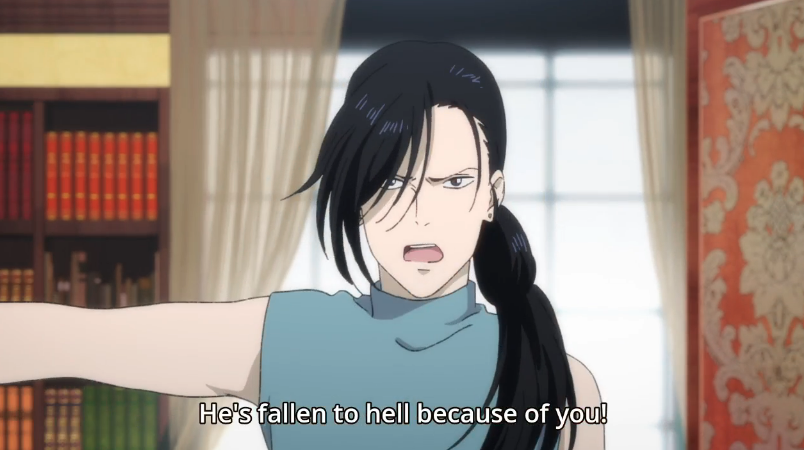
Yut-Lung sees this as well:
Golzine’s city is nothing more than a hell, and Yut-Lung can’t escape it, so doesn’t want Ash to escape it either.
But Ash, fortunately and yet (differently) unfortunately, has heavenly symbolism with him as well. “Angel Eyes,” the prequel in which Shorter and Ash meet, has Shorter telling Ash he looks like an angel from a Christmas card Nadia mailed him–yet importantly, Shorter never looked at Ash like anything other than a person.
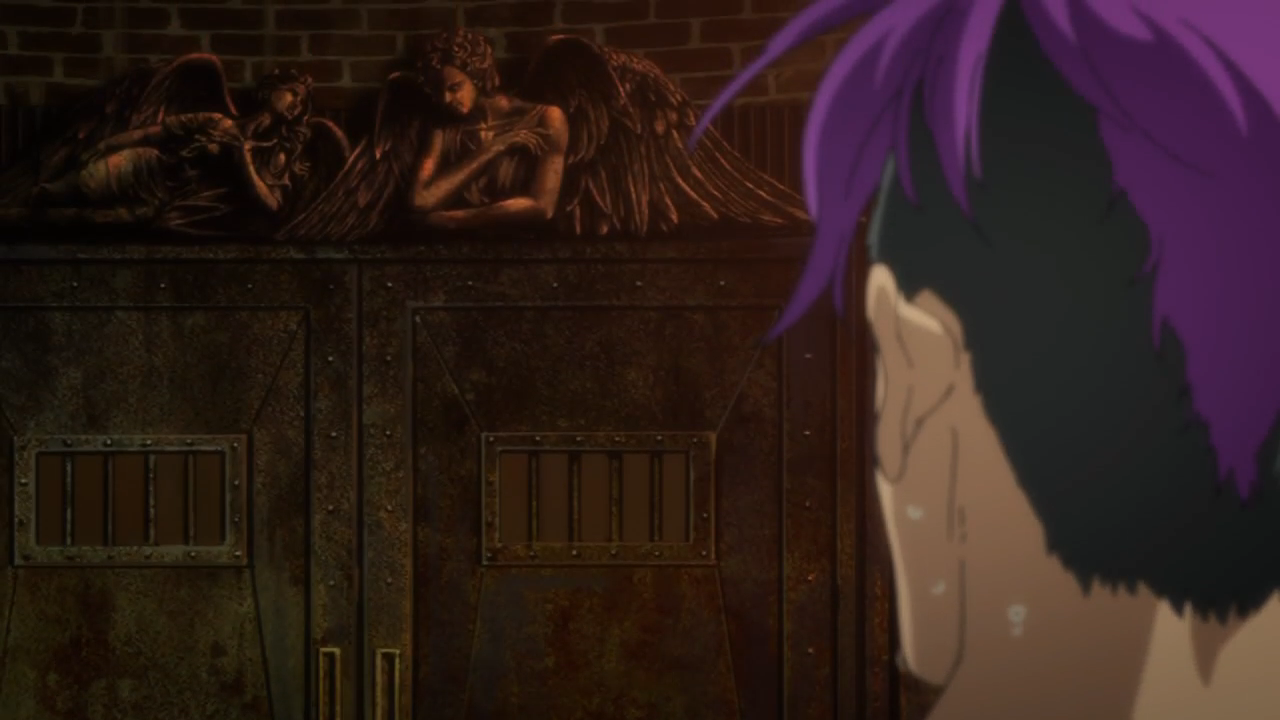
There’s then this horrid scene in which Shorter is killed, which takes place in Dino’s so-called execution room, and there’s distinct Christlike imagery in this scene (fitting for the name Aslan). Ash has been betrayed by friends (however, even that has been staged by Dino since Shorter did not want to betray Ash, and Ash did not fault him) and is hung in a crucifix position:
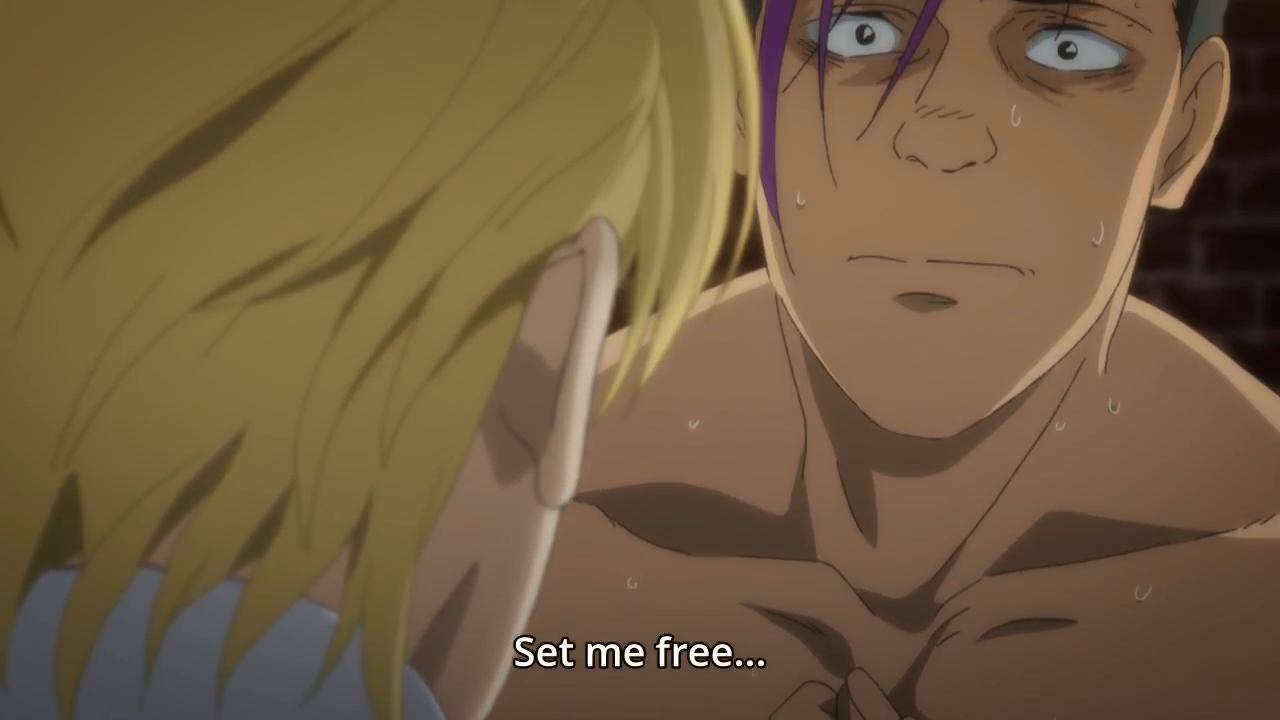
With angels on the wall, angels that tease Angel Eyes and remind us how Shorter sees Ash as opposed to the cruel mockery of how Dino is portraying Ash. The angels are also above the barred door to escaping the execution chamber, because death=freedom for Shorter and again, in the biblical tale and in Narnia, Jesus/Aslan’s death leads to freedom for humanity/Narnia.
The scene results in a sacrifice of Ash himself when he mercy-kills Shorter, because that’s another calling card of Ash’s character: he doesn’t see himself as having value, which leads to him making sacrificial decisions like shooting a gun into his head only to find out it was empty, going back to hell with Dino, etc, all for the sake of Eiji and the other people he loves. It’s a crucial difference between Ash and Dino: Dino only thinks of himself. Ash thinks of others, too. But Ash’s sacrificial tendencies, while stemming from genuine love, comprise a tragic flaw.
Additionally, it’s important to note that this scene is again something cruel Dino has set up. Dino sees himself as an arbitrator of life and death, as a god/devil. Ash never chose these god/devil roles. The fact that he goes by “Ash” instead of “Aslan” implies, again, that he does not see himself as a god or as a devil, but also struggles to see himself as a person.
Which is something all the bad guys do to an extent. Most characters refuse to Ash like a normal child because of his talents and gifts, which his name is symbolic of. Like Wang-Lung Lee:
But not, however, Max.
Or George.
Or Charlie.
And most especially, not Eiji.
Ash is not a devil, but he can do devilish things (and he does, like murdering begging people). He is not an angel, but he can do angelic things (like saving his loved ones).
He’s just a child. And he’s a friend for these people, and they are all going to save him from the disgusting party Golzine has planned. They know he won’t be able to fight for them this time, but they’re going, because they value him as a person. Because they love him and care about him, not because they want him to adopt a particular role.















 hamliet