*sobs* I’m annoyed. Tumblr, I like what you do, I like your site, I like my blog and I don’t want to lose all my followers lol. I get the crackdown and honestly I personally don’t mind it–it’ll be nice to scroll my dashboard at work without worrying a mutual has reblogged someone eating dick because I don’t enjoy seeing that content at all–but I know it’ll bother a lot of people and push artists and creators to other platforms, which is just really stupid. And the whole female nipples as nudity–CAN WE NOT. Sigh.
Anyways, yes, I have a twitter! It’s @kateevelyn3. I might look into setting up a, like, actual blog too that isn’t hosted on tumblr and see if I can transfer my content there just in case. Uggggghhhhhhh.
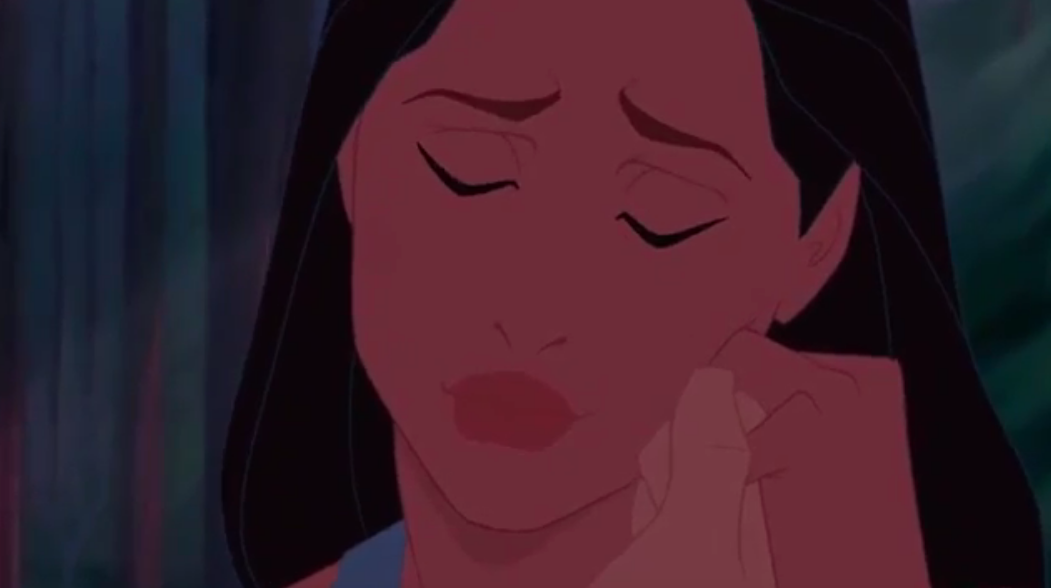
That one Disney Princess movie without a happy ending.
As per my requisite disclaimer, there is absolutely room for (a lot of) legitimate criticism of Pocahontas,
especially around its portrayal of culture, history, and race, and this is not going to invalidate any valid criticism of
the film or of Pocahontas, but rather offer a different perspective on her
film and specifically on Pocahontas as a Disney character in the Disney film, not as a real person.
Out of all the Disney films, though, I do want to add an extra disclaimer for Pocahontas. It has a lot of cringe-worthy and outright inaccurate and offensive racial portrayals. The song “Savages” in addition to having extremely racist terms used in it, equates Native Americans with the colonists, and while the message of the song would make sense in the Romeo and Juliet situation the film portrays it as, it does not work in the context of a real historical issue where there was a clear aggressively racist, genocidal, and plain morally wrong side (the colonists), especially when the oppression of Native Americans is still very much a thing. However, I want to focus this meta on Pocahontas’s fictional character within the film, because I think there’s a lot to like in terms of who she is. That being said, divorcing from context is hard, so there’s a tension there. If anything I say is insensitive, please let me know.
So Pocahontas opens with the colonizers setting sail from England with the song “Virginia Company,” which includes the lyrics:
For the New World is like heaven And we’ll all be rich and free Or so we have been told By the Virginia Company So we have been told by the Virginia Company
The emphasis on “so we have been told” sets up one of the themes Pocahontas’s character exemplifies: the idea of choosing your path versus following lies and promises given by people who are probably motivated by their own selfish desires (Governor Radcliffe). The riches the song describes are, of course, not there, but the colonists follow the hope of it and wind up missing the forest for the trees. Essentially, Pocahontas encourages critical thinking and moving one’s concerns from just one’s own life to one’s place in the world.
The beginning also sets up John Smith as a foil to Pocahontas. From the very beginning, he’s fundamentally concerned about himself, constantly talking about his wants and adventures. In the song, “Mine,” which emphasizes the greed of the colonists, Smith, who has no interest in gold, chimes in “hundreds of dangers await/And I don’t plan to miss one!” He’s only thinking about his own desire for the next thrill, telling the other colonists that he’s “been to dozens of new worlds” and doubts this one will be unique, and comments that he expects the Native Americans to be basically the same as other people: “If they’re anything like the [people] I’ve fought before…” His perspective is entirely centered on himself: he views adventures and new lands and other people also as things for himself, instead of seeing himself as part of a whole world.
Pocahontas is a bit different, but she also struggles to learn responsibility throughout the film. It’s noted to Powhatan in his introduction (when he asks where his daughter is) that she “takes after her mother” and “goes wherever the wind takes her.” Cut to Pocahontas and Nakoma (a good friend, this movie miiiiight pass the Bechdel test? It’s kinda borderline), and Pocahontas jumps off a cliff. However, Meeko jumps after her and is terrified, symbolically warning that even though her freedom is not the selfishness of John Smith, her choices still affect others both positively and negatively at times as well, as we’ll see them affecting her father, Kocoum, Nakoma, and more.
Powhatan tells her “you
are the daughter of the chief. It is time for you to take your place
among the people,” and gives her the necklace that belonged to her mother. Pocahontas is often compared to her mother: the first two scenes I mentioned, and Grandmother Willow also tells Pocahontas her mother once asked her the same question about what path to take in life. There is perhaps the suggestion that people are expecting Pocahontas to take her mother’s path, but as Grandmother Willow encourages, she has her own choices to make.
The answer, after all, as Grandmother Willow says, is to “listen.” Empathy and learning are paths to being able to make wise decisions, after all. This will be emphasized later when she begs her father to “try talking to [the colonists]” instead of resorting to war. Towards the climax of the film,
Smith comments that the colonists won’t want to listen to reason because
“everything about this land has them spooked.” A creepy figure then
appears, howling as if to emphasize his words–but it turns out to be
Percy, Radcliffe’s dog, symbolizing that what’s really spooking the
colonists is themselves.
When Smith and Pocahontas meet, he almost shoots her, and then falls in love with her, which is the story calling him out on the violence he previously bragged about.
When she runs, he tries to stop her from leaving by forcing her to stay via grabbing her canoe.
But Pocahontas is not having that. He tries to speak to her in English and they realize they can’t understand each other, so he offers her his hand–symbolic of listening. Notably after this the language issue goes away which again, don’t think too hard about it it’s a children’s story, but symbolically it seems to represent the idea that once they’re listening to each other, they can understand each other.
When Smith goes all White Savior on Pocahontas, claiming that “we’ll show your people how to use this land
properly… build houses” and Pocahontas points out their houses are just fine, he patronizing counters “you think that your houses are fine only because you don’t
know any better.“ And she leaves. Pocahontas is not here for your racist patronization instead of listening to her. They then launch into “Colors of the Wind,” with its fitting lyrics about how they all have a place in the world, but it’s essentially not all about them and encourages respect for “every rock and tree and creature.” You desires matter, but so do other people’s.
When she says she has to go because she can hear the drums signifying that her people are in trouble, the exact same scene as their first meeting plays out, except this time he lets her leave instead of trying to stop her. He lets her make her own choices.
When Pocahontas starts spending more and more time with John Smith, Kocoum warns Nakoma “tell her not to run of… she listens to you.” In response Nakoma snorts and says, “Sure she does,” because well, Pocahontas doesn’t, and she doesn’t tell her best friend what’s going on until it’s too late. This leads to tragedy when Nakoma tries to help her by sending Kocoum to help her because she worries for her friend’s safety, and Kocoum is killed. As he dies, he tears Pocahontas’s necklace from her neck, symbolically threatening to tear her connection with her mother’s free path.
And yet John Smith is unquestionably the one more at fault for bringing about the tragedy. Radcliffe tells an impressionable Thomas that “a man’s not a man unless he learns how to shoot.” Oh hey white America hasn’t changed at all.
Smith then gives him
advice, teaching him how to shoot from his presumably many experiences shooting…
…but Thomas then uses the gun to save Smith but kill Kocoum.
Smith then takes the blame for Thomas, sacrificing himself for a kid who’s really naive and was only trying to follow in the footsteps of Smith, his idol. And Pocahontas then throws herself onto Smith, protecting him at the risk of her own life as well. As she runs to save him, she sings “I don’t t know what I can do/Still i know I’ve got to try” jumping over a gap between two rocks because symbolism.
This shows Pocahontas growing, taking responsibility for what is about to happen to Smith. They stop the war, but Smith is shot because he again realizes that he should take responsibility because he’s the one who came here in the first place (and the… smokescreen… reason the colonists were marching on them) and jumps in front of Powhatan to save him.
He asks Pocahontas to return with him. Her father gives her his blessing to do so. But she turns him down, though she loves him, because she says, “my place is with my people.” But instead of having her path written for her, she has made her own choice, and she made it by listening. It was time she take her place among her people, but she needed to define that place herself, and listen to the world around her to arrive there, instead of simply acquiescing.
And so he leaves and cue a tragic ending, but for the children. But Pocahontas’s character has a lot of power and emphasis on growing up and what that entails: learning, listening, guidance, making mistakes and growing from them. I really like her character a lot, and it’s certainly one of the more thematically… realistic as opposed to optimistic Disney films.
Up next, one of my favorites: Esmeralda! Yes I know she isn’t technically a princess but to quote the Genie from Aladdin, she’s a prince[ss] to me, so I’m writing about her 😛 For previous entries in this series, see here:
Anime!! My thoughts are basically that it was a wild ride. I’m looking forward to more of the story, because in some ways it really felt like it was just the beginning, almost a prologue. I grew very attached to Nanachi (despite only entering the story for the last three episodes), Riko, and Reg.
The villain set up was also well done, but horrifying–like nauseatingly horrifying. I like how it seems to be tackling, again, the way orphans are treated by society as junk that no one cares about, and how it’s critiquing that via Nanachi and Mitty’s story, and also of course through Riko and Reg.
The abyss in some ways can be viewed as the dregs of human nature/society symbolically (from what I saw in the anime, at least, and I’d have to watch again to really write about this in depth, and maybe this is or isn’t continued in the manga) and of course, kids are the ones who suffer the most from it, who are used to test things. The orphans especially.
Ahhh so, I think @linkspooky wrote a fantastic meta on that scene here. I agree with Link’s perspective, and also would say that that scene in 160 is one of my favorites in the entire manga as well. I can’t wait to see it animated, lol.
As for deserve… it was narratively karmic, but also terrifying and not good for Shigaraki’s development (well, narratively, good, in terms of boy get help, not good, if you get what I mean!)
It asked for 10 and I had to have my sister help me whittle it down lmao. Endeavor, Father from Noragami, Historia’s parents, and Grisha Jaeger were definitely on the shortlist 😛
OMG…. true. Someone write this, please. Then she and Shigaraki can be siblings or cousins and she can then relate to Shouto having a brother on the dark side… the Todomomo possibilities!



 hamliet